In the world of high-end hospitality and luxury residential development, the "luxury" experience is often defined as much by what guests don't hear as by what they see. While architects spend thousands on soundproof glazing and acoustic wall panels, the subtle, intrusive hiss of a faucet in a neighboring suite can instantly degrade the perception of quality. For MEP (Mechanical, Electrical, and Plumbing) engineers and B2B specifiers, understanding the technical nuances of EN 817 acoustic standards is no longer optional—it is a critical requirement for modern building performance.
Zhejiang Xindong Sanitary Ware Co., Ltd., a leader in precision valve engineering since 1999, recognizes that acoustic performance is a core pillar of product quality. In this article, we explore the engineering behind noise classification and why it should be a top priority in your next procurement cycle.
The European Standard EN 817 (Sanitary tapware - Mechanical mixing valves) provides a comprehensive framework for testing the mechanical and hydraulic properties of faucets. Among these, the acoustic classification is perhaps the most significant for B2B buyers focused on multi-unit developments.
Plumbing noise generally falls into two categories:
1. Airborne Noise: The sound of water hitting the basin or the hiss of air bubbles.
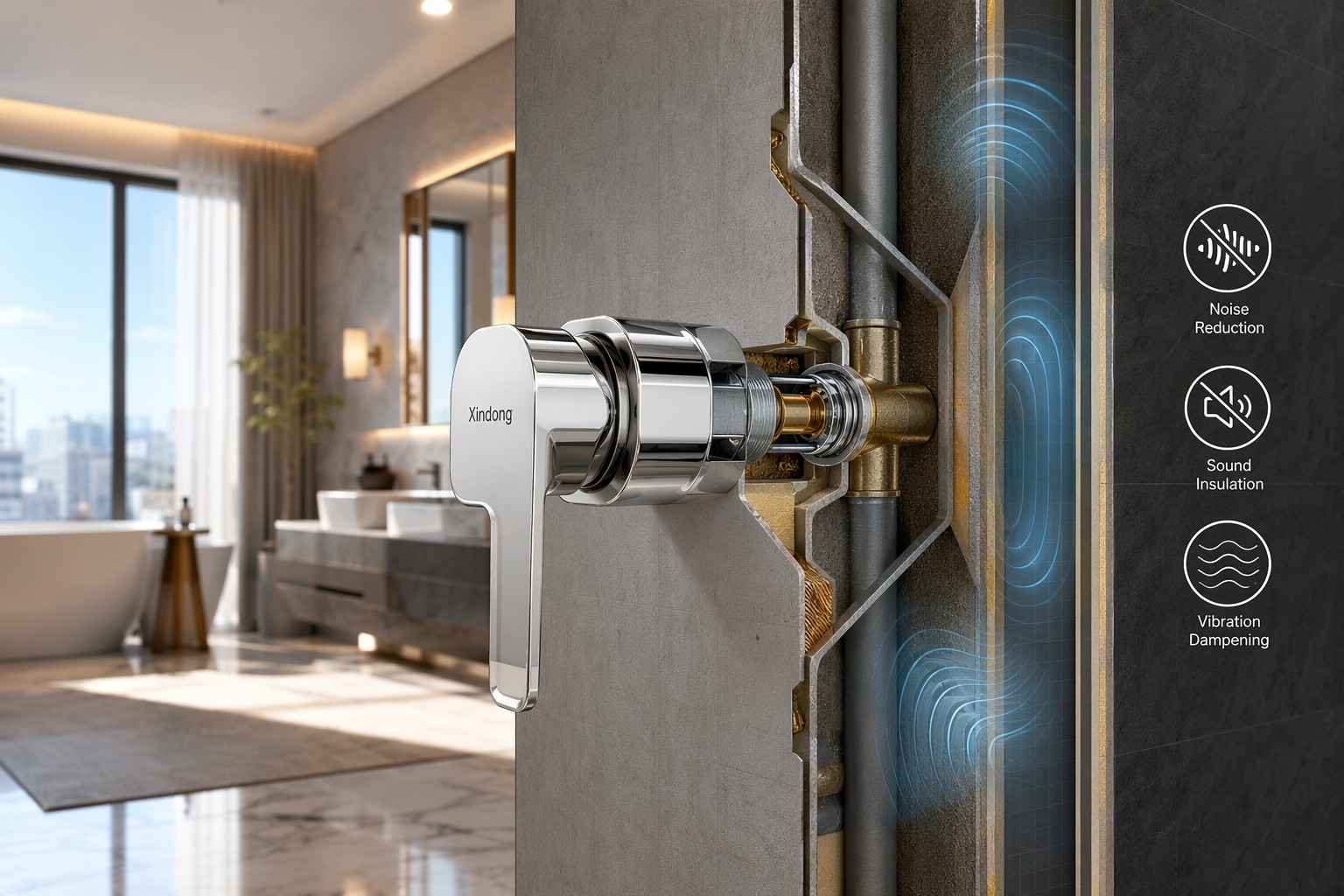
2. Structure-Borne Noise: Vibrations caused by water turbulence within the valve body that travel through the piping and walls.
EN 817 classifies tapware into acoustic groups based on the noise levels generated at specific water pressures (typically 0.3 MPa):
| Acoustic Group | Noise Level [dB(A)] | Application Suitability |
| Group I | Lap ≤ 20 | 5-Star Hotels, Luxury Apartments, Hospitals |
| Group II | 20 < Lap ≤ 30 | Standard Residential, Offices, Public Spaces |
| Non-Classified | Lap 30 | Industrial, Temporary Installations |
For premium projects, specifying Group I valves is essential. A difference of just 10 decibels represents a tenfold increase in perceived sound intensity, which can be the difference between a restful night and a guest complaint.
For hotel facility managers, plumbing noise is a major contributor to negative reviews. Flanking noise—sound that travels through structural connections—often originates from poorly engineered valve cartridges or turbulent flow paths in low-quality brassware.
When water flows through a faucet, any sharp angles, internal burrs, or poorly seated seals create turbulence. This turbulence generates high-frequency vibrations that the building's rigid piping system amplifies. By selecting valves that meet stringent EN 817 Class I requirements, developers can significantly reduce "acoustic leakage" between adjacent rooms.
At Xindong, our R&D team utilizes advanced flow simulation software to optimize the internal architecture of our valves and faucets. Our engineering process focuses on three key areas to ensure Class I acoustic performance:
1. Precision Ceramic Cartridges: The heart of the mixer tap is the cartridge. We use high-grade ceramic discs that provide smooth, laminar flow transitions, minimizing the cavitation that leads to whistling sounds.
2. Internal Flow Path Optimization: Our brass valve bodies are cast with smooth internal surfaces. By eliminating internal turbulence zones and sharp 90-degree turns, we reduce the kinetic energy transferred to the piping system.
3. Acoustic Decoupling Components: We offer specialized mounting hardware that includes rubberized gaskets and isolators, preventing the direct transmission of vibration from the faucet to the stone or ceramic countertop.
When evaluating suppliers for large-scale projects, MEP engineers must look beyond the aesthetic finish. A WRAS or CE certified product provides a baseline of safety, but acoustic reports according to ISO 3822 (the measurement standard for plumbing noise) provide the empirical data needed for acoustic modeling.
Zhejiang Xindong Sanitary Ware Co., Ltd. provides comprehensive technical data sheets for our B2B partners, ensuring that our faucets not only look the part in a luxury suite but also perform silently behind the scenes.
Acoustic standards are a silent guardian of property value. As urban density increases and guest expectations rise, the demand for noise-reducing plumbing technology will only grow. By specifying EN 817 Group I classified valves, you are investing in the long-term comfort and acoustic integrity of your infrastructure.
For more information on our range of acoustically optimized valves and faucets, visit [Xindong Sanitary Ware](https://www.cn-xindong.com).
 Hot News
2026-10-17
2026-10-16
2026-10-15
2026-10-14
2026-10-13
2026-10-12

The company, founded in 1999 and located in Yuhuan,specializes in taps, thermostatic shower valves and shower kits. With over 30,000 sqm of space and 380+ employees, we hold numerous certifications and 65+ patents.
 EN
EN