A pallet of chrome brass mixers can clear customs in Jebel Ali in a day and then sit for three weeks in Dammam on identical paperwork. The product is rarely the problem. The conformity route usually is.
If you buy or specify tapware for Gulf construction projects, most of the confusion comes from treating the GCC as a single market. It is not. There is a regional standards body — the Gulf Standardization Organization (GSO) — but product entry is policed at national borders by national regulators, each with its own portal, its own certificate names and its own reading of the same test reports.
Saudi Arabia relies on SASO, the Saudi Standards, Metrology and Quality Organization, and its SABER platform. Two electronic documents matter: the Product Certificate of Conformity (PCoC), issued per model or model family by an approved body, and the Shipment Certificate of Conformity (SCoC), issued per consignment. You cannot obtain the second without the first, and customs will not release the goods without the second.
The UAE route is ECAS, the Emirates Conformity Assessment Scheme, administered by the Ministry of Industry and Advanced Technology (MoIAT). One detail trips up importers every year: ESMA, the Emirates Authority for Standardization and Metrology, no longer exists as a separate authority. It was absorbed into MoIAT in 2020. Certificates and correspondence that still name "ESMA" as an issuing body invite avoidable questions at the border.
Beyond those two markets, the remaining GCC states run their own national arrangements. Kuwait, Qatar, Bahrain and Oman each maintain a standards and metrology body, and each typically accepts evidence of conformity against GSO-adopted standards — but the accepted certificate format and the responsible authority differ from country to country. A single generic "GCC pack" is rarely enough. Confirm the destination country's requirement before you quote a delivery date, because a certificate that satisfies Riyadh may not satisfy Doha.
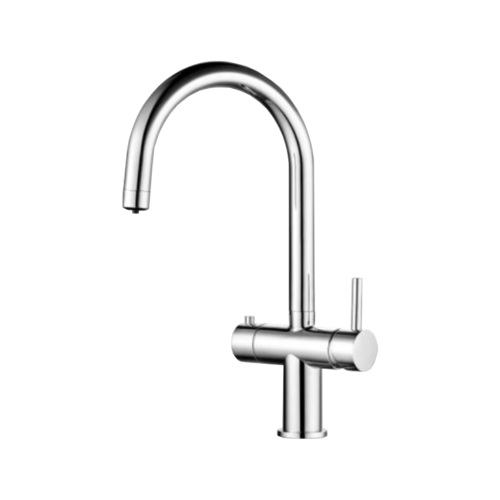
G-Mark, the Gulf Conformity Mark, is mandatory for low-voltage electrical equipment under the GSO technical regulation BD-142004-01, and for toys. A purely mechanical brass mixer is not in that scope. But once a range includes an electronically operated product — a sensor tap, an instant-boiling tap, a thermostatic unit with electronic control, or a valve with a solenoid actuator — that SKU falls under the low-voltage regulation and needs G-Mark together with the linked QR code.
This is the most common compliance gap we see in mixed taps-and-valves catalogues. Exporters certify the mechanical models, then ship the electronic variants as though they belong to the same family. Remedial certification at the port is slow and expensive.
The SASO technical regulation for building materials covers sanitary ware and related products, and plumbing fixture fittings sit under dedicated general-requirement standards including SASO 1477 and SASO 2655. More visible to project buyers is the SASO Water Efficiency Label, which is mandatory for faucets and showers and is steering Saudi construction toward low-flow cartridge technology. A model that lacks the label can be challenged at the border even when its PCoC is valid.
Compliance is not a formality; it maps onto measurable product properties. Expect scrutiny of:
Each of these is a test with a number attached. When an importer can quote that number, they stop guessing at the border.
Shipments move cleanly when the file contains a valid PCoC, a matching SCoC, accredited-laboratory test reports, a supplier's declaration of conformity, correctly formatted Arabic labelling, and — critically — a model list that matches the invoice line for line. Model-list mismatch is the single most frequent cause of delay, and it is entirely avoidable.
In practice, delays cluster in six places: a certificate issued for a model family that does not include the ordered variant; missing or non-compliant Arabic labels; electronic models shipped without G-Mark; faucets missing the Water Efficiency Label; test reports from laboratories without the right accreditation; and a PCoC that expires between issuance and the SCoC application. Each is a paperwork failure rather than a product failure, but each one costs berthing, storage and goodwill.
Before a consignment is booked, run the same short check every time. Confirm the PCoC is current and its model list covers every variant on the invoice. Confirm the SCoC is applied for only after the goods are ready, so it does not expire before loading. Check that Arabic labelling is applied in the required format and that the Water Efficiency Label is present on every regulated faucet. For any electronically operated SKU, confirm G-Mark and the QR code are in place. Finally, confirm the test reports come from a laboratory whose accreditation is recognised by the destination regulator, and keep that evidence in the shipping file rather than on someone's desktop.
The cheapest way to keep a Gulf project on schedule is to treat compliance as a design input rather than an inspection outcome. Choose brass grades that suit the target market's water chemistry, lock the model naming convention before the first sampling, confirm that electronic and mechanical SKUs are routed to the correct regimes, and order the documentation pack at the same time as the production order rather than after the vessel sails. Specifiers who build these steps into the purchase order spend their time on commissioning, not on the port.
**About the author**
This guide was prepared by the technical and market-access team at Zhejiang Xindong Sanitary Ware Co., Ltd., a valve and faucet manufacturer based in Yuhuan, Zhejiang, China. Established in 1999, Xindong supplies brass valves, thermostatic shower valves, mixer taps and OEM fittings to importers, MEP contractors and project specifiers worldwide. Enquiries: [email protected].
 Hot News
2026-09-22
2026-09-21
2026-09-20
2026-09-19
2026-09-18
2026-09-17

The company, founded in 1999 and located in Yuhuan,specializes in taps, thermostatic shower valves and shower kits. With over 30,000 sqm of space and 380+ employees, we hold numerous certifications and 65+ patents.
 EN
EN