District heating systems—where heat is generated at a central location and distributed to multiple buildings—are a cornerstone of sustainable urban development. However, the sheer scale of these networks presents a significant engineering challenge: how to ensure every room in every building receives the correct amount of heat without wasting energy.
The answer lies in precision control at the "last mile" of the network. Thermostatic Radiator Valves (TRVs) and multi-port manifold stations are the critical components that transform a blunt heating network into a smart, responsive system.
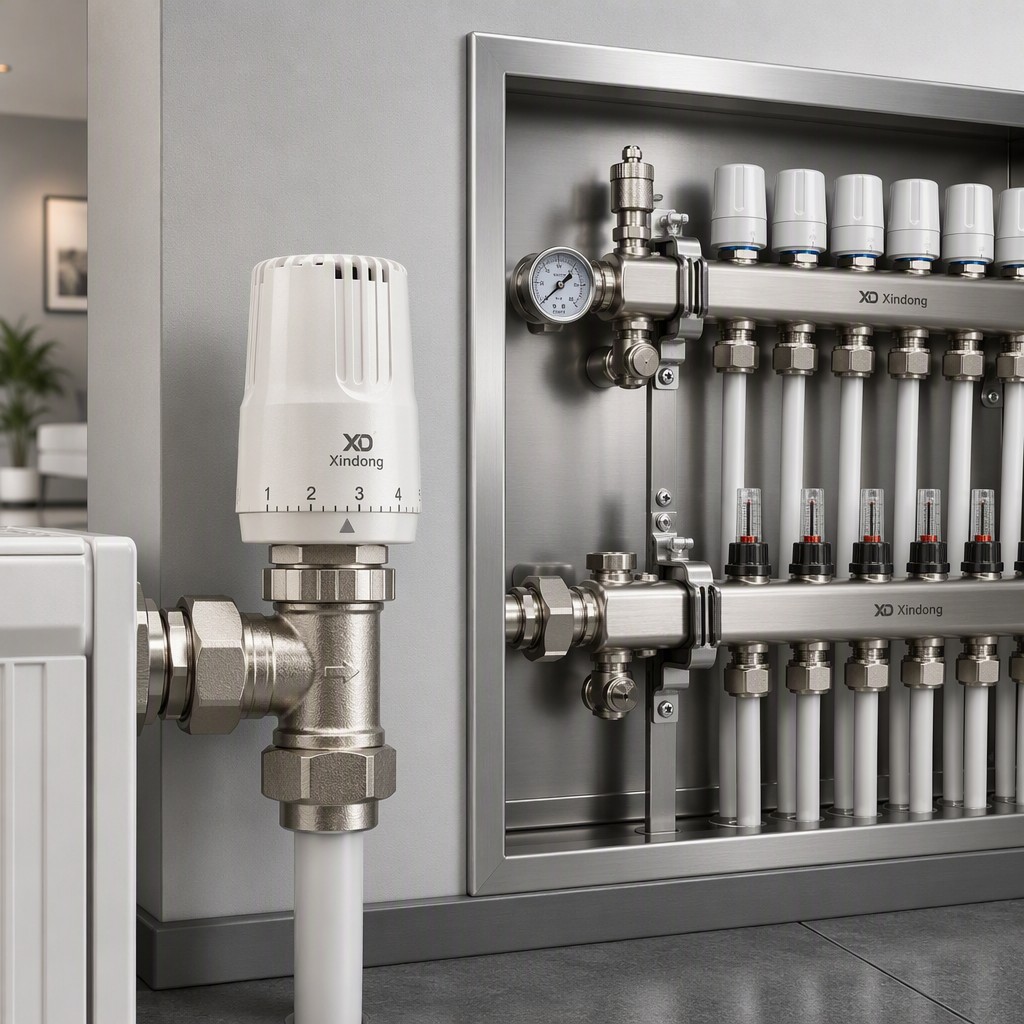
A TRV is a self-regulating valve fitted to hot water heating system radiators. It works by sensing the air temperature around it and automatically adjusting the flow of hot water into the radiator to maintain a set temperature.
For district heating operators, TRVs provide several key benefits:
1. Hydronic Balancing: They prevent "short-circuiting" where buildings closest to the heat source get too much heat, while those at the end of the line remain cold.
2. Individual Room Control: Users can set different temperatures for different rooms, significantly reducing overall energy consumption by avoiding overheating unoccupied spaces.
3. Energy Savings: Studies show that switching from manual valves to high-quality TRVs can reduce heating energy consumption by 15-25%.
Xindong’s range of TRVs is engineered for durability, featuring high-quality brass internals and sensitive thermal elements that respond to temperature changes as small as 0.5°C.
While TRVs control individual radiators, manifold stations act as the distribution hubs for entire floors or buildings. A manifold station takes the incoming hot water from the district network and distributes it to various heating circuits (e.g., underfloor heating or radiator groups).
Advanced Features of Xindong Manifold Stations:
• Integrated Flow Meters: Allow for precise manual balancing of each circuit.
• Stainless Steel Construction: Provides exceptional resistance to the high-pressure and potentially corrosive water chemistry of large district networks.
• Modular Design: Xindong’s manifold stations are designed for quick installation and easy maintenance, reducing labor costs for large-scale MEP projects.
In large multi-building complexes, the interaction between the central plant and the individual building controls is complex. Without proper thermostatic controls, the system often runs at higher-than-necessary temperatures to compensate for poor distribution.
By implementing a coordinated strategy using Xindong TRVs and manifold stations, facility managers can:
• Lower Return Temperatures: More efficient heat extraction at the radiator level means cooler water returns to the plant, improving the efficiency of heat exchangers and boilers.
• Reduce Pump Energy: As TRVs close in response to satisfied heat demand, the overall flow rate decreases, allowing variable-speed pumps to run at lower power.
With over two decades of manufacturing experience, Zhejiang Xindong Sanitary Ware Co., Ltd. understands the rigorous demands of B2B infrastructure projects. Our products are designed to meet international standards for pressure rating and thermal performance, ensuring long-term reliability in the most demanding district heating environments.
As cities move toward carbon neutrality, the optimization of district heating networks becomes a priority. Precision thermostatic controls are not just a luxury—they are an essential requirement for modern, energy-efficient building design. Xindong remains at the forefront of this transition, providing the hardware that makes smart heating possible.
For a full catalog of TRVs and Manifold Stations, visit [Xindong Sanitary Ware](https://www.cn-xindong.com).
 Hot News
2026-10-17
2026-10-16
2026-10-15
2026-10-14
2026-10-13
2026-10-12

The company, founded in 1999 and located in Yuhuan,specializes in taps, thermostatic shower valves and shower kits. With over 30,000 sqm of space and 380+ employees, we hold numerous certifications and 65+ patents.
 EN
EN