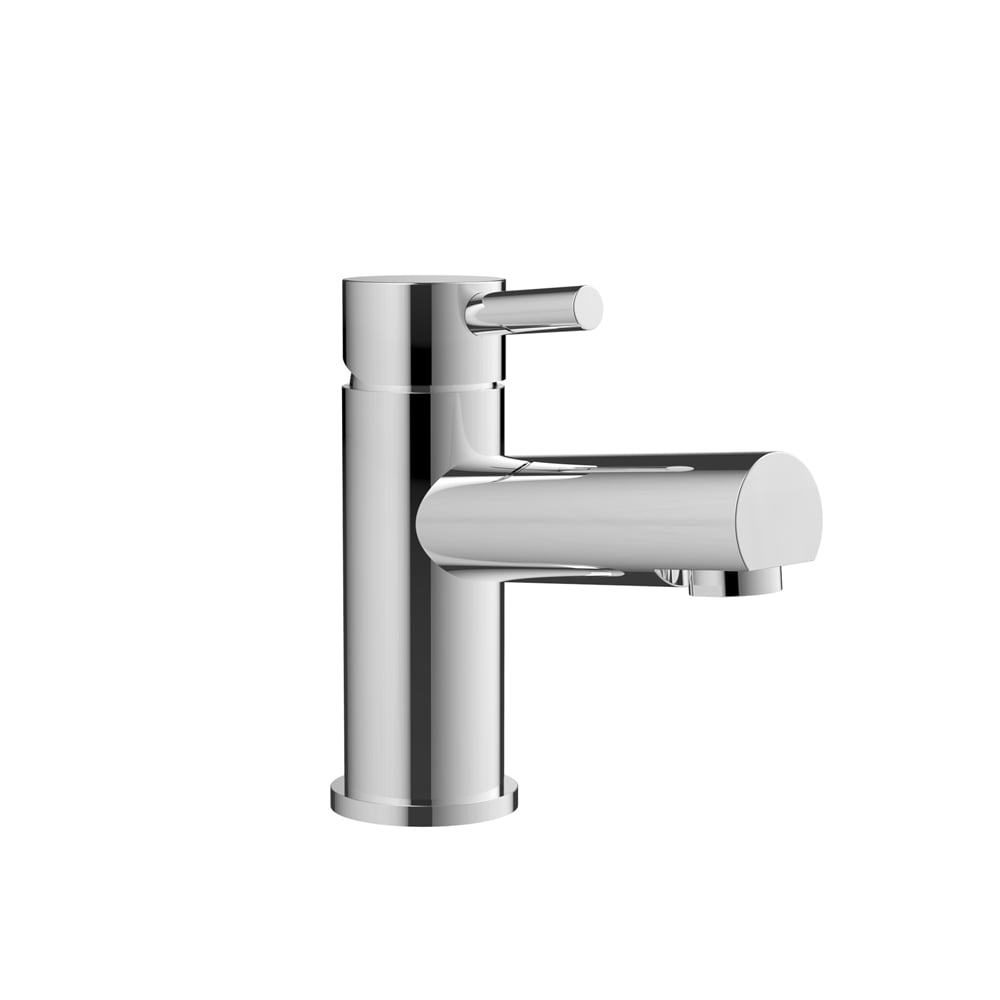
In a cloakroom the basin is usually the last thing chosen and the mixer is the last thing thought about. That order is backwards. A 400 mm cloakroom basin with a 130 mm spout throws water onto the floor every time someone washes their hands, and no amount of specification writing afterwards fixes it. The mixer has to be picked against the bowl, not against the catalogue photograph.
This is the checklist we run with distributors and specifiers before a compact basin programme goes to production.
Three dimensions decide whether a mixer works in a small washroom:
A 35 mm ceramic cartridge is the reason a modern basin mono can sit in a 42–46 mm body and still deliver full flow. That smaller body matters in three places: the tap hole (standard 35 mm), the clearance behind the spout for a pop-up waste rod, and the back-nut access under a narrow basin where a basin wrench barely fits.
Small details that separate a well-designed compact mixer from a shrunken standard one:
Where deck space is genuinely tight — a 350–400 mm cloakroom basin, a WC room with a shelf, or a wheelchair-accessible washbasin — a wall-mounted basin mixer such as the Xindong T730022 removes the tap from the deck entirely. The spout projects 150–200 mm from the finished wall and the lever sits above the bowl, clear of the surface.
Two installation rules apply. First, the concealed body is set before tiling, so the finished wall thickness must be known to the millimetre; a 5 mm error moves the spout and changes the reach. Second, the body needs a service access point — a removable panel or an accessible isolation valve — because cartridge work happens behind the wall. Wall-mounted mixers also need the hot and cold pipe centres confirmed against the body, typically 150 mm.
A cloakroom basin holds perhaps two litres. A mixer rated 9 l/min at 3 bar will splash out of a shallow bowl before the user has wet their hands, and it will drain a small hot-water supply faster than the basin fills.
For most cloakrooms, 4.5–6 l/min at 3 bar is the sensible band. Many public and commercial specifications now require basin outlets at or below 6 l/min to meet water-efficiency scoring, and EN 246 covers the general requirements for the flow regulators used to achieve it. Confirm the exact threshold in the scheme your project is being assessed under, because the numbers differ between certification bodies and are revised periodically.
Check the minimum pressure too. A mixer with a 0.5 bar minimum will not perform on a tank-fed gravity system where the basin outlet delivers 0.3 bar; a 0.3 bar-rated model with a suitable aerator will. On mains-pressure systems, 1.0 bar or above gives comfortable lever feel and predictable flow.
For a project submittal, quote the standards rather than adjectives:
Bowl depth measured, spout reach at 55–70% of it.
Lever arc clear of mirror, shelf and wall.
Deck thickness within the published range; tails long enough to reach isolators.
Minimum pressure verified on site, not assumed from the street main.
Flow rate at 3 bar between 4.5 and 6 l/min for a shallow bowl.
Cartridge size and replacement part number recorded in the O&M file.
Isolation valves accessible without removing the basin.
Finish standard and salt-spray hours stated by name, not by "high quality chrome".
Specifying by photograph rather than by dimension is the first. The second is ignoring the lever arc: a compact mixer with a tall lever looks elegant in a render and hits the mirror in a 1.1 m wide room. The third is treating flow rate as a headline number to maximise. In a cloakroom, restrained flow is a feature — it protects the user's clothes, the floor finish and the hot-water cylinder.
Get the reach, the arc and the litres per minute right and the rest of the specification falls into place.
*Written by the technical sales team at Zhejiang Xindong Sanitary Ware Co., Ltd., which manufactures brass basin mono mixers (T749002, T713002, T8802, T7502, T7102) and the T730022 wall-mounted basin mixer for importers, distributors and project specifiers. Dimensional drawings and flow data: www.cn-xindong.com.*
 Hot News
2026-10-24
2026-10-23
2026-10-22
2026-10-21
2026-10-20
2026-10-18

The company, founded in 1999 and located in Yuhuan,specializes in taps, thermostatic shower valves and shower kits. With over 30,000 sqm of space and 380+ employees, we hold numerous certifications and 65+ patents.
 EN