In the world of high-traffic commercial and industrial plumbing, the choice between aerated and laminar flow is often dismissed as a mere aesthetic preference. However, for facility managers, MEP (Mechanical, Electrical, and Plumbing) engineers, and procurement heads operating in regions with "hard water"—water high in mineral content like calcium and magnesium—this choice is a critical determinant of maintenance costs and infrastructure longevity.
At Zhejiang Xindong Sanitary Ware Co., Ltd., our laboratory research into fluid dynamics has revealed a direct correlation between the type of water stream and the frequency of descaling interventions. Understanding the physics behind these flow types is essential for optimizing maintenance cycles in demanding B2B zones.
1. Aerated Flow: The Standard Comfort
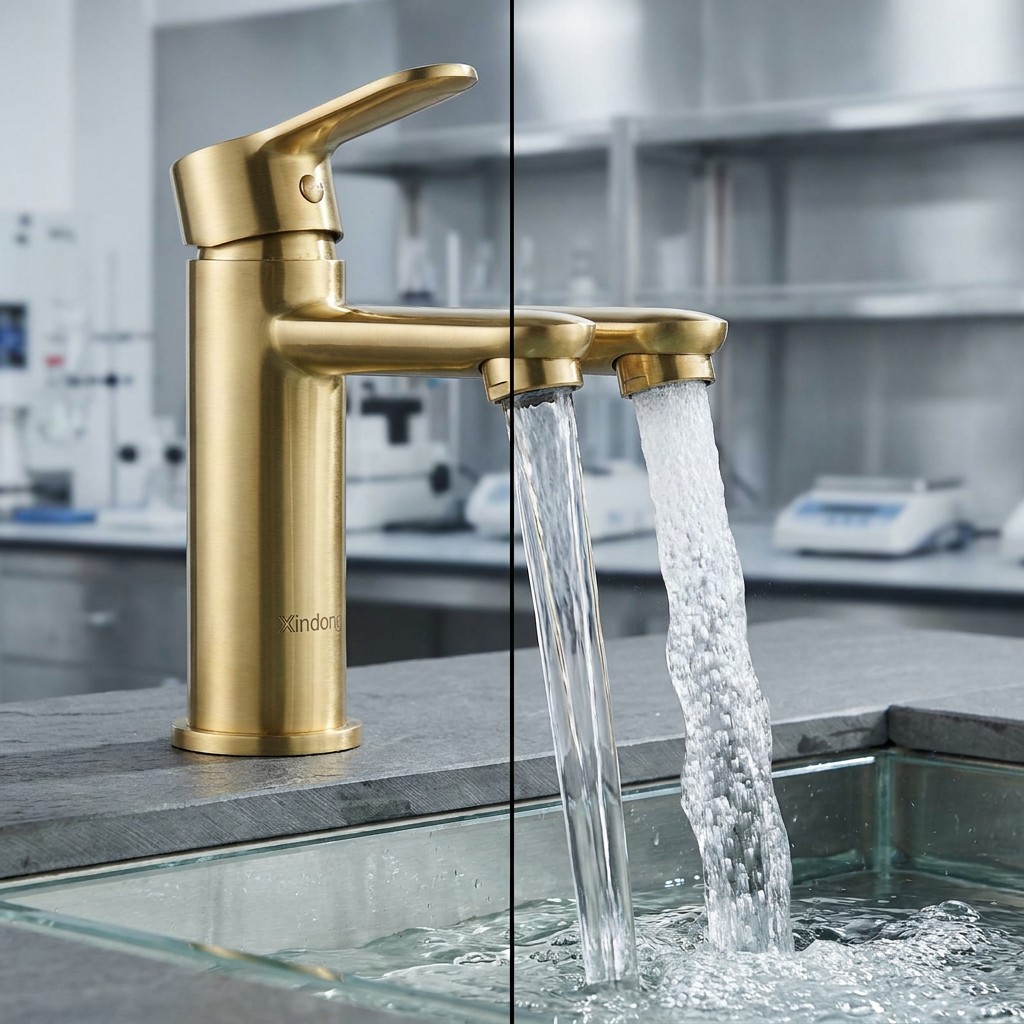
Aerated flow is the most common stream type found in modern faucets. By mixing air into the water stream, aerators create a wider, softer, and "whiter" stream that feels voluminous while using less water.
The Hard Water Challenge: The very mechanism that makes aerated flow comfortable—the fine mesh screen of the aerator—is its greatest liability in hard-water zones. As water passes through the mesh, the introduction of air can trigger the precipitation of dissolved minerals. Over time, calcium carbonate builds up within the tiny apertures of the mesh, leading to uneven spray patterns, reduced flow rates, and eventual total blockage.
2. Laminar Flow: The Technical Precision
Laminar flow, by contrast, is a crystal-clear, non-turbulent stream. It does not mix air with the water, resulting in a solid, glass-like pillar of water.
The Maintenance Advantage: Because laminar flow devices lack the intricate mesh screens found in traditional aerators, there are fewer surfaces for mineral deposits to cling to. The smooth internal geometry of a Xindong laminar flow faucet minimizes the "pockets" where water can stagnate and minerals can settle. This results in significantly longer intervals between maintenance cycles.
In a B2B context—whether it’s a 500-room hotel, a high-rise office building, or an industrial laboratory—maintenance is not just about a single faucet; it’s about scale.
The Cost of Scaling
In hard-water zones, aerated faucets may require descaling or aerator replacement every 3 to 6 months to maintain peak performance. For a facility manager, this translates to hundreds of man-hours spent on routine plumbing tasks.
By switching to laminar flow solutions, especially those engineered with Xindong’s proprietary internal coatings, these cycles can often be extended to 12 or 18 months. The reduction in labor costs and part replacements offers a compelling ROI for procurement professionals.
Hygiene and Cross-Contamination
In healthcare and laboratory settings, the fluid dynamics of the stream are even more critical. Aerated flow, by introducing room air into the water stream, can potentially introduce airborne pathogens into the water. This is why laminar flow is the gold standard for clinical environments. The solid stream reduces splashing and aerosolization, further protecting the integrity of the zone.
Zhejiang Xindong Sanitary Ware Co., Ltd. doesn't just manufacture valves; we engineer solutions for real-world challenges. Our R&D team has focused on three key areas to address the hard-water maintenance crisis:
1. Material Integrity: We utilize high-grade DZR (Dezincification Resistant) brass, which resists the corrosive effects of mineral-heavy water, preventing the internal pitting that often attracts scale.
2. Precision Machining: Our CNC-machined internal pathways are polished to a micron-level finish, ensuring that laminar flow remains stable and mineral-repellent.
3. Advanced Testing: In our in-house labs, we simulate years of hard-water exposure to ensure that our faucets maintain their flow characteristics under the most grueling conditions.
For B2B procurement heads and engineers, the choice between laminar and aerated flow should be a data-driven decision based on local water quality and desired maintenance frequency. While aerated flow remains a popular choice for guest-facing hospitality areas due to its perceived volume, laminar flow is increasingly becoming the preferred specification for high-traffic, high-maintenance, and high-hygiene zones.
At Xindong, we are committed to providing the technical transparency and high-precision hardware required to keep your infrastructure running smoothly. By choosing the right fluid dynamics for your environment, you aren't just buying a faucet—you're securing a lower total cost of ownership (TCO) for your entire facility.
For technical specifications on Xindong's laminar flow valves and custom B2B solutions, visit [www.cn-xindong.com](https://www.cn-xindong.com).
 Hot News
2026-10-17
2026-10-16
2026-10-15
2026-10-14
2026-10-13
2026-10-12

The company, founded in 1999 and located in Yuhuan,specializes in taps, thermostatic shower valves and shower kits. With over 30,000 sqm of space and 380+ employees, we hold numerous certifications and 65+ patents.
 EN
EN