When sourcing kitchen taps from a Chinese manufacturer, compliance is not optional—it is the first gatekeeping criterion that determines whether a product can legally enter your market. For B2B procurement managers, import distributors, and project developers across Europe, the UK, and North America, understanding the specific certifications required for kitchen taps is a fundamental step in protecting both your end customers and your own business reputation.
A kitchen tap connects directly to the drinking water supply. Any material that leaches heavy metals—particularly lead—or harbours bacterial growth inside the valve body poses a direct public health risk. Regulators in mature markets have responded with strict certification frameworks, and customs authorities increasingly refuse shipments that cannot provide documented compliance. Choosing a supplier based on price alone, without verifying certification status, exposes importers to product recall costs, customs seizure, and legal liability that far exceed any upfront saving.
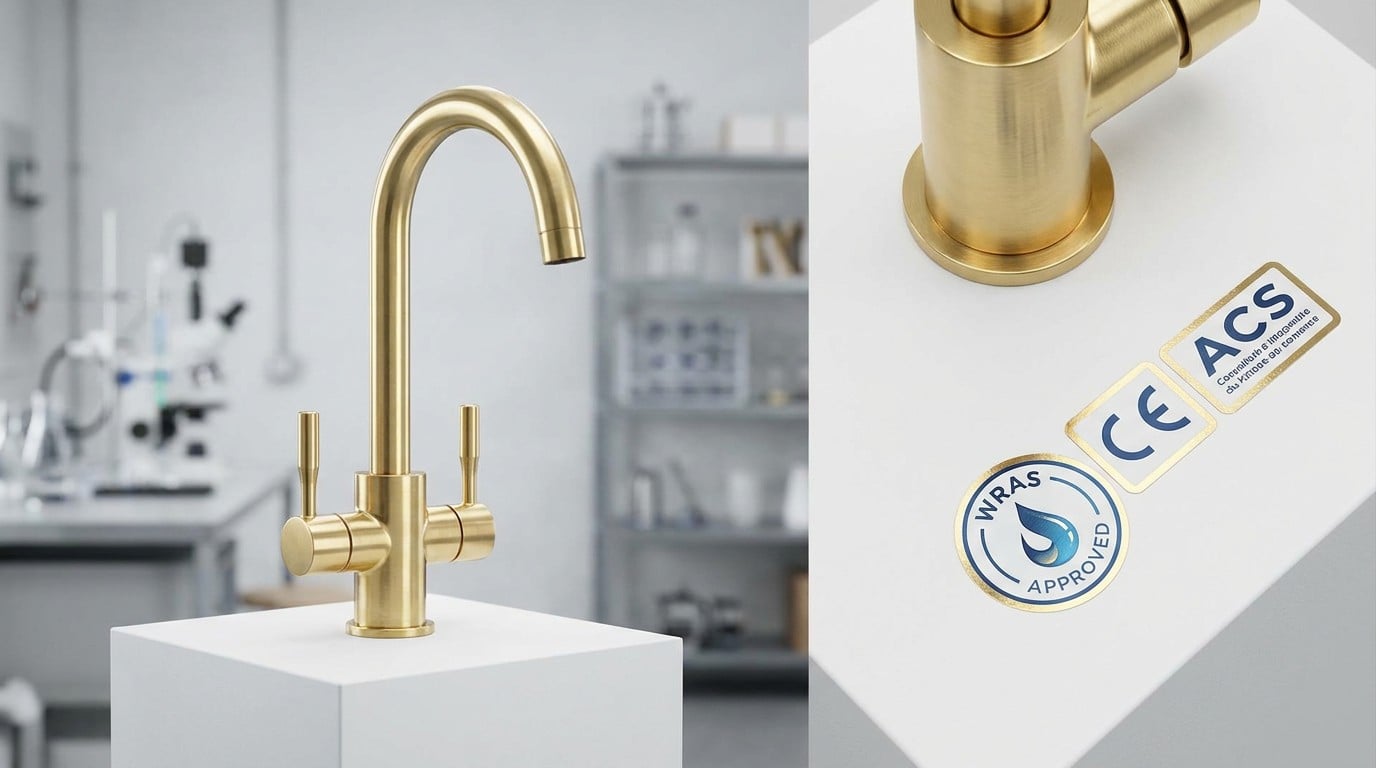
The Water Regulations Advisory Scheme (WRAS) is a mandatory requirement for any product that contacts drinking water in the United Kingdom. WRAS approval confirms that the tap body materials, sealants, lubricants, and internal components do not contaminate the water supply and comply with the Water Supply (Water Fittings) Regulations 1999. B2B buyers distributing kitchen taps through UK plumbing merchants or specifying products in UK construction projects must verify that every model holds a current WRAS approval number. Ask your supplier to share the approval certificate and cross-reference the product against the WRAS-approved products directory before placing any purchase order.
The CE mark declares that a product conforms to European health, safety, and environmental protection standards. For plumbing fixtures, this typically covers the Low Voltage Directive (for electrically assisted taps), the Construction Products Regulation, and REACH compliance for chemical substances. A kitchen tap that cannot carry a CE mark cannot be legally sold within the EEA. Importantly, since Brexit, CE marking no longer satisfies UK requirements, so dual-certification products (both WRAS and CE) are often required by distributors serving both markets simultaneously.
France operates its own drinking water contact material certification: the Attestation de Conformité Sanitaire (ACS). Any tap, valve, or fitting sold in France that contacts potable water must hold a current ACS certificate issued by an accredited French laboratory. This is a separate requirement from CE marking and is often overlooked by importers targeting France. The ACS tests the specific brass alloy composition, solder materials, and any internal coating to ensure no harmful migration into water. Suppliers should be able to provide the full ACS test report and the certificate number for each product reference.
For buyers supplying the United States and Canada, NSF/ANSI 61 certification is the critical standard. It verifies that the materials used in the tap do not leach contaminants into drinking water above EPA thresholds. Additionally, the US Safe Drinking Water Act mandates that all wetted-surface materials in products sold for potable water use must contain a weighted average lead content of no more than 0.25%. Canadian provinces follow equivalent provincial regulations. Importers must confirm both NSF/ANSI 61 and lead-free compliance before any North American product launch.
Established in 1999 and operating from a 30,000+ square metre facility in Yuhuan, Zhejiang, Xindong Sanitary Ware has invested in laboratory testing infrastructure precisely to support global B2B buyers. The company manufactures kitchen taps using solid lead-free brass alloys, ceramic disc cartridges, and surface finishes applied through both multi-layer electroplating and PVD processes. Products are designed to accommodate the material specifications required for WRAS, CE, ACS, and NSF/ANSI 61 compliance. B2B buyers are encouraged to specify their target market at the enquiry stage so that the most appropriate certified product references can be recommended.
Before issuing a purchase order for imported kitchen taps, confirm the following: request the original certification certificates with visible certificate numbers and expiry dates; verify the certificate holder name matches the factory supplying your order; check that the specific product model and finish are listed in the scope of each certificate; request the supporting test report from an accredited third-party laboratory; and confirm whether the certificates cover the full production run or only a tested sample batch. Following this checklist systematically prevents the most common compliance failures that cause costly shipment delays or market access denials.
Established 1999 · 30,000+ sqm factory · 65+ patents · Monthly capacity 200,000+ sets · ISO 9001 certified. Contact: [email protected] | www.cn-xindong.com
 Hot News
2026-10-17
2026-10-16
2026-10-15
2026-10-14
2026-10-13
2026-10-12

The company, founded in 1999 and located in Yuhuan,specializes in taps, thermostatic shower valves and shower kits. With over 30,000 sqm of space and 380+ employees, we hold numerous certifications and 65+ patents.
 EN
EN