In the world of B2B valve procurement, "Zero Leakage" is the ultimate goal. Whether for residential plumbing, industrial systems, or commercial projects, a failing valve can lead to thousands of dollars in water damage and system downtime. The only way to guarantee this reliability is through rigorous pressure testing during the manufacturing process.
At Zhejiang Xindong Sanitary Ware Co., Ltd., pressure testing is the cornerstone of our quality assurance. This guide outlines the standard testing procedures B2B buyers should expect from a top-tier valve manufacturer.
Every valve, regardless of its design, has potential failure points: the body casting, the seals, and the stem. Pressure testing identifies:
• Casting Defects: Microscopic pinholes or porosity in the brass that might not be visible to the naked eye.
• Improper Sealing: Misaligned seats or faulty O-rings that allow water to bypass the valve in the closed position.
• Structural Integrity: Ensuring the valve can withstand the maximum rated pressure of the system it is intended for.
Most international standards (such as EN 12266-1 or API 598) require two primary types of pressure tests.
A. The Shell Test (Hydrostatic)
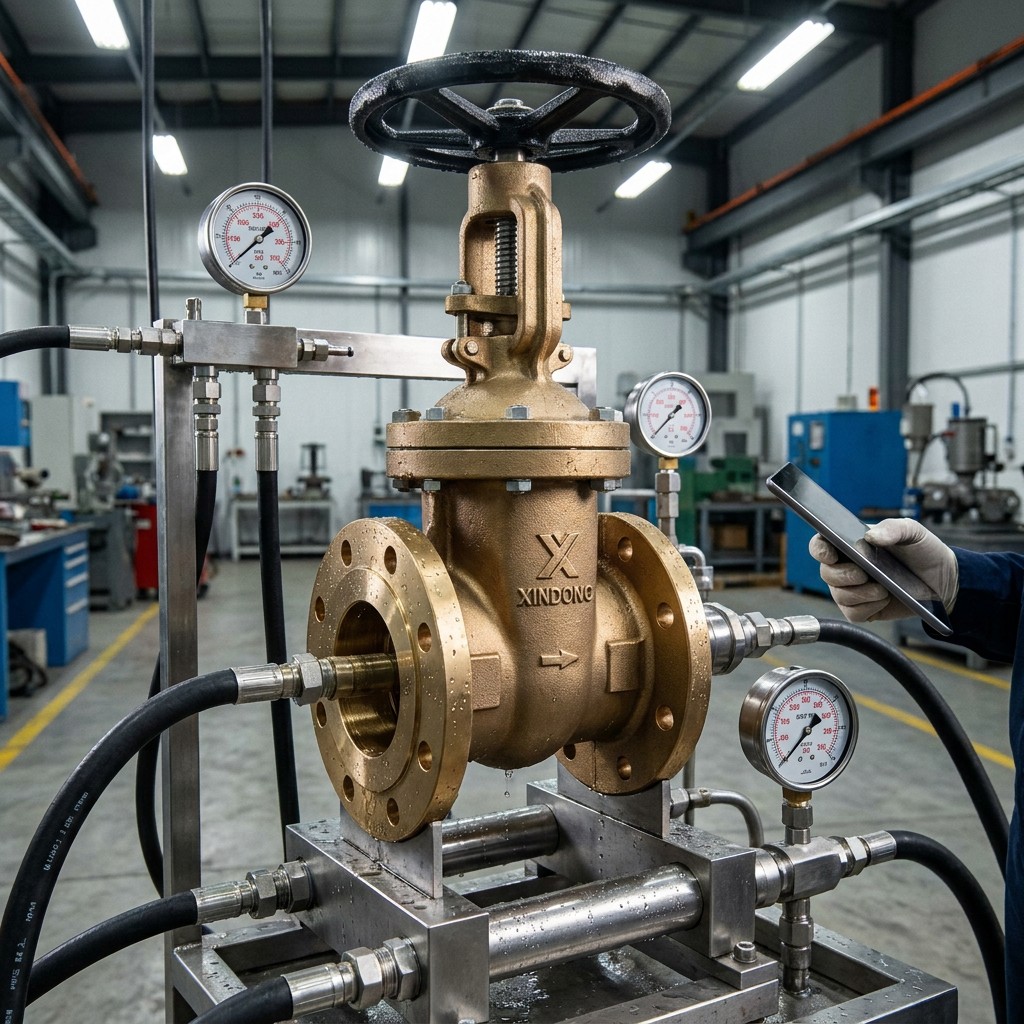
The valve is placed in a partially open position, and both ends are sealed. Water is pumped into the valve body at a pressure typically 1.5 times the maximum allowable working pressure.
• What it checks: The integrity of the brass body and the stem seals.
• B2B Expectation: There should be zero visible leakage through the walls or the packing.
B. The Seat Test (Closure Test)
The valve is closed, and pressure is applied to one side.
• What it checks: The effectiveness of the internal seal (the ball and seat in a ball valve, or the disc and seat in a gate valve).
• B2B Expectation: Depending on the classification, some standards allow for a few drops, but for high-end applications like those served by Xindong, "Bubble Tight" (zero leakage) is the standard.
While water (hydrostatic) is excellent for checking structural strength, air testing (pneumatic) is often used for detecting even smaller leaks. Air molecules are smaller than water molecules, making them more likely to find microscopic paths.
• Method: The valve is pressurized with air and submerged in water. Any bubbles indicate a leak.
When auditing a supplier like Xindong, look for the following:
• 100% Testing Policy: Avoid suppliers that only perform "batch testing." Every single valve should be tested before it leaves the factory.
• Automated Testing Rigs: Human error is a risk in manual testing. Automated rigs ensure consistent pressure and duration for every test.
• Data Logging: Modern factories log the results of every test, providing a digital trail for quality control.
• Calibration Records: Ensure the pressure gauges used in the factory are regularly calibrated by an independent third party.
At Xindong, our testing lab is equipped with state-of-the-art hydraulic and pneumatic testing stations. We simulate real-world conditions, including thermal cycling tests for our thermostatic valves, to ensure that our products don't just work on Day 1, but continue to perform for years to come.
Pressure testing is the difference between a high-performance component and a liability. As a B2B buyer, understanding these tests allows you to ask the right questions and ensure that your supply chain is built on a foundation of quality.
Located in Yuhuan, China, Xindong is a professional manufacturer of brass valves, faucets, and thermostatic solutions. Our commitment to 100% pressure testing and advanced quality control makes us a trusted partner for B2B clients worldwide.
 Hot News
2026-10-17
2026-10-16
2026-10-15
2026-10-14
2026-10-13
2026-10-12

The company, founded in 1999 and located in Yuhuan,specializes in taps, thermostatic shower valves and shower kits. With over 30,000 sqm of space and 380+ employees, we hold numerous certifications and 65+ patents.
 EN
EN