In a care home or assisted-living scheme, the washroom is where design decisions turn into resident safety outcomes. A resident who cannot reliably judge water temperature, reach a control, or react quickly to a sudden change is exposed to a hazard that signage and staff vigilance will never fully remove. The effective interventions belong in the specification, the commissioning and the maintenance regime — not in the care plan.
Scalding is a time-and-temperature problem. The lower a person's skin thickness, circulation and reaction speed, the shorter the exposure needed to cause a serious burn. Three failure modes matter most in care settings: a thermostatic element that drifts out of calibration; a control that a resident can move in the wrong direction; and a loss of cold supply that sends undiluted hot water to the outlet. All three are preventable at specification stage.
Several instruments work together, and they answer different questions:
**Blended delivery temperature.** The healthcare benchmark for bathing, showering and hand-washing in care and high-risk settings is a maximum blended temperature of around 41 °C at the outlet, with automatic fail-safe to cold if either supply is lost. Domestic TMV2 applications typically allow a higher limit, which is one reason a domestic valve should not be substituted into a care bathroom.
**Valve type.** Specify TMV3 (high-pressure or low-pressure variants as the supply dictates) for showers and basins in high-risk settings. Confirm the approval covers the exact model, not merely the product family.
**Fail-safe direction.** On loss of cold supply the valve must shut off the hot, never pass it through. This is a fundamental test criterion, and it should be verified at commissioning, not assumed from the datasheet.
**Stability under draw-off.** Temperature should hold within roughly ±2 °C as other outlets on the same supply open and close. Ask for the test evidence.
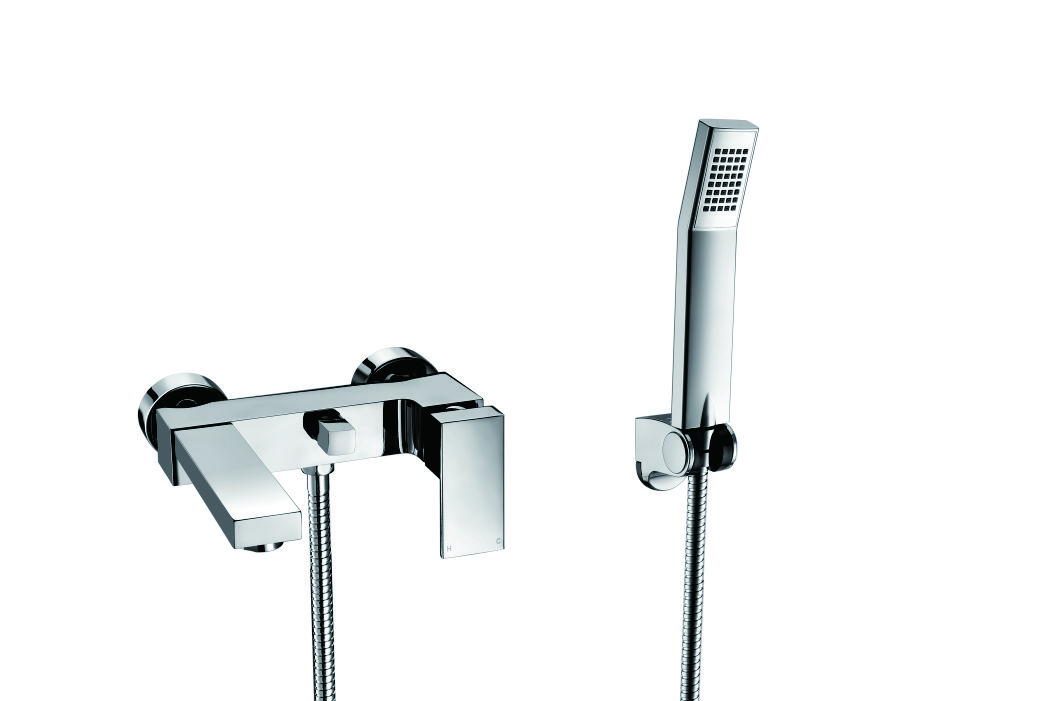
**Control type.** A single sequential lever — temperature first, then flow — is the safest configuration. It removes the two-handle guessing game, gives the user one predictable motion, and is far easier to operate with limited grip strength or reduced dexterity.
**Serviceability.** The valve must be cleanable and its strainers clearable without breaking the wall. In practice, a poorly accessible valve means a valve that is never maintained.
Dementia design guidance, including work from the Dementia Services Development Centre at the University of Stirling, is consistent on a handful of points:
None of these choices conflict with clinical function. In fact, a fixture that is obvious and easy to operate is usually also a fixture that is easier to clean and harder to misuse.
Scald safety and water hygiene pull in the same direction. **HTM 04-01** requires regular flushing, temperature monitoring and outlet cleaning; thermostatic valves should be serviced and re-tested on a documented cycle — at least annually, and more often in high-risk or heavily used settings. Choosing outlets that can be dismantled for cleaning, and avoiding mesh aerators that trap organic matter, reduces both infection risk and maintenance labour.
Confirm the valve carries a **TMV3** approval for the correct pressure type, and that the certificate names the exact model.
Set the blended outlet limit at around 41 °C and record the commissioning figure.
Verify fail-safe-to-cold behaviour on both showers and basins.
Fit single sequential lever controls throughout the care bedrooms.
Check the LRV contrast between controls and wall surfaces.
Confirm the valve and strainers are serviceable without wall damage.
Budget for the annual TMV test and record it alongside the water-hygiene log.
Zhejiang Xindong Sanitary Ware Co., Ltd. has designed and manufactured thermostatic shower valves, taps and brass fittings from its Yuhuan, Zhejiang facility since 1999. Our care-oriented range centres on thermostatic valve technology with large single-lever controls, satin finishes, and bodies engineered for straightforward servicing. We hold TMV2, TMV3 and WRAS approvals across parts of the thermostatic range and can supply the test and conformity documentation that estates teams and their M&E consultants need at tender stage.
A care-home bathroom is a safety device as much as a fixture set. Get the valve type, the fail-safe direction, the outlet temperature and the control geometry right at specification stage, then service them on a written cycle — and the room quietly protects residents every day, without anyone having to think about it.
 Hot News
2026-10-06
2026-10-05
2026-10-04
2026-10-03
2026-10-02
2026-10-01

The company, founded in 1999 and located in Yuhuan,specializes in taps, thermostatic shower valves and shower kits. With over 30,000 sqm of space and 380+ employees, we hold numerous certifications and 65+ patents.
 EN
EN