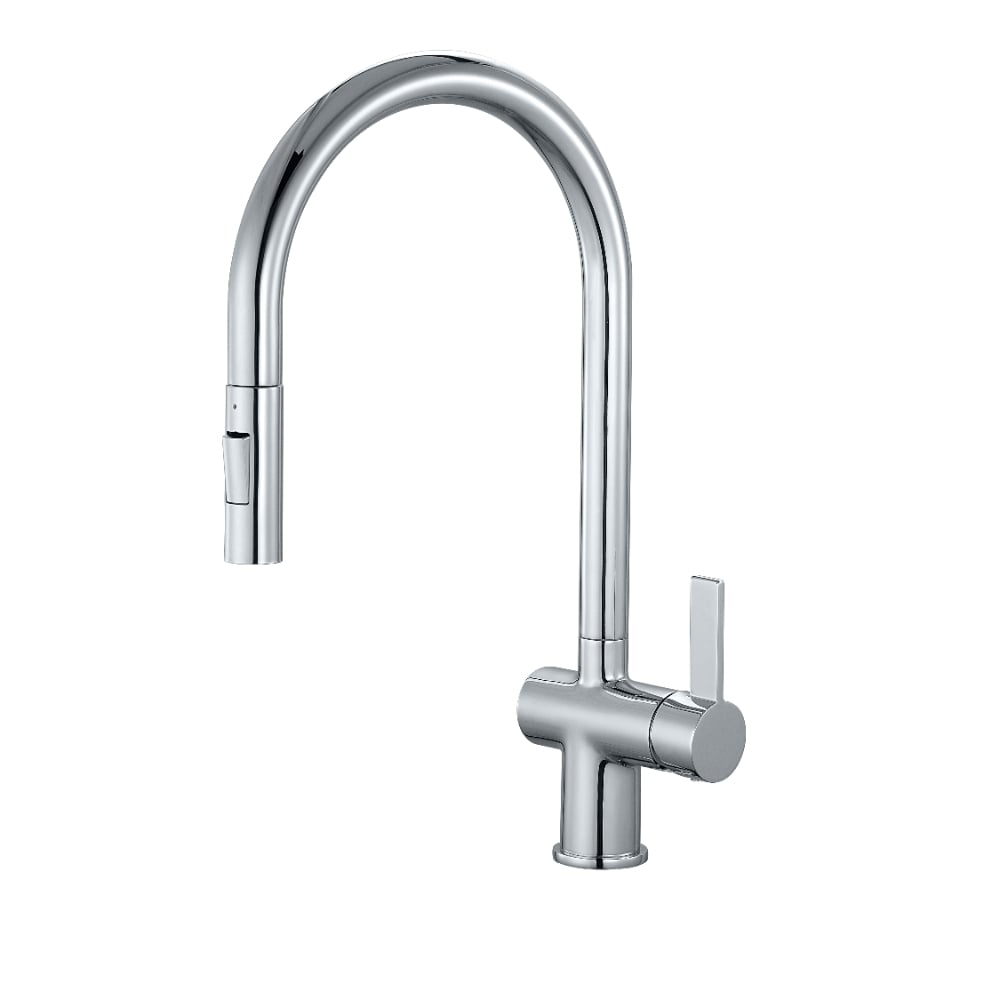
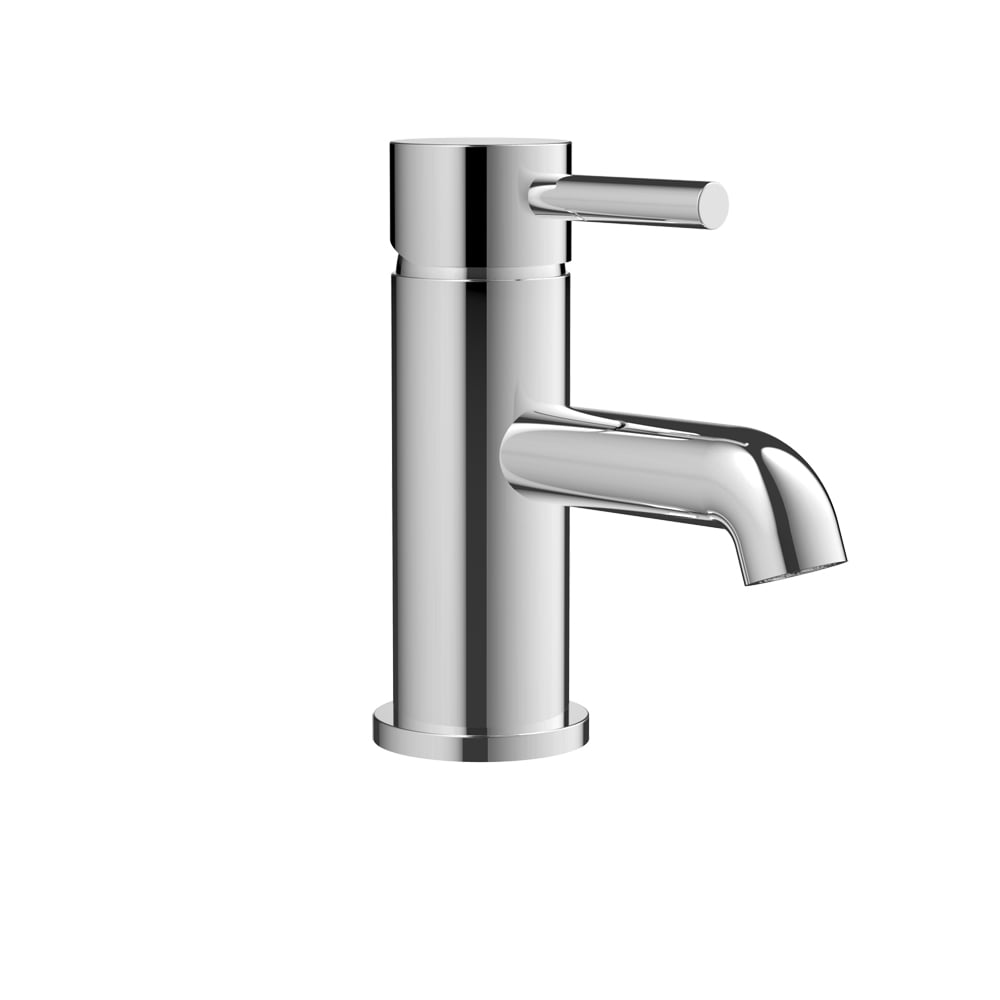
Island taps rarely fail because the cartridge was poor or the finish was thin. They fail because a tap designed to sit against a wall was dropped into the middle of a room where it has to serve people standing on two, sometimes three, sides. The geometry that made it fine on a run of base units becomes the whole problem.
This is the specification conversation that saves the most callbacks, and it almost never happens.
A conventional sink run has one user position and one wall. An island has a working side, a seating side and two walkways. The tap therefore has two jobs that pull in opposite directions: it must reach the bowl comfortably for the person washing up, and it must not be an obstacle, a drip source or a head-height hazard for the person sitting at the overhang.
Start by fixing which side the tap is on. On islands with a raised bar or a seating overhang, mount the tap on the working side, with the spout arcing *inward* over the bowl. Buyers often ask for the tap on the seating side because it looks better in photographs. It also puts a stainless steel arc at chin height and drips cold water onto knees. Say no.
On a peninsular, the tap usually sits at the closed end of the run. That position demands more rotation than an island — often close to a full half-turn — to serve a bowl offset toward the open end. It is the one case where a wider swivel is genuinely necessary rather than decorative.
Two numbers decide whether an island tap works: spout reach, meaning horizontal distance from the centre of the tap body to the aerator outlet, and the distance from the mounting hole to the far edge of the bowl it must serve.
The common mistake is specifying reach against the bowl centre. Water has to fall into the bowl, work on the dishes and drain, so the outlet should sit near the centre of the *bowl*, not the centre of the sink unit. On a double-bowl island sink this matters twice: if the tap is mounted on the dividing deck, a 200 mm reach serves the near bowl well and the far bowl badly, and the user rotates the spout 90 degrees for every pot.
With an island worktop of 900–1000 mm depth and a bowl set toward the working side, 200–250 mm of reach typically covers one bowl properly. For a double bowl, either mount centrally between the bowls with 250 mm-plus reach, or accept the swing and specify a smooth swivel with a defined stop.
Also check what is behind the tap: there is no wall to stop a tall lever handle, so it can rotate freely and end up over the floor. A handle arcing over open space feels wrong in the hand; users expect resistance at the end of travel.
Full 360-degree rotation is sold as a premium feature. In a kitchen it is a liability more often than an asset. 360 degrees means the spout can point at the floor, at the seating area, at a hob, or into a walkway. Every one of those positions is a wet floor or a burn risk. The useful arc on an island is typically 120 to 180 degrees — enough to cover the bowl, a second bowl and the worktop either side.
Swivel stops exist for this reason. Most quality mixers use a ceramic cartridge with a rotation limiter — a ring, pin or grub screw that restricts travel, usually set around 60–90 degrees either side of centre at the factory and adjustable on site.
Two practical points follow. First, state the default stop in the quotation and confirm it is adjustable on site — a factory-set 120-degree arc will not suit a peninsular sink offset to one side. Second, specify that the stop is *set during commissioning*. A two-minute adjustment prevents the spout swinging over the edge of the island the first time a child pulls the handle.
There are legitimate 360-degree cases: a tap in the corner of an L-shaped island serving two prep zones, or a pot-filler position where the arm must park flat against the worktop. Outside those, a limited arc is the better product.
The failure modes are consistent.
Reach overpromised on the drawing. The spec sheet says 220 mm; the drawing shows a 700 mm sink unit with the tap at one end. The arithmetic never worked, but nobody did it.
Tap pushed too far back.On deep worktops the tap gets moved to the rear edge to keep it out of the way, and the spout now lands on the drainer. Reach should be chosen from the mounting position actually drawn.
No stop, low-friction swivel. The spout migrates while the user scrubs, water ends up outside the bowl, and the complaint arrives as "the tap leaks".
Flow chosen for a wall run. A high-mounted island tap with a long drop to the aerator splashes harder, and on a restricted supply it feels weak.
· Installation · Practical swivel arc · Mounting position · Watch out for ·
|---|---|---|---|
· Single-bowl island, seating one side · 120–150° · Working side, behind bowl centre · Spout never parks over the overhang ·
· Double-bowl island · 180°, with stop · Central dividing deck · Reach must cover the far bowl ·
· Peninsular, bowl offset to open end · 180–270° · Closed end of run · Handle clearance to side panel ·
· Island with raised bar · 90–120° · Working side · Lever fouling the upstand ·
· Corner-mounted, two prep zones · 360° acceptable · Corner, arm parks flat · Spout drainage direction ·
Confirm five points on paper: bowl centre relative to the mounting hole, spout reach in millimetres, default swivel arc and whether it is adjustable, handle sweep clearance, and supply pressure at the tap. Add the declared flow rate at a stated pressure.
Mechanically, the swivel should not be the weak point. EN 817 is the relevant reference for mechanical mixing valves with a single sequential cartridge, and EN 246 covers aerator and flow-regulator specification; for UK supply, WRAS approval of wetted materials is the baseline.
An island tap is chosen on appearance and judged on arithmetic. Do the arithmetic in the quotation and the appearance gets to stay.
Zhejiang Xindong Sanitary Ware Co., Ltd. is an OEM/ODM manufacturer of kitchen mixer taps and brass basin mixers in Yuhuan, Zhejiang, China, supplying importers and project specifiers with swivel-spout brass tapware for island, peninsular and standard sink runs. Technical drawings and OEM enquiries: [email protected] · +86-0576-87499008 · https://www.cn-xindong.com
 Hot News
2026-11-19
2026-11-18
2026-11-17
2026-11-16
2026-11-11
2026-11-10

The company, founded in 1999 and located in Yuhuan,specializes in taps, thermostatic shower valves and shower kits. With over 30,000 sqm of space and 380+ employees, we hold numerous certifications and 65+ patents.
 EN