Most water-treatment complaints are not about water quality. They are about a shower that used to be strong and now is not, or a tap that dribbles on the top floor. Almost always the chemistry is fine and the hydraulics are not. Point-of-entry (POE) and point-of-use (POU) treatment do different jobs, and the design skill lies in sequencing them so each device gets the water it needs — while the building still gets the flow and pressure it expects. This is where the valve package matters as much as the media.
POE equipment treats everything entering the building. An ion-exchange softener removes calcium and magnesium and protects the components downstream that hate scale: water heaters, boilers, thermostatic shower cartridges, instant boiling taps and dishwashers. POU equipment polishes at the point of use — typically a drinking-water tap with reverse osmosis or a carbon block — delivering better-tasting water without softener sodium in the drinking supply.
That division of labour is the design principle: softening everything suits the mechanical system but not the kitchen tap, so a POU RO unit is conventionally fed by softened water — the softener protects the membrane, and the membrane removes the sodium the softener added.
The sequence is not arbitrary. A workable arrangement is: pressure-reducing valve first, then backflow protection, then a sediment filter, then carbon — granular or catalytic where chloramine is present — then the softener, then UV disinfection where required, then the POU RO unit at the kitchen.
Carbon before the softener protects resin from chlorine and chloramine degradation; softening before the RO unit protects the membrane from scaling; and UV belongs after filtration, because turbidity and iron absorb UV and defeat the dose. Backflow protection sits at the entry, and every device that creates a cross-connection risk — softener brine line, RO concentrate line, chemical dosing — needs an air gap or approved mechanical protection, per EN 1717 internationally or the Water Supply (Water Fittings) Regulations 1999 in the UK, with a physical air gap always strongest.
This is the step that gets skipped. Static mains pressure tells you almost nothing; what matters is dynamic pressure at the far end of the building during peak demand. Every device has a rated pressure drop at a rated service flow, and those numbers add up fast: a softener control valve might take 0.2–0.5 bar, a carbon block 0.3–0.7 bar, and strainers, elbows and long runs of small-diameter tube take more.
Set a total budget — a common target is to keep the whole train under about 0.7 bar — and size every stage against it. Feed pressure matters at the far end too: POU RO units want roughly 2.8 bar (40 psi) of feed pressure, so an undersized line from the entry to the kitchen degrades rejection ratio even if the membrane is perfect. Where the incoming supply is marginal, a booster pump after the entry train is a legitimate answer.
A softener's capacity (resin volume) and its service flow are two different specifications, and both must be met. Capacity decides how often it regenerates; service flow decides whether it passes a morning peak without excessive pressure loss. Sizing for capacity alone is the classic error, because a unit with the right capacity but an undersized valve throttles every shower in the house.
The same applies to cartridges: a filter that loads quickly changes the hydraulics within weeks, so leave differential pressure monitoring in the design, plan regeneration outside peak demand, and confirm the drain can take the backwash flow.
A treatment train without proper valving is a maintenance liability. The minimum is a full-bore isolation valve either side of every device, so a bypass can be opened and a stage isolated without interrupting supply. Two things routinely go wrong:
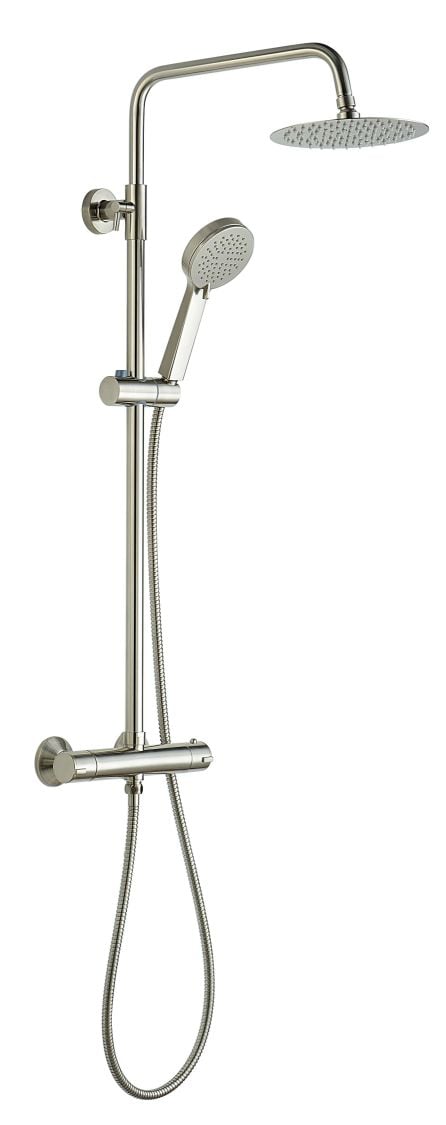
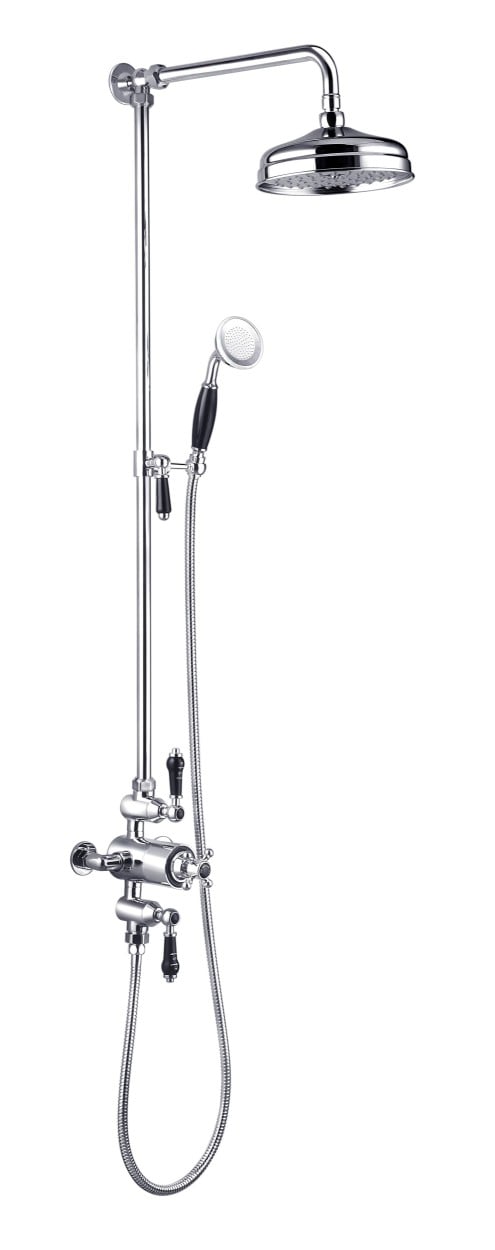
Thermostatic mixing valves and shower cartridges deserve special mention, because scale is their principal failure mode. A softened supply matched to the valve's rated pressure and temperature envelope is what keeps TMV2/TMV3-class valves performing to BS EN 1111 and EN 1287 over their service life; hard water shortens that life no matter how good the valve is. Closed volumes in the softened circuit also need expansion control, and dead legs should be designed out entirely.
Measure static and dynamic pressure at the entry, then at the farthest fixture with the peak load running — a bucket test beats a gauge on the incoming main. Test hardness before and after the softener, TDS before and after the RO membrane to confirm rejection, and free chlorine after carbon to confirm the media is still working. Record the differential pressure across each filter as a baseline, and walk the train to confirm every isolation valve is fully open and every bypass fully closed — the most common "low pressure" fault is a valve nobody touched.
Good water treatment is a hydraulic design problem with a chemistry outcome. Get the sequence right, budget the pressure loss, size for peak flow, and put full-bore isolating valves, bypasses and drains around each stage — or every service call will start with the same question: why has the pressure dropped?
---
**About the author**
*Zhejiang Xindong Sanitary Ware Co., Ltd. — Technical & Export Team*
Xindong has manufactured brass valves, fittings, thermostatic shower valves and mixer taps in Yuhuan, Zhejiang for more than 25 years, from a 30,000 m² plant with 380+ employees, in-house design and testing laboratories, and over 65 design and structure patents. Products are developed and tested in line with the approval regimes of the company's export markets, including WRAS, TMV2/TMV3, cUPC and NSF/ANSI requirements, and are supplied to importers, MEP contractors and water-treatment integrators across Europe, the Middle East and North America.
Contact: No.242 JinHai Road, Xuanmen Industrial Zone, Yuhuan, Zhejiang, China · +86-0576-87499008 · [email protected] · https://www.cn-xindong.com
 Hot News
2026-09-30
2026-09-29
2026-09-28
2026-09-24
2026-09-23
2026-09-22

The company, founded in 1999 and located in Yuhuan,specializes in taps, thermostatic shower valves and shower kits. With over 30,000 sqm of space and 380+ employees, we hold numerous certifications and 65+ patents.
 EN
EN