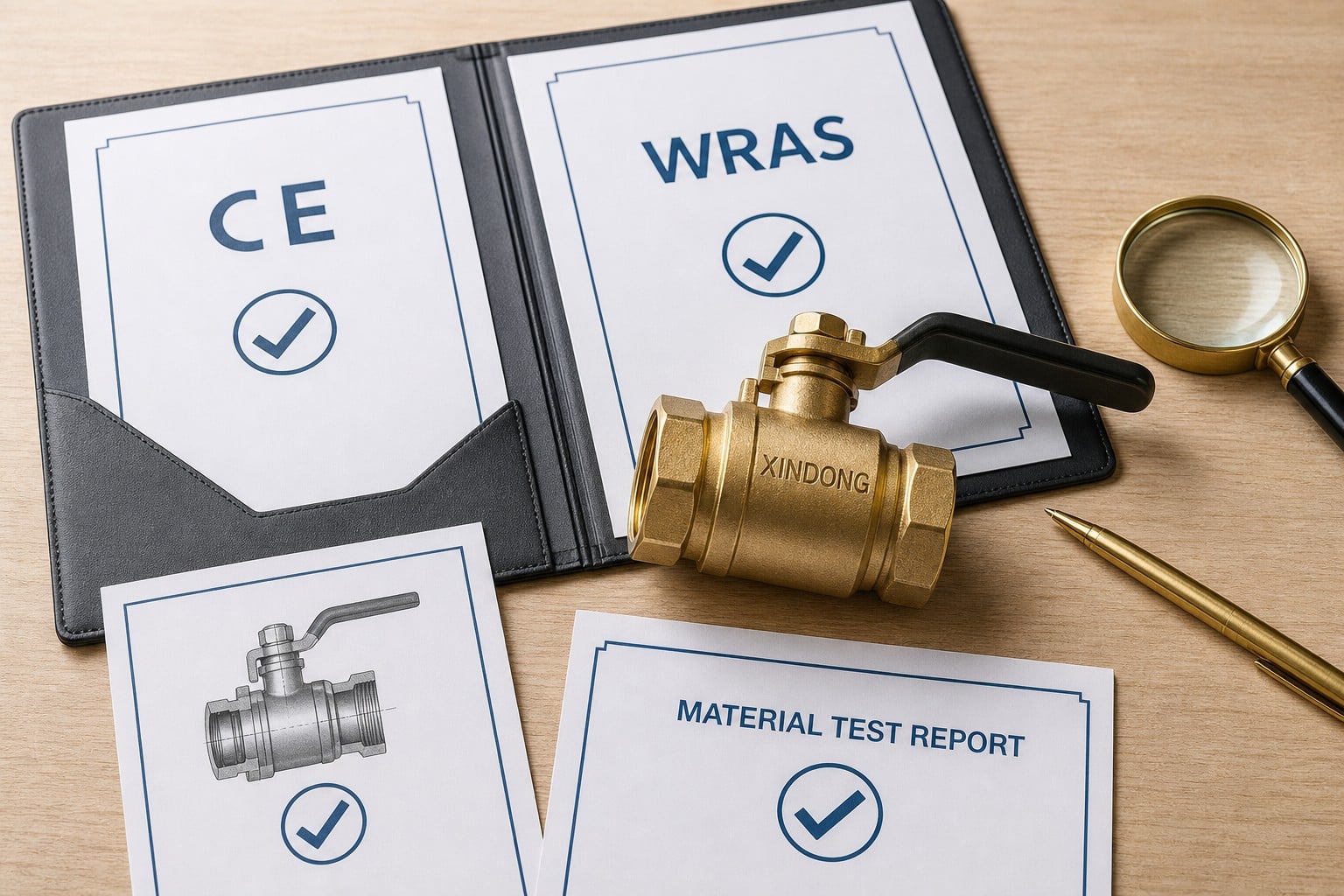
Ask most B2B buyers what they received with their last valve shipment and the answer is: a commercial invoice, a packing list, and a bill of lading. Ask what the next audit or regulator will demand, and the list grows into a compliance dossier the size of the valve itself.
The paperwork is part of the product. A valve that cannot be documented cannot be legally sold in many markets, cannot win a public tender, and cannot survive a liability claim. Here is the dossier a professional buyer should request — and how to check it rather than just file it.
1. Declaration of Conformity (DoC) / CE Declaration. For products placed on the EU/EEA market, the manufacturer's DoC states which EU directives and harmonized standards the product meets. Depending on the valve type and use, the relevant framework may be the Pressure Equipment Directive (PED 2014/68/EU), the Machinery Directive, or the Construction Products Regulation (CPR 305/2011) with its system of CE marking and Declaration of Performance (DoP). The DoC must name the directives, the standards applied (e.g., EN 1111, EN 1287 for thermostatic mixers; EN 331 for ball valves), the manufacturer's identity, and be signed by an authorized representative. A valid DoC is specific to a product family, not a blanket "we comply with EU rules" letter.
2. Product approvals and certificates. Market-specific schemes that actually carry enforcement teeth:
• WRAS approval (Water Regulations Advisory Scheme, UK) — confirms compliance with the UK Water Supply (Water Fittings) Regulations, including materials in contact with water. Check the certificate number against WRAS's online directory.
• ACS (Attestation de Conformité Sanitaire, France) — the French material-safety certification for products in contact with drinking water.
• NSF/ANSI 61 and NSF/ANSI 372 (North America) — drinking-water system components and lead-free compliance (≤0.25% lead in wetted surfaces).
• TMV2 / TMV3 scheme approvals (UK) — performance certification for thermostatic mixing valves; TMV3 is required in healthcare settings. These files include third-party test reports, not just a mark.
3. Material test reports (mill certificates / EN 10204 3.1 certificates). For brass bodies, request the material certificate proving the alloy — e.g., CW617N (standard forging brass) or CW602N (dezincification-resistant, DZR) per EN 12165 — and its actual chemical composition. Add lead-content declarations where relevant to NSF/ANSI 372 or EU Drinking Water Directive 2020/2184 requirements.
4. Pressure test certificates. Most reputable manufacturers pressure-test every valve body and completed assembly. Request the test certificate covering the test medium, pressure (typically 1.5× rated working pressure for hydrostatic body tests, and a separate seat/closure test), duration, and pass criteria, plus the batch or serial numbers tested.
5. Quality management certification. ISO 9001 certification of the manufacturing site is the baseline; add ISO 14001 (environment) where tenders require it. These are system audits — they confirm process control, not product compliance, so treat them as supporting evidence only.
6. Product technical file / datasheet. Dimensional drawings, flow characteristics, pressure-temperature ratings, materials list, spare parts list, and installation/commissioning instructions. For thermostatic products, include the temperature performance data and the commissioning procedure.
7. Batch traceability documents. For long-term contracts, require batch numbers on valves, cartons, and the packing list, plus a batch test record — traceability turns a one-off complaint into a quick root-cause investigation.
The Documentation Checklist at a Glance
| Document | What it proves | Red flags |
| CE DoC / DoP | Legal conformity with EU directives & standards | Generic wording, no standards listed, unsigned |
| WRAS / ACS / NSF certificates | Material safety & water regulations compliance | Number not verifiable on the issuing body's directory |
| TMV2/TMV3 approval file | Thermostatic performance under third-party test | No test report attached, claims without scheme name |
| EN 10204 3.1 material certificate | Actual alloy composition, DZR/lead compliance | "Typical" composition instead of batch analysis |
| Pressure test certificate | Body and seat integrity per batch | No test pressure/medium/duration stated |
| ISO 9001 | Site quality system | Certifying body not accredited (no IAF/UKAS mark) |
| Datasheet & drawings | Dimensional and performance truth | Missing pressure/temperature ratings |
| Batch traceability | Unit-level accountability | No batch numbers on goods or packing list |
Three verification steps separate a professional buyer from a paper collector:
1. Check certificate numbers online. WRAS maintains a searchable approval directory; NSF publishes certified product listings; CE DoCs reference standards you can look up. An approval that cannot be verified at the source is a printing exercise.
2. Ask for the test report behind the mark. "WRAS approved" should come with the approval schedule and product codes. "CE marked" should come with the DoC naming EN standards. If the supplier cannot produce the underlying document, the mark is decoration.
3. Inspect on arrival. Spot-check one or two units from each batch: verify the engraved/printed batch code matches the packing list, confirm marking (manufacturer name, standard references, pressure/temperature ratings) on the valve body, and compare the actual material to the certificate. If you run random third-party material testing on brass (spectrometric analysis is inexpensive), you have a compliance program, not a hope.
Put documentation obligations in the purchase contract, not a friendly email: the dossier is due with the shipping documents; certificate re-issuance for customs must be provided within an agreed window; and the supplier must notify you of any material or process change affecting compliance, with the right to re-verify at your cost. Add a clause requiring approvals to be maintained for the duration of the agreement — a lapsed WRAS/ACS/NSF approval mid-contract is a supply-chain risk you did not price.
A compliance dossier is cheap to request and expensive to miss. The documents — CE DoC, WRAS/ACS/NSF approvals, material test reports, pressure test certificates, and batch traceability — prove that the valve you bought is the valve that was tested, and the valve that was tested is the valve on the wall. Verify every number, put the obligations in the contract, and the paperwork becomes your best defense in audits, customs, and claims.
Zhejiang Xindong Sanitary Ware Co., Ltd. manufactures WRAS, ACS, and NSF/Lead-free certified brass valves, faucets, and thermostatic mixing valves (including TMV2/TMV3-approval models) in a 30,000 m² facility with in-house laboratories, CNC machining, and full pressure testing of every assembly. Xindong provides complete export dossiers — material certificates, pressure test records, DoCs, and approval files — with batch traceability for OEM/ODM customers. To request a sample documentation package, contact us at [www.cn-xindong.com](https://www.cn-xindong.com).
 Hot News
2026-10-17
2026-10-16
2026-10-15
2026-10-14
2026-10-13
2026-10-12

The company, founded in 1999 and located in Yuhuan,specializes in taps, thermostatic shower valves and shower kits. With over 30,000 sqm of space and 380+ employees, we hold numerous certifications and 65+ patents.
 EN
EN