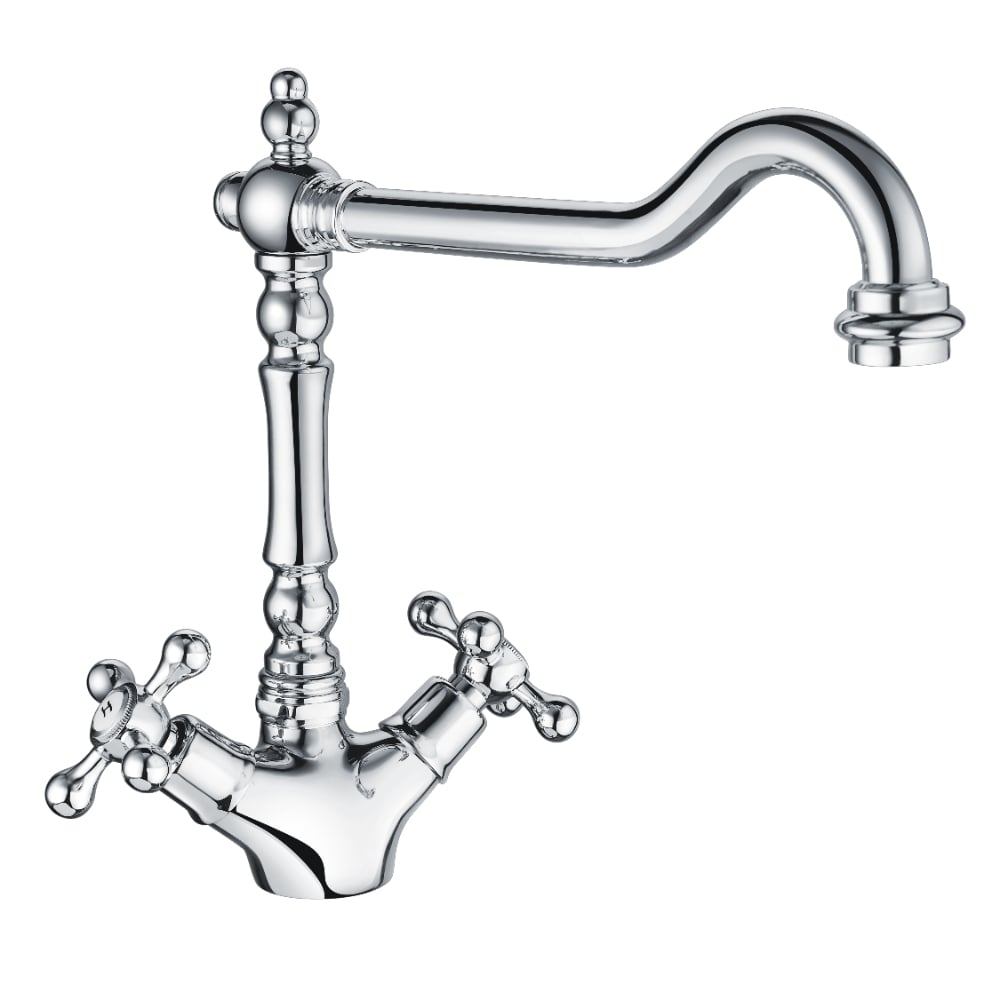
A basin mixer rarely lands on a vanity alone. Beside it sit a soap dispenser, a lotion pump, a filtered-water spout. When those items are specified late — after the top has been templated and the brassware ordered — the deck becomes a negotiation rather than a plan. The expensive mistakes are almost never about style. They are about millimetres, pump chemistry, and who refills the bottle at seven in the morning.
Every hole drilled into stone removes material and creates a stress riser. Six holes in a 600 mm top is not automatically wrong, but each one needs a purpose and a landing zone: mixer, dispenser, waste, and whatever else the client has seen on social media and now cannot live without.
· Deck service · Typical hole diameter · Watch out for ·
|---|---|---|
· Monobloc basin mixer · 35 mm · Tail pipes and fixing nut need clearance below deck ·
· Bottle-down soap dispenser · 25–32 mm · Body shank often needs 28 mm minimum ·
· Pump head with remote reservoir · 22–28 mm · Suction tube must not kink on the cabinet shelf ·
· Pop-up waste rod · 30–35 mm · Rod arc fouls the mixer body if set behind it ·
· Deck hand shower · 25–30 mm · Needs a flat landing of at least 45 mm ·
Two rules save most callbacks: keep at least 60 mm of solid material between hole edges — 80–100 mm on thin or veined stone — and keep every hole 50 mm from the front and side edges so the fabricator can polish without chipping. If the numbers do not fit, remove a service; do not shrink the gaps.
The two architectural families behave differently in service, and the difference is operational rather than aesthetic.
A bottle-down unit screws a sealed cartridge bottle directly under the deck, usually 200–300 ml. Installation is quick, there is no suction tube to route, and the soap never contacts the cabinet. The trade-off is capacity: in a busy washroom the bottle is changed weekly, and whoever changes it must reach past the trap.
A pump head with remote reservoir uses a suction tube down to a 500 ml–1 litre container, or to a bulk tank in the vanity. Capacity is better and the refill point can be moved to the front of the cabinet. But tube length, tube internal diameter and the vertical lift all affect priming. A 6 mm tube drawing soap 400 mm upward will cavitate and lose prime; a 9–10 mm tube on the same lift behaves far better. Specify the tube route, not just the dispenser.
Most piston pump chambers are calibrated for liquids in the 1,000–3,500 mPa·s range. Typical liquid hand soap sits comfortably inside that band. Thick lotions, aloe gels and some "natural" formulations run above 8,000 mPa·s and will either dispense a thin ribbon or refuse to return.
The site fix is usually dilution, and it is a bad fix: diluted soap loses preservative efficacy, supports bacterial growth in the reservoir, and the extra moisture attacks the pump from inside. If the soap is too thick, move to a lotion-duty pump with a larger chamber, or specify a foam pump — a different mechanism entirely, not a drop-in swap.
Note two fluids in the specification: high-alcohol sanitiser swells many elastomers, so confirm seals with the pump supplier; abrasive scrub particles score the pump cylinder within months.
Brass pump bodies are usually chrome- or nickel-plated over a free-machining brass. Soap residue is mildly alkaline and carries chloride from water and from the soap itself. Left standing in the pump chamber between shifts, that film is enough to attack a 304 stainless spring and to stain plating at the threads.
Three practical countermeasures:
Be precise about what standards cover. EN 817 addresses mechanical performance of single-lever mixers and includes an acoustic group for certain classes; EN 200 covers tapware generally. Neither certifies a soap dispenser. WRAS approval concerns the water fittings themselves, BS EN 806-2 gives installation guidance, and EN 1717 addresses backflow protection — relevant to hose-attached outlets, not to a soap pump. Dispenser durability is a materials question you must specify directly.
The reference point for everything on the deck is the basin centre line, not the cabinet centre line — they are rarely the same, and the sink is what the user's eye and hand follow.
Set the mixer on the centre line. Set the dispenser 80–120 mm to one side, measured centre to centre, on the side matching the dominant hand of the main user group. Then check three clearances before the top is drilled: the pump spout must discharge inside the bowl, not onto the deck rim; the pump head must clear the mirror or shelf by at least 200 mm so a hand fits underneath; and the pop-up rod, if fitted, must not sit in the arc between mixer and dispenser.
On a vessel basin the pump spout must clear the rim, which pushes the dispenser to 120–140 mm from the mixer. Draw it in plan and elevation at 1:5 before templating.
Get those lines right and the deck stops being a source of variation between one installation and the next. The mixer, after all, is the part everyone photographs; the dispenser is the part everyone touches twenty times a day.
Zhejiang Xindong Sanitary Ware Co., Ltd. is a brass basin mixer manufacturer based in Yuhuan, Zhejiang, producing OEM and ODM brass basin mixers (T749002, T713002, T8802, T7502, T7102) and the wall-mounted basin mixer T730022 for sanitary ware brands, distributors and project specifiers. For drawings, deck-hole data or dispenser pairing advice, contact [email protected] or +86-0576-87499008.
 Hot News
2026-11-16
2026-11-11
2026-11-10
2026-11-09
2026-11-08
2026-11-07

The company, founded in 1999 and located in Yuhuan,specializes in taps, thermostatic shower valves and shower kits. With over 30,000 sqm of space and 380+ employees, we hold numerous certifications and 65+ patents.
 EN