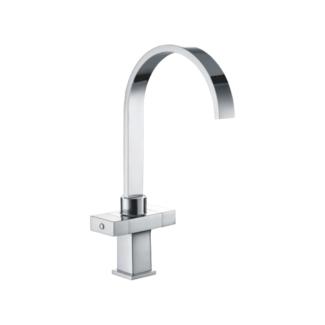
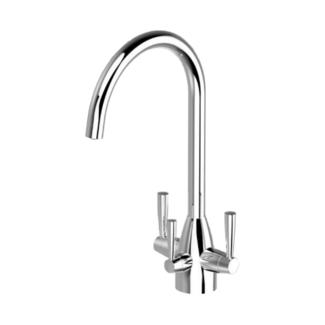
A three-way tap looks like a kitchen mixer until you count the handles. One spout, one column, but three water sources feeding it: mains cold, hot, and a third line that might be filtered ambient, chilled, or near-boiling from an under-sink tank. The appeal is obvious: one hole in the worktop instead of three, and filtered water without a second tap cluttering the sink.
The engineering is where projects fall apart, and most field failures are specification failures, not cartridge failures: a diverter sized for the wrong pressure, a filtered line sharing a check valve with a boiling tank, a body that will not fit the tank's outlet height.
A three-way tap is two cartridges stacked in one column, not one clever cartridge doing everything.
The lower cartridge is a conventional mixing cartridge — usually 35 mm or 40 mm ceramic disc — handling hot and cold through the two side inlets. Above it sits a separate diverter cartridge, typically 30 mm, with its own rotating ceramic plate. That plate carries a machined channel connecting the third inlet to the common outlet when you turn the collar or secondary handle, and blanks it off when you turn back.
Because the functions are mechanically independent, the diverter works while the mixer runs: fill a pan with hot water, then twist for filtered without disturbing the temperature setting. Combining both in a single disc hits a hard limit — the port geometry crowds, and cross-leakage between filtered and hot becomes real at 3 bar.
Two details separate a good body from a cheap one. The diverter should seat on a machined shoulder with an O-ring, not a pressed-in sleeve; sleeves creep under thermal cycling and weep at the collar within a year. And the third inlet should be an isolated gallery drilled through the body, not a tube brazed on afterwards.
The tap is the interface; the performance the user judges you on comes from what is under the sink, and the two must match.
Carbon block suits chlorine, taste and odour, with low pressure drop on a 1/4" or 3/8" line. Reverse osmosis gives the lowest TDS but produces wastewater and needs storage, so the tap must tolerate an accumulator. Boiling or chilled tanks are the third case: water stored at 98 °C or 4 °C delivered through the same spout, which changes backflow, insulation and pressure rating entirely.
Wetted materials on that gallery must be declared. NSF/ANSI 61 covers health effects of components in contact with drinking water; NSF/ANSI 372 covers lead in wetted surfaces. In the UK, WRAS approval is what merchants and municipal specifiers ask for — and it is product-level, not company-level. A WRAS-approved cartridge does not make the tap approved. Confirm the certificate lists the actual model and finish.
Flow rate is the second mismatch. A filtered line pushing through 1/4" tube at 0.5 bar feels weak beside the mains side, and consumers read weak as "the filter is broken." Ask the tank supplier for delivered flow at your minimum inlet pressure, then size the outlet to it. A restricted aerator on the filtered gallery is normal; a restricted one on the hot gallery is a complaint waiting to happen.
Every three-way tap connects a potable line to something else — a filter housing, a chiller, a boiling tank with an expansion vessel. EN 1717 governs how that connection is protected, working by fluid category. Category 1 is wholesome water, category 2 carries no significant health risk, 3 is moderate risk, 4 significant, 5 serious risk from a pathogenic or toxic source.
A plain carbon filter downstream of a tap is generally category 2. A boiling tank with a metal element and stagnant storage drifts toward 3. A chiller with a coil immersed in a bath can reach 4 or 5. Protection must match the category and sit at the right point in the circuit.
In practice: the tap should carry an integrated non-return valve on the third inlet — and on hot and cold in better designs — so a mains pressure drop cannot siphon tank water backwards. The tank or filter needs its own device upstream, sized to the assessed category. And avoid dead legs; 300 mm of stagnant loop between tank and spout is a biofilm reservoir regardless of what the valve does.
For boiling water, the thermal case matters as much as the hydraulic one. The body must be rated well above tank output with margin, and the spout must not deliver above the safe temperature the market requires. EN 1111 is the reference for thermostatic mixing performance where a thermostatic element limits delivery; where the design relies on a plain mixing cartridge that standard does not apply and the safety case rests on the tank's controls. Be precise about which architecture you sell, because buyers increasingly are.
Check |
Why it matters |
Typical answer |
Worktop hole diameter |
Must clear thread and locating collar |
35 mm |
Max bench thickness |
Limits clamp travel |
40 mm, 50 mm long-thread |
Under-sink headroom |
Tank outlet and hose bend |
450 mm, more for boilers |
Third-line connection |
Push-fit size, orientation |
1/4" or 3/8", rear entry |
Min dynamic pressure |
Filtered flow collapses below it |
1.0 bar mixed, 0.5 bar filtered |
Backflow category |
Sets valve type and location |
Assess per EN 1717 |
Body temperature rating |
Boiling tanks push limits |
90 °C continuous |
Certification scope |
Model and finish, not company |
WRAS, NSF/ANSI 61, 372 |
Two checks get skipped most: bench thickness on stone worktops, where a 30 mm slab plus substrate can exceed a standard thread, and hose routing — a pull-out hose and a 3/8" line competing for the same 60 mm gap behind the cabinet is a return, not an installation.
For private-label ranges, fix the cartridge platform first — one mixer and one diverter cartridge from a qualified source — then vary shell, finish and handle around it. The certification dossier stays stable as the range expands, and a spare cartridge in year three is a stock item, not a special order.
Zhejiang Xindong Sanitary Ware Co., Ltd. makes brass basin mixers and kitchen mixer taps, including diverter-body and pull-out platforms, at its plant in Yuhuan, Zhejiang, and works with OEM and ODM customers on cartridge selection, finish specification and certification documentation.
Zhejiang Xindong Sanitary Ware Co., Ltd.
Yuhuan, Zhejiang, China
Email: [email protected]
Tel: +86-0576-87499008
Web: https://www.cn-xindong.com
 Hot News
2026-11-07
2026-11-06
2026-11-05
2026-11-04
2026-11-03
2026-11-02

The company, founded in 1999 and located in Yuhuan,specializes in taps, thermostatic shower valves and shower kits. With over 30,000 sqm of space and 380+ employees, we hold numerous certifications and 65+ patents.
 EN