**By the Technical Sales Team, Zhejiang Xindong Sanitary Ware Co., Ltd.**
Three numbers decide whether a basin works: how high the outlet sits above the mounting surface, how far it projects, and where the stream lands. Get them wrong and you get a permanent wet patch on the countertop and a complaint you cannot fix without a new tap.
The trap: these numbers are chosen at three different times by three different people — basin from one catalogue, tap from another, countertop drilled on site. Here is the geometry in the form an installer or specifier can apply.
**Spout height** is the vertical distance from the base of the tap — that is, the mounting surface — to the underside of the outlet. It is not overall tap height, nor height above the basin rim. Datasheets quoting only "total height" are useless here, because the body above the outlet varies enormously between designs.
**Reach**, or projection, is the horizontal distance from the centre of the tap body to the centre of the outlet. On a deck-mounted mixer it is measured from the tap hole; on a wall-mounted one, from the finished wall face — which is why the two are not interchangeable.
**Outlet angle** is the direction water leaves the spout: a near-vertical discharge drops, a forward-angled one throws. Most basin spouts angle slightly downward and forward; the aerator corrects the rest.
The governing variable is the height of the bowl above the mounting surface, plus the bowl's internal depth.
Basin Type |
Bowl Height Above Deck |
Spout Height |
Reach |
Cloakroom / small inset basin |
0 mm (inset) |
80–110 mm |
90–120 mm |
Standard inset countertop basin |
0 mm (inset) |
100–140 mm |
110–140 mm |
Semi-recessed |
0 mm, shallow bowl |
100–130 mm |
100–130 mm |
Vessel / countertop bowl |
100–160 mm |
220–300 mm |
130–180 mm |
Deep vessel bowl |
160 mm+ |
280–350 mm |
150–200 mm |
Two rules sit under the table. First, the outlet must clear the bowl rim by a working margin — 25 mm is the usual minimum and the figure that keeps it above spillover level for backflow. Second, it must not sit so high that falling water gains speed: a 300 mm drop into a shallow bowl splashes however good the aerator is.
For a vessel basin the arithmetic is additive: bowl height plus rim clearance plus a hand-washing gap. A 140 mm bowl needs an outlet at roughly 240–260 mm above the counter. That is why tall mixers are a distinct product family, not a styling variant.
Height gets the water over the rim. Reach decides whether it stays in the bowl.
The working rule: the stream should land between one-third and one-half of the way across the basin from the back edge, and never closer than 75–100 mm to the front rim. Land it too far back and the water runs down the back of the bowl and pools at the deck; land it too far forward and every hand-wash splashes over the front edge.
On an inset basin this is simple: the ceramic sets the tap hole. On a drilled countertop or wall-mounted installation it is a design decision and should be drawn, not guessed. Before drilling, hold the tap in position, run it at normal flow and watch where the stream strikes — aerated streams behave differently from open ones.
Reach also has an accessibility dimension: on assisted or wheelchair-accessible basins the lever must be operable with a closed fist without leaning over the bowl. Longer reach plus a forward-set lever solves that; a short spout on a deep bowl does not.
Splash is a function of impact velocity, discharge angle and the distance between impact point and bowl wall.
**Aeration** is the primary control. An aerator mixes air into the stream, softening impact and widening the pattern so it lands as a dome rather than a needle. It is specified under **EN 246** and is replaceable — a badly chosen aerator is a five-minute fix, not a new tap.
**Flow rate** is the second. At 12 l/min into a shallow cloakroom bowl, splash is inevitable; at 5–6 l/min it is manageable. On a low-flow project, select tap and basin together: a 5 l/min stream landing 250 mm below the outlet looks weak, and users compensate by opening the lever fully.
**Distance** is the third: every extra millimetre of drop adds velocity, which is the hidden cost of an over-tall spout.
**Bowl shape** is the fourth. A shallow, flat-bottomed vessel with near-vertical walls throws water back out; a deep curved bowl contains it. Two basins of the same footprint behave completely differently.
Backflow protection under **EN 1717** depends on the outlet staying above the basin's spillover level. A spout that dips into the bowl, or sits below the rim, creates a risk category the installation was never designed for. With **EN 817** for the mixing function, **WRAS** in the UK, **KIWA** in the Netherlands and Belgium, **NSF/ANSI 61 and 372** in North America and **WaterMark** in Australia, geometry is a compliance issue, not an aesthetic one. NSF/ANSI 372 sets the lead limit for wetted brass, so the alloy matters as much as the shape.
Is spout height measured from the finished surface, or from the substrate?
Does the outlet clear the bowl rim by at least 25 mm?
Does the stream land one-third to one-half across the bowl, at least 75 mm from the front rim?
Is the aerator specified by flow class, and is a replacement available?
Does the lever operate with a closed fist without leaning over the bowl?
Is the outlet above spillover level with the basin full?
Has the tap been test-run in position before the countertop is drilled?
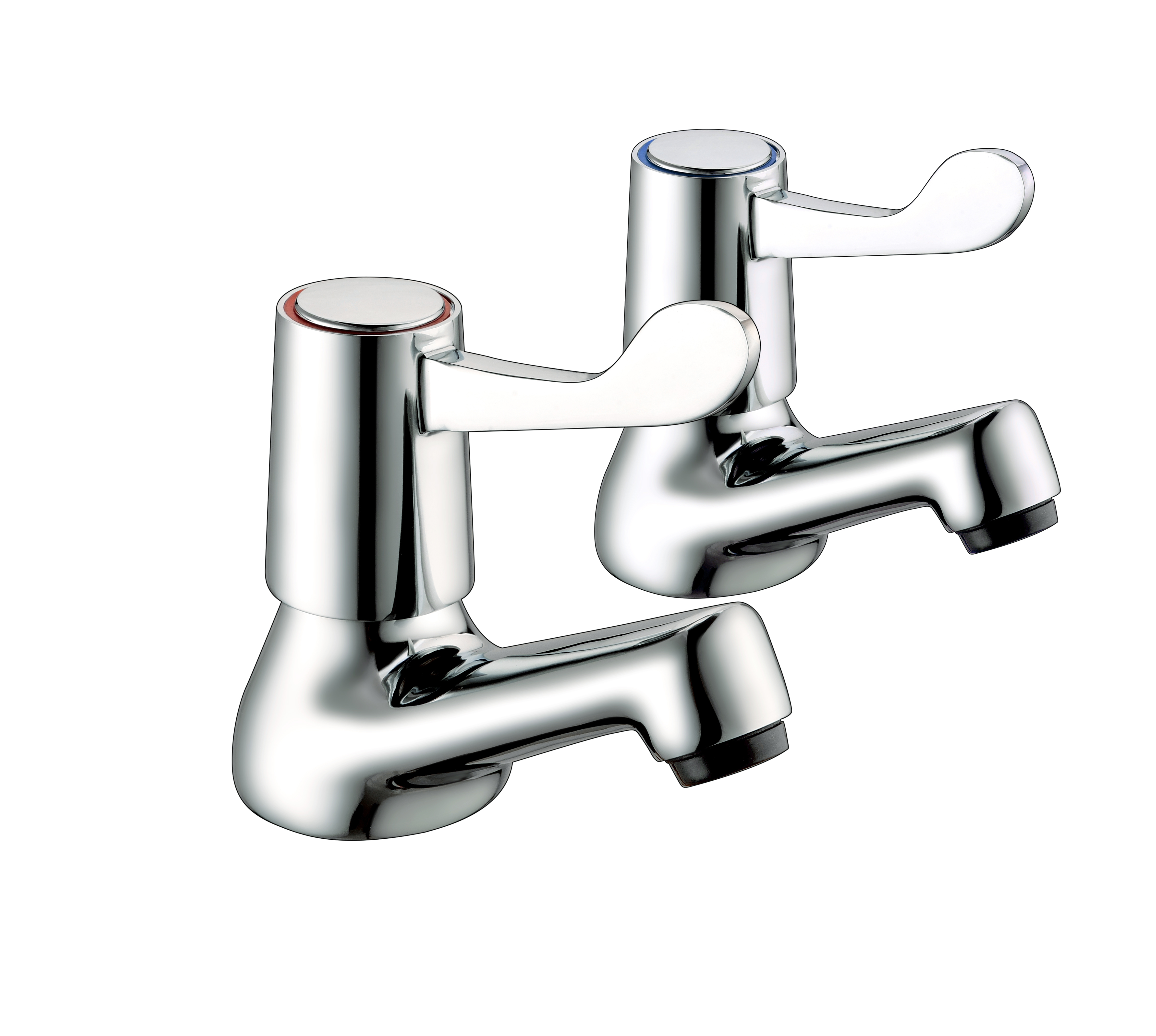
Xindong's brass basin mono mixers — T749002, T713002, T8802 and T7502 at standard heights, T7102 as a taller body for vessel basins — share one 35 mm cartridge and aerator family, so a project can mix deck heights without doubling spares. T730022 applies the same geometry to a wall-mounted installation.
**How to know you got it right:** run the tap at full flow over a dry countertop for thirty seconds. If the deck is still dry and the water lands where you designed it to land, the geometry is correct.
*Zhejiang Xindong Sanitary Ware Co., Ltd. manufactures brass basin mixers for importers, distributors, specifiers and installers. Dimensioned drawings and aerator flow data for individual models are available on request.*
 Hot News
2026-10-22
2026-10-21
2026-10-20
2026-10-18
2026-10-17
2026-10-16

The company, founded in 1999 and located in Yuhuan,specializes in taps, thermostatic shower valves and shower kits. With over 30,000 sqm of space and 380+ employees, we hold numerous certifications and 65+ patents.
 EN