Domestic hot-water design lives between two conflicting requirements. Store water hot enough to suppress Legionella growth — 60°C or higher in most guidance — yet deliver it to a shower or basin at no more than 48–49°C to prevent scalding. The thermostatic mixing valve (TMV) exists precisely to reconcile this conflict, and its correct integration with the water heater type determines whether the system is safe, efficient, and code-compliant.
For MEP engineers, plumbers, and facility managers, the integration question is not "which valve" but "which valve, where, and sized for what." Here is a practical guide across the three mainstream heater technologies.
A thermostatic mixing valve blends hot and cold water and holds the blended outlet temperature constant, compensating for supply temperature and pressure fluctuations. Internally, a wax or shape-memory element modulates the hot/cold ratio. Quality valves — those certified to schemes like TMV2 or TMV3 in the UK, or ASSE 1017/1016 in North America — add check valves and strainers on both inlets and, in the case of TMV3, are designed for healthcare-grade applications with fail-safe cold-water failure behavior.
That last point matters: in a compliant thermostatic valve, loss of the cold supply forces the valve closed to prevent scalding. This safety function is why TMVs must be specified, not substituted with a cheaper non-thermostatic mixer.
Storage systems are the most straightforward integration. The heater stores water at 60–65°C for Legionella control; the TMV is installed on the outlet of the heater or at the point of use to deliver 43–49°C.
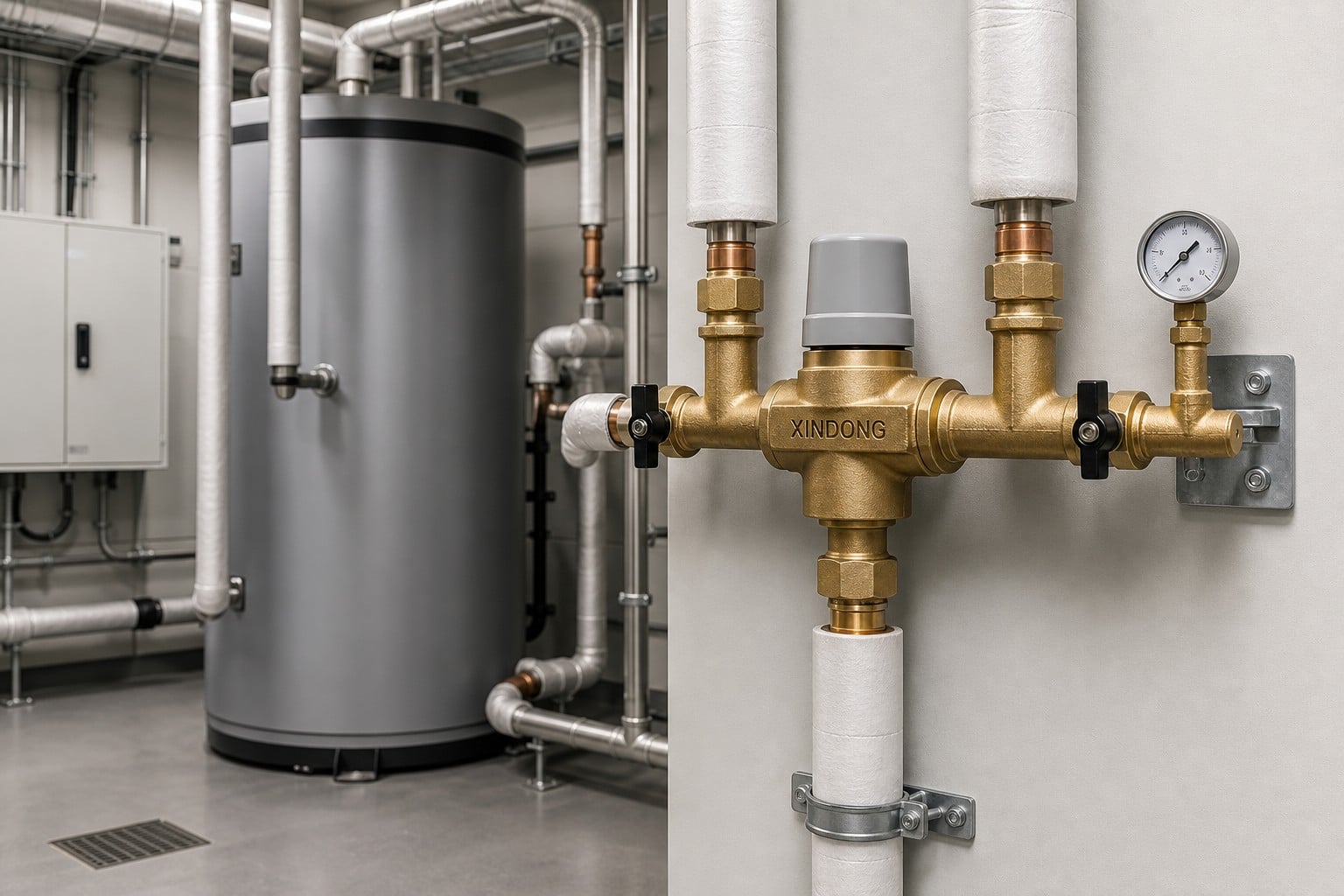
Central TMV on the heater outlet — the most common commercial arrangement. One valve protects the entire distribution network. Locate it immediately downstream of the heater, with an accessible service union and isolation valves on both sides, and leave the recommended straight pipe run on the hot inlet (usually 5–10 pipe diameters) to avoid turbulence that disturbs blending.
Point-of-use TMVs — used for showers, patient rooms, and basins where individual temperature control is required or where long distribution runs make a central valve impractical. In hotels and healthcare, hybrid designs (central blending plus point-of-use TMV3 protection at showers) are common and recommended.
Recirculation loops. If the system includes a hot-water return line, the return must connect back to the heater or a return manifold — never through the TMV's cold inlet. A recirculating pump pulling blended water back into the tank can create temperature stratification and false blending. Install check valves on both heater connections and, where return temperatures must be maintained, add a separate circulation TMV sized for the return flow.
Tankless heaters change the rules in three ways:
1. Minimum activation flow. Condensing tankless units fire only above a minimum flow threshold (often 3–6 L/min). A downstream TMV's internal resistance can push the blended draw below that threshold, causing the burner to cycle or drop out mid-shower. Size piping and the TMV generously, and confirm the combination's pressure drop against the heater's activation curve.
2. Flow-rate rating. Tankless heaters are rated by temperature rise at a given flow. The TMV must handle the heater's full output flow at the coldest inlet condition without excessive pressure drop — undersizing starves the shower and defeats the heater's purpose.
3. Outlet temperature modulation. Modern modulating tankless units deliver near-constant outlet temperature, but they cannot react instantly to draw changes. The TMV downstream absorbs the residual overshoot — a 2–3°C safety buffer that also prevents the heater's max-temperature setting from reaching the user.
Practical rule: install the TMV as close to the heater as possible on the mixed-water side, never between the heater and its cold inlet, and never mount it where the heater's condensate or flue gases can reach the valve body.
Heat-pump water heaters (HPWHs) store water at lower temperatures — typically 50–60°C, and often set lower for efficiency. Two implications:
• Reduced blending headroom. Delivering 48°C from a tank stored at 50°C leaves almost no temperature differential for the TMV to regulate against. The valve may hunt or fail to hold temperature under draw. Specify a TMV with a low minimum hot-inlet temperature (many require a minimum hot inlet of 55°C or state the minimum differential explicitly), and set the HPWH's storage setpoint accordingly — most manufacturers publish a "TMV-compatible" minimum.
• Legionella control. The efficiency case for storing at 45–50°C collides with Legionella guidance. Standard practice is to retain a periodic pasteurization cycle (weekly or per local code, raising storage to 60°C+), which the TMV downstream makes safe for occupants. Verify the TMV's maximum hot-inlet rating exceeds the pasteurization temperature.
Heat-pump systems also typically run at lower flow pressures; confirm the TMV's minimum working pressure (most require 1–3 bar) is met at peak simultaneous draw, or add a small booster.
| System type | Sizing basis | Typical TMV location | Notes |
| Storage tank, central | Peak simultaneous blended flow (fixture units or diversity) | Heater outlet, after isolation valves | Allow straight pipe run on hot inlet; add circulation TMV if return loop exists |
| Storage tank, point of use | Individual fixture flow (shower: 8–12 L/min typical) | At the fixture group | TMV3/ASSE 1016 for healthcare |
| Tankless | Heater rated output flow at design temperature rise | Immediately downstream of heater | Verify minimum-activation flow and pressure drop |
| Heat pump | Peak blended flow; verify low hot-inlet range | Heater outlet | Check pasteurization-cycle compatibility |
| Recirculation | Return loop flow rate | Return manifold / heater return | Never route blended water through cold inlet |
Specify a valve with integral check valves and strainers (they are required in TMV2/TMV3 schemes), and record the commissioning test — outlet temperature at max and min draw, and cold-water-failure shutoff — in the handover documentation.
The water heater type defines the TMV's sizing basis, location, and selection constraints. Storage systems need correct placement and loop hygiene; tankless systems need flow and activation compatibility; heat-pump systems need low-temperature regulation headroom and pasteurization tolerance. Get those three right, and the TMV quietly does its job for decades.
Zhejiang Xindong Sanitary Ware Co., Ltd. manufactures brass thermostatic mixing valves and thermostatic shower systems, including models produced to TMV2 and TMV3 certification requirements, with integral check valves, strainers, and DZR brass bodies. Xindong's engineering team supports OEM customers with valve sizing, integration drawings, and commissioning documentation. For sizing worksheets and product datasheets, contact us at [www.cn-xindong.com](https://www.cn-xindong.com).
 Hot News
2026-10-17
2026-10-16
2026-10-15
2026-10-14
2026-10-13
2026-10-12

The company, founded in 1999 and located in Yuhuan,specializes in taps, thermostatic shower valves and shower kits. With over 30,000 sqm of space and 380+ employees, we hold numerous certifications and 65+ patents.
 EN
EN