Every facility manager knows the failure mode: a thermostatic shower valve that suddenly delivers lukewarm water, a cartridge that screeches when turned, or a check valve that rattles until a water hammer event finishes it off. What most teams do not realize is that these failures were scheduled months earlier — the day limescale was allowed to accumulate on a thermostatic element.
In commercial buildings, descaling is not cosmetic maintenance. It is the difference between a brass valve that serves 15 years and one that is rebuilt every 24 months. For procurement teams and MEP engineers specifying long-term supply contracts, the maintenance program is as important as the valve specification itself.
Hard water contains dissolved calcium and magnesium bicarbonates. When water is heated — or simply held in a valve body — these salts precipitate onto brass, ceramic, and wax-element surfaces. The effects compound:
• Thermostatic elements lose stroke. A wax element in a thermostatic mixing valve (TMV) expands to modulate flow. A 1 mm layer of scale insulates the element, delays response, and reduces stroke, so outlet temperature drifts and recovery time lengthens.
• Cartridge seals and ceramics wear faster. Scale acts as an abrasive slurry between ceramic discs, scoring the lapped faces that make a quarter-turn cartridge drip-free.
• Flow paths narrow. Scale buildup in valve ports and strainers reduces flow rate, raising outlet temperatures in mixers and increasing pump energy.
• Check valves stick. A stuck check valve on a hot-water inlet is a cross-connection risk, not just a nuisance.
The economic case is simple: a replacement thermostatic element or cartridge typically costs 5–15% of the valve's price. Replacing a failed valve in an occupied hotel bathroom costs several times the valve price once labor, downtime, and guest disruption are counted. Preventative descaling exists to spend the small number and avoid the large one.
Scale accumulation rate depends on water hardness, temperature, and flow. Rather than guessing, set intervals by risk tier and verify with inspection:
| Application | Water hardness | Recommended inspection | Descaling trigger |
| Hotels, spas, healthcare (high duty) | Hard (180 ppm CaCO₃) | Every 6 months | Scale visible on strainer or element; outlet temperature drift 2°C |
| Hotels, spas, healthcare | Soft–moderate | Every 12 months | Annually as standard |
| Office/retail washrooms | Any | Every 12–24 months | On complaint, or at planned shutdown |
| Plant rooms (TMVs on hot-water distribution) | Any | Every 12 months | Pressure/flow drop or temperature drift |
| Emergency/safety showers | Any | Per local code (often monthly/weekly) | Per code — descale at every inspection |
Document every inspection in a logbook with photos. The logbook is also your evidence base for warranty discussions — most valve warranty exclusions cite limescale damage, and a documented program is the difference between a covered claim and a contested one.
Cleaning method choice decides whether you extend or shorten valve life:
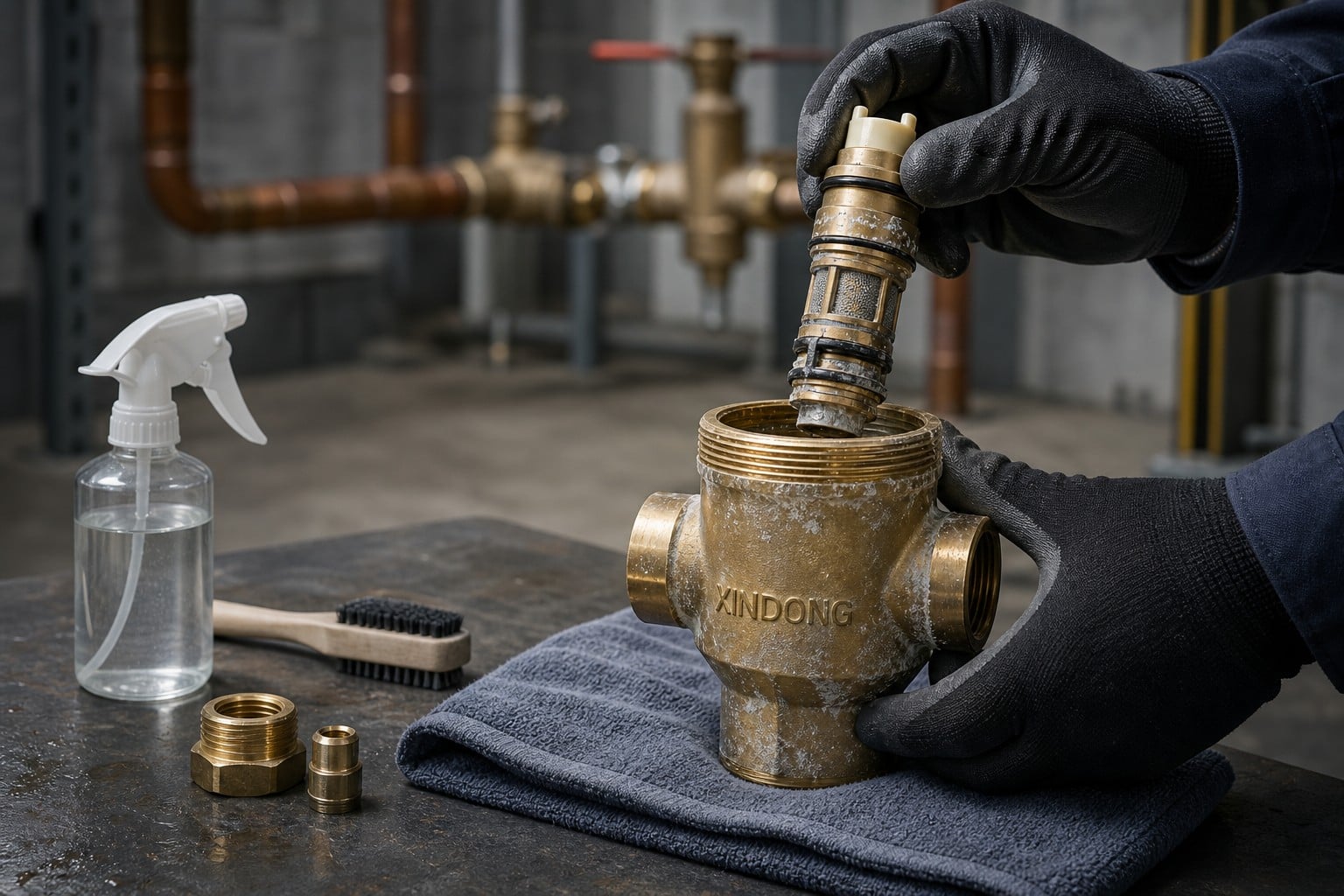
Chemical descaling (preferred for thermostatic elements and cartridges). Remove the element or cartridge, immerse in a food-grade citric acid or proprietary descaler solution diluted per manufacturer instructions (typically 5–10% for citric acid). Soak 15–30 minutes, then rinse thoroughly in clean water. Citric acid is far safer for brass, EPDM, and PPS components than hydrochloric-acid-based descalers, which can attack dezincification-resistant alloys and damage elastomer seals.
Mechanical cleaning (for strainers, filter housings, and valve bodies). Use soft nylon brushes, brass or wooden scrapers — never steel wire brushes or abrasive pads on sealing faces. Deburr any nicked surfaces. For ceramic disc cartridges, replace rather than attempt face lapping; the discs are precision-matched pairs.
Ultrasonic cleaning (for rebuild shops). Effective for complex cartridge internals, but verify fluid compatibility with elastomers and do not use for wax elements — sustained ultrasonic energy can degrade the wax blend.
Do not: use muriatic acid on brass; soak assembled valves with mixed materials; over-tighten on reassembly; or lubricate ceramic discs with anything other than the manufacturer's approved grease (silicone-free, water-grade).
Thermostatic elements are the most failure-prone and most expensive component in a TMV. They are also the easiest to protect:
1. Always fit the supplied strainers and clean them at every inspection — debris, not scale, is the leading cause of element failure.
2. Never immerse a wax element in boiling water or steam; thermal shock degrades the wax response curve.
3. Mark the element's position before removal so reinstallation preserves the original temperature calibration.
4. Replace elements on a schedule tied to the logbook, not only on failure. At 8–10 years in hard-water duty, proactive replacement is cheaper than emergency callouts.
5. Where a facility runs a rebuild program, stock genuine elements, seal kits, and complete cartridges matched to the valve model — mixing components across manufacturers voids performance and compliance claims.
A descaling program that cannot be measured cannot be defended at budget time. Track four numbers per site:
• Mean time between failures (MTBF) of thermostatic and cartridge components — trend it upward.
• Outlet temperature stability — measured at peak draw; drift beyond ±2°C signals descaling or element replacement is due.
• Leak rate on the annual pressure test — a rising baseline means seal degradation, not bad luck.
• Maintenance cost per valve per year — should fall after the first two cycles as failures are prevented rather than reacted to.
Preventative descaling is a scheduled, documented, and measurable discipline. Combined with genuine spare parts, gentle chemical cleaning, and element handling care, it routinely doubles the service life of commercial valves, cartridges, and thermostatic elements — and it turns the maintenance department from a cost center into the reason the building's hot-water system keeps performing.
Zhejiang Xindong Sanitary Ware Co., Ltd. has manufactured brass valves, faucets, and thermostatic shower systems since 1999, with 65+ patents and in-house pressure testing in a 30,000 m² facility. Xindong supports OEM/ODM customers with documented spare-part programs, service manuals, and cartridge/element replacement programs for thermostatic valves. For maintenance program templates, spares lists, or valve datasheets, contact us at [www.cn-xindong.com](https://www.cn-xindong.com).
 Hot News
2026-10-17
2026-10-16
2026-10-15
2026-10-14
2026-10-13
2026-10-12

The company, founded in 1999 and located in Yuhuan,specializes in taps, thermostatic shower valves and shower kits. With over 30,000 sqm of space and 380+ employees, we hold numerous certifications and 65+ patents.
 EN
EN