Hotel developers, hospitality fit-out contractors, and FF&E procurement managers regularly face the same specification decision: which shower valve type should be installed across a hotel's guest bathrooms? The answer has direct implications for guest safety, operational maintenance costs, and the long-term reputation of the property. This article provides a clear technical comparison to support that decision.
A pressure-balancing valve monitors and maintains the ratio between hot and cold water supply pressures. When cold water pressure drops—for example, when a toilet is flushed on the same supply line—the valve mechanically shifts its internal spool or diaphragm to proportionally reduce hot water flow, keeping the temperature ratio approximately constant. However, it does not measure or control the actual water temperature: if the boiler delivers hotter water, the user will feel this change and must manually adjust the lever.
A thermostatic valve directly measures water temperature using a thermal actuator—typically a wax-filled element or a bi-metallic strip. The element expands or contracts in response to actual water temperature and adjusts the blending of hot and cold supply within milliseconds to maintain the user's pre-set temperature regardless of pressure or supply temperature fluctuations. This is a fundamentally more precise form of temperature control.
In a hotel with 200 rooms connected to a shared hot water riser, simultaneous demand at peak morning hours creates both pressure and temperature variation across the system. A pressure-balancing valve cannot compensate for temperature variation caused by the boiler cycling or distant rooms drawing heavily from the hot supply. Guests in rooms at the top of a high-rise building may experience noticeably cooler water during peak demand. A thermostatic valve eliminates this variation.
More critically, a thermostatic valve provides genuine anti-scald protection. The temperature dial includes a factory-set safety override—typically requiring deliberate force to exceed 38°C—which means the system will not deliver scalding water even if the hot supply runs at 70°C. For hotels accommodating elderly guests, families with young children, or accessible rooms for guests with reduced sensitivity, this is a legal safety requirement in many jurisdictions, not merely a comfort feature.
Pressure-balancing valves have fewer moving parts and lower manufacturing complexity, making them less expensive per unit. However, in hard water areas they are prone to mineral scale accumulation on the spool mechanism, which over time can cause the valve to stick in an intermediate position—delivering a constant temperature that the guest cannot adjust. The repair requires valve body removal and full descaling or cartridge replacement.
Thermostatic cartridges are more sophisticated and more expensive to replace, but the wax element or bi-metal actuator is typically more resistant to scale build-up than the precision spool of a pressure-balancing valve. Additionally, most thermostatic valves allow the cartridge to be accessed and replaced through the front trim without removing the entire valve body from the wall—a significant advantage in an occupied hotel where minimising room downtime is critical.
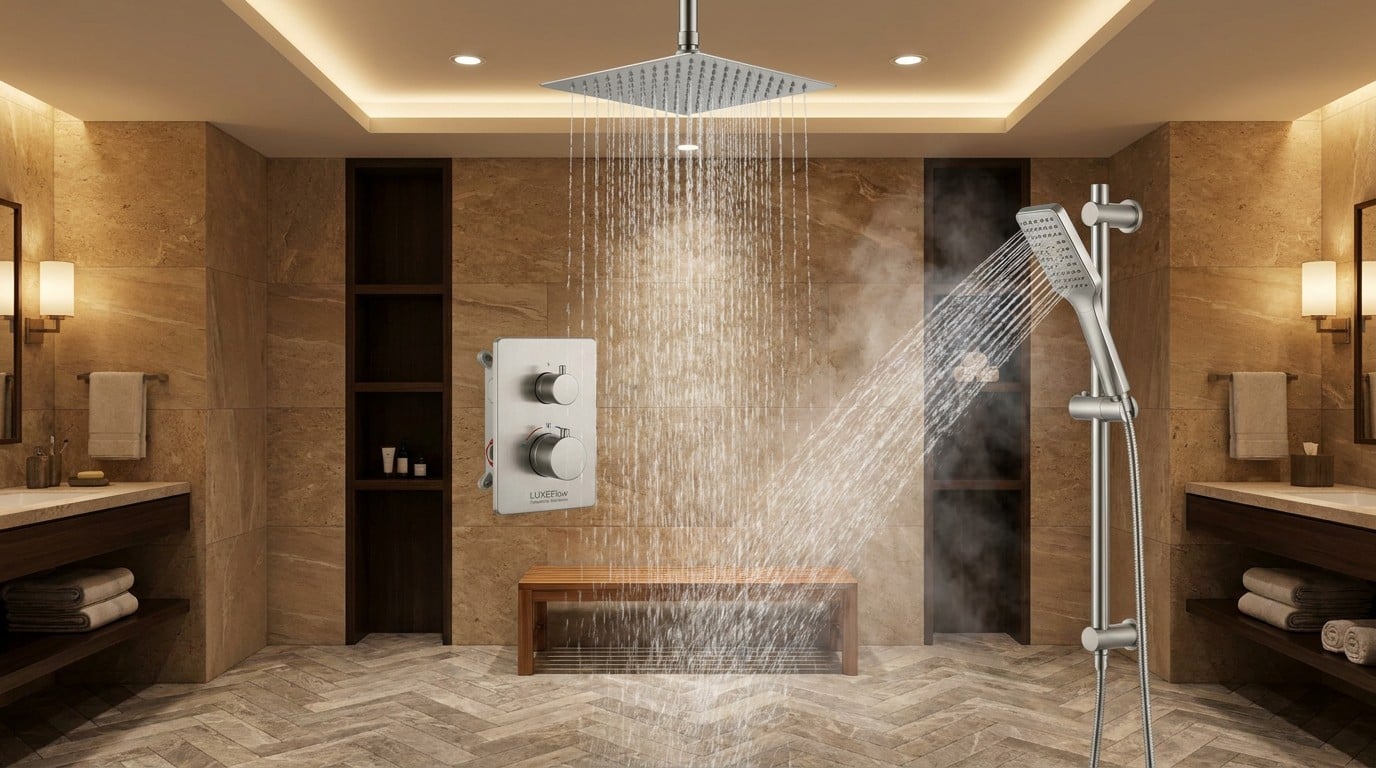
Xindong's K115 and K116 Thermostatic Shower Kits are designed specifically for the demands of commercial and hospitality installation. Both models feature solid brass valve bodies, high-precision thermostatic cartridges calibrated to maintain ±1°C temperature stability, and anti-scald override buttons. The K115 suits contemporary organic bathroom aesthetics, while the K116's geometric design aligns with more structured modern interiors. Both models are available with sliding rail hand showers and large-format rainfall heads in chrome and brushed nickel finishes. For hotel developers specifying across multiple room categories, Xindong supports bulk orders with consistent finish batches and documented quality control reporting per shipment.
Established 1999 · 30,000+ sqm factory · 65+ patents · Monthly capacity 200,000+ sets · ISO 9001 certified. Contact: [email protected] | www.cn-xindong.com
 Hot News
2026-10-17
2026-10-16
2026-10-15
2026-10-14
2026-10-13
2026-10-12

The company, founded in 1999 and located in Yuhuan,specializes in taps, thermostatic shower valves and shower kits. With over 30,000 sqm of space and 380+ employees, we hold numerous certifications and 65+ patents.
 EN
EN