Water does not climb 30 floors by itself. In a high-rise commercial building, the pressure boosting system is the heart of the plumbing infrastructure — and if it is sized wrong, every valve downstream pays the price.
Undersized booster sets cause flow starvation on upper floors during peak demand. Oversized systems cycle erratically, hammering pressure reducing valves (PRVs) and shortening their service life. Getting it right requires a systematic approach that starts long before you specify a pump.
The starting point is not the pump curve — it is the loading units table. Use BS EN 806-3 (Europe) or the IPC/UPC loading unit method (North America and Middle East projects):
1. Count fixtures per floor — WC, basin, shower, kitchen sink, cleaner's sink
2. Assign loading units (LU) per BS EN 806-3 or local equivalent
3. Sum LUs per zone, then apply the diversity curve to convert to design flow rate (L/s)
4. Add 15–20% contingency for future tenant fit-out and unplanned demand
| Building Type | Typical Peak Demand Factor | Design Flow (per 100 fixtures) |
| Office (commercial) | 0.4–0.6 | 2.5–3.5 L/s |
| Hotel (hospitality) | 0.6–0.8 | 4.0–6.0 L/s |
| Mixed-use residential | 0.5–0.7 | 3.0–5.0 L/s |
A common error: applying residential demand factors to a commercial office where the fixture usage pattern is entirely different. An office building experiences sharp peaks at 9:00 and 13:00; a hotel has a flatter but sustained evening peak. Size for the actual demand pattern, not a generic table.
The booster set has one job: lift water to the highest outlet. After that, gravity-fed zones with PRVs handle the rest. The decision tree:
• Buildings under 15 floors: Single pressure zone with break tank at roof level, PRVs on each floor branch
• Buildings 15–30 floors: Two or three pressure zones, intermediate break tanks, staged PRV banks
• Buildings over 30 floors: Series-connected booster sets, multiple break tanks, pressure-sustaining valves on transfer mains
The golden rule: no PRV should reduce pressure by more than a 4:1 ratio in a single stage. If the incoming pressure is 12 bar and you need 2 bar at the outlet, use two PRVs in series — each dropping roughly 6:2 — rather than one valve fighting a 12:2 reduction. A valve operating at the extremes of its range wears faster and hunts.
A booster set can be perfectly sized on paper and still cause field problems if the downstream valves are not selected for the operating regime.
When specifying PRVs for booster-fed systems:
| Parameter | Requirement | Why |
| Maximum inlet pressure rating | ≥1.5× pump dead-head pressure | Protects against start-up surge |
| Minimum flow rate | Within valve's stable control range | Prevents hunting at low demand |
| Cavitation resistance | Stainless steel seat and trim | Extends service life under high differential |
| Serviceability | Cartridge-type internals | Valve can be serviced without draining the riser |
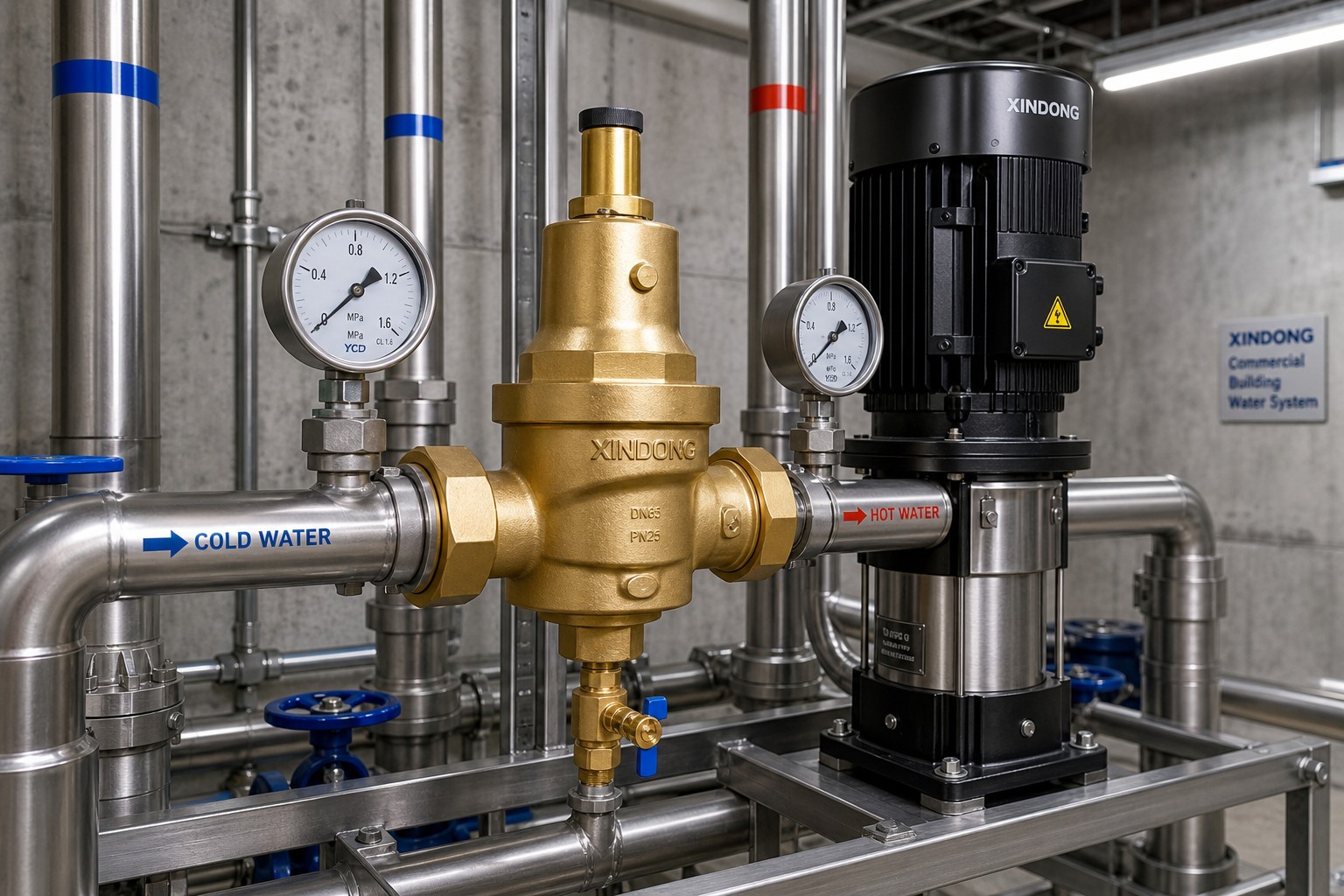
Xindong's brass PRV range is designed with cartridge-type internals for in-line serviceability — a feature that facility managers consistently rank as their top priority for riser-mounted valves that cannot be easily isolated.
This is the intersection that often gets overlooked. A TMV on the 25th floor of a booster-fed building sees different inlet pressures depending on whether the pump is at minimum speed (2:00 AM, one fixture running) or full speed (9:15 AM, every floor at peak demand).
TMVs with balanced spool designs — where both hot and cold inlet pressures act on equal surface areas — maintain stable outlet temperature across this pressure range. Single-seat designs without pressure balancing will drift, and the drift will be worst at the floor furthest from the pump.
Every branch connection to a vertical riser must have a spring-loaded check valve rated for the static head plus pump surge. Swing check valves on vertical risers can slam shut during pump cycling, generating water hammer that propagates through the entire column. Spring-loaded check valves with soft-close mechanisms eliminate this risk.
The booster set commissioning is only half the story. After the pump manufacturer completes their start-up, walk every floor and verify:
1. PRV outlet pressure at minimum, average, and peak demand
2. TMV outlet temperature stability across the same three demand levels
3. Check valve closure — no detectable backflow through any branch
4. Pump cycling frequency — no short-cycling during low-demand periods
Document these readings floor by floor. When a tenant on Floor 18 complains of temperature fluctuation six months later, this baseline data tells you whether the problem is in the booster set, a valve, or a tenant-side modification.
Xindong has been manufacturing brass valves and thermostatic controls since 1999, producing over 200,000 sets monthly from a 30,000 sqm facility in Zhejiang, China. Our valves carry WRAS, CE, ACS, and NSF/Lead-free certifications, and our engineering team supports MEP consultants with technical submittals including pressure drop curves, material certificates, and TMV2/TMV3 compliance documentation.
When the booster set specification lands on your desk, the valve schedule deserves the same attention as the pump curve. Water pressure is only useful if it arrives at the outlet stable, safe, and controlled — and that is a valve's job.
Contact Xindong for technical data sheets on PRVs and thermostatic valves for high-rise applications: [www.cn-xindong.com](https://www.cn-xindong.com)
 Hot News
2026-10-17
2026-10-16
2026-10-15
2026-10-14
2026-10-13
2026-10-12

The company, founded in 1999 and located in Yuhuan,specializes in taps, thermostatic shower valves and shower kits. With over 30,000 sqm of space and 380+ employees, we hold numerous certifications and 65+ patents.
 EN
EN