A hotel guest turns on the tap at 6:30 AM. If hot water takes 40 seconds to arrive, you have lost that guest's goodwill before they have even had their coffee. If hot water arrives in 3 seconds, nobody notices — and that silence is exactly what a well-balanced recirculation loop delivers.
The challenge for MEP engineers is that a domestic hot water recirculation (DHWR) system has two conflicting goals: deliver hot water instantly to the furthest fixture, and consume as little pump energy and heat loss as possible. Balancing is the mechanism that reconciles these goals.
In a typical hotel riser layout, the DHWR return main runs vertically through the building core, with branch returns from each floor or guest room wing joining at common points. Without balancing, the shortest return path — the floor closest to the plant room — steals most of the recirculation flow. The furthest floor sees virtually none.
The result is familiar to every hotel maintenance team: Floor 2 gets scalding water instantly, Floor 16 waits 45 seconds. The thermostatic mixing valves on Floor 2 work overtime while the ones on Floor 16 barely warm up.
CIBSE CP1 recommends a maximum temperature drop of 5 K between the flow from the calorifier and the return at the furthest balancing valve. In practice:
| System Type | Acceptable ΔT | Action Required If |
| Hotel with ≤50 rooms | ≤5 K | ΔT 7 K at any return branch |
| Hotel 50–200 rooms | ≤7 K | ΔT 10 K at furthest branch |
| Resort, multi-building | ≤10 K | ΔT 12 K with user complaints |
Measure temperature at the return side of each balancing valve during the building's lowest-demand period (typically 3:00–4:00 AM). This is when the recirculation loop is doing all the work and any imbalance is most visible.
The traditional approach: fixed-orifice double-regulating valves (DRVs) with pressure-test points. The commissioning engineer adjusts each valve to achieve the design flow rate, then locks the setting. Advantages: low cost, simple. Disadvantages: cannot respond to changes in system pressure, temperature, or demand patterns. Every floor renovation means rebalancing the entire loop.
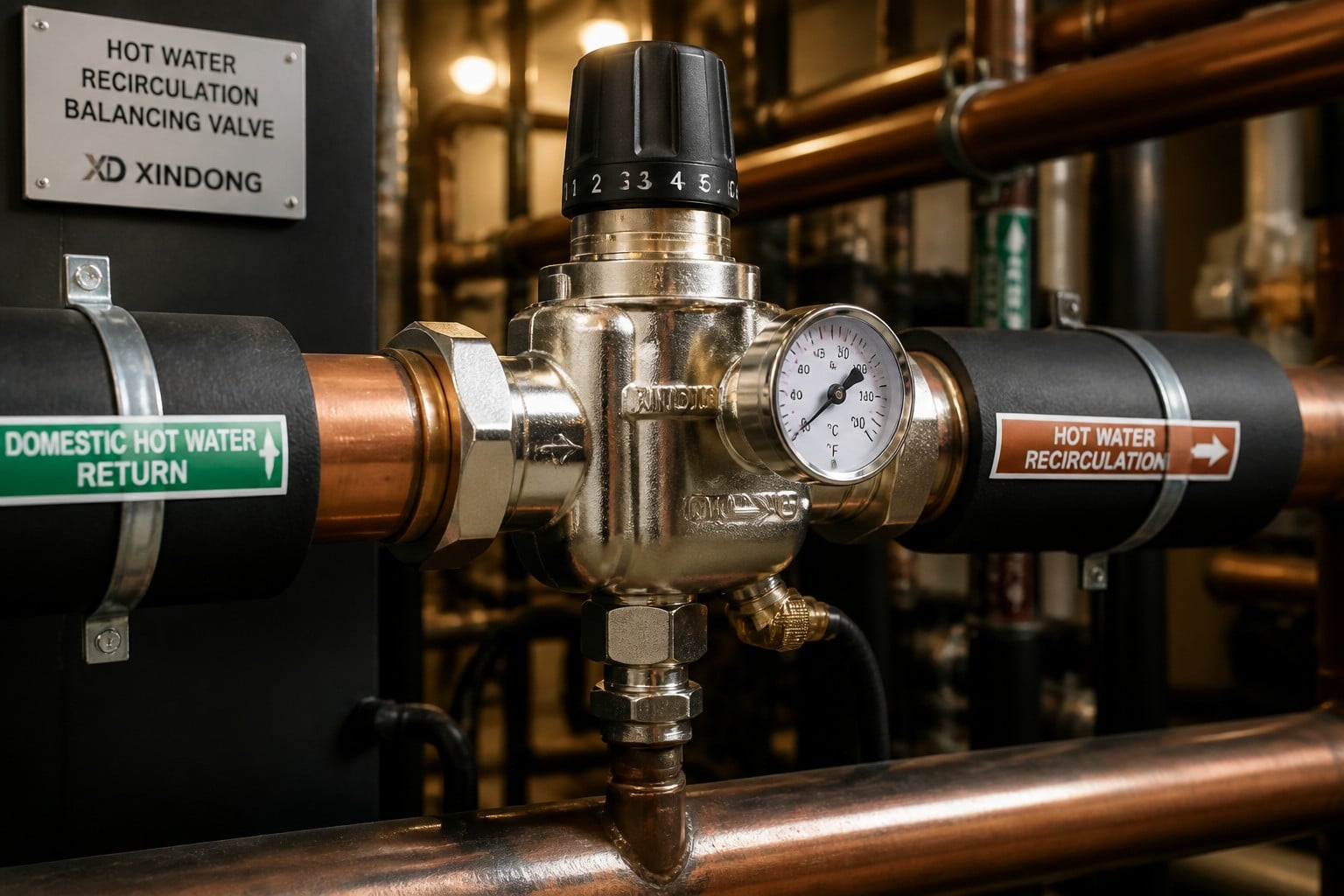
A thermostatic balancing valve maintains a set return temperature by modulating flow — opening when the return water cools, throttling when it reaches the setpoint. This is self-balancing: the valve compensates for pressure fluctuations and varying heat loss along the loop without manual intervention.
For hospitality projects, TBVs offer three distinct advantages:
1. Self-adjustment after renovations: When a guest floor is refurbished and fixtures are repositioned, the TBV adapts without a commissioning visit.
2. Demand-driven energy saving: During low-occupancy periods, TBVs reduce recirculation flow rates, cutting pump energy by 20–30%.
3. Legionella compliance: TBVs maintain minimum return temperatures (typically 50–55 °C) required for Legionella control, reporting an alarm if temperature drops below the threshold.
Draw the loop as a single-line diagram with every branch return labelled. Mark pipe diameters, lengths, and the design flow rate at each connection point. This map is your baseline — without it, balancing is guesswork.
Run the recirculation pump at design speed. Measure flow at the pump discharge and adjust the pump speed or discharge valve until the total recirculation flow matches the design value. A variable-speed pump with a differential pressure sensor makes this step significantly easier.
Start at the hydraulically most remote balancing valve — the one with the longest pipe run from the plant room. This valve gets the least natural flow, so give it priority:
1. Fully open the most remote valve
2. Measure return temperature and flow
3. Adjust until the design ΔT is achieved
4. Lock the setting and tag the valve
Then move to the next-most-remote valve and repeat. Work your way inward toward the plant room. Each adjustment affects valves already set, so you will need two or three passes.
After initial balancing, simulate peak demand by opening fixtures on multiple floors simultaneously. Monitor return temperatures — if any branch return drops significantly, that branch needs additional flow allocation.
Record every valve setting, flow rate, and ΔT. Tag each valve with the commissioning date and the engineer's initials. This documentation is the benchmark for future troubleshooting. When the hotel manager calls six months later about a cold tap on Floor 8, the first question is "has this valve moved from its commissioned setting?"
A well-balanced DHWR loop typically reduces recirculation pump energy by 15–25% compared to an unbalanced system. For a 200-room hotel with a 1.5 kW recirculation pump running 24/7:
• Unbalanced operation: 1.5 kW × 8,760 hrs = 13,140 kWh/year
• Balanced operation (with VSD): Typically 0.9–1.1 kW average = ~8,760 kWh/year
• Annual saving: ~4,380 kWh, or roughly £1,300–£1,700 at current UK commercial electricity rates
The energy savings alone justify the balancing valve specification — and the guest satisfaction improvement is free.
For hospitality projects, specify balancing valves with these features:
• Integral pressure-test points (P/T plugs) for flow verification without draining
• Lockable adjustment mechanism to prevent tampering by non-technical staff
• Thermostatic element rated for continuous operation at 50–65 °C
• Brass body with WRAS approval for potable water contact
Xindong's brass balancing and thermostatic valves are manufactured under ISO 9001 quality management, with WRAS, CE, and ACS certifications. Our cartridge-type designs allow field replacement without removing the valve body — a critical feature for in-wall installations in occupied hotel corridors. With over 25 years of manufacturing experience and 65+ design patents, we supply valves engineered for the real-world demands of hospitality plumbing.
A hotel's reputation is built one shower at a time. Balanced recirculation ensures every guest gets the same experience — and the same silent, instant hot water — regardless of which floor they are on.
For valve schedules and technical submittals for hospitality projects, visit [www.cn-xindong.com](https://www.cn-xindong.com).
 Hot News
2026-10-17
2026-10-16
2026-10-15
2026-10-14
2026-10-13
2026-10-12

The company, founded in 1999 and located in Yuhuan,specializes in taps, thermostatic shower valves and shower kits. With over 30,000 sqm of space and 380+ employees, we hold numerous certifications and 65+ patents.
 EN
EN