A thermostatic mixing valve sitting in its box is a promise. A TMV that has been properly commissioned, tested, and documented is an assurance. The gap between the two is where reputations are made — or lost.
As water safety standards tighten across the UK, EU, and Middle East, the ability to commission TMVs to BS 7949:2022 and document results to CIBSE AM14 standards has become a non-negotiable skill for MEP contractors and facility management teams. This guide walks through the complete commissioning sequence.
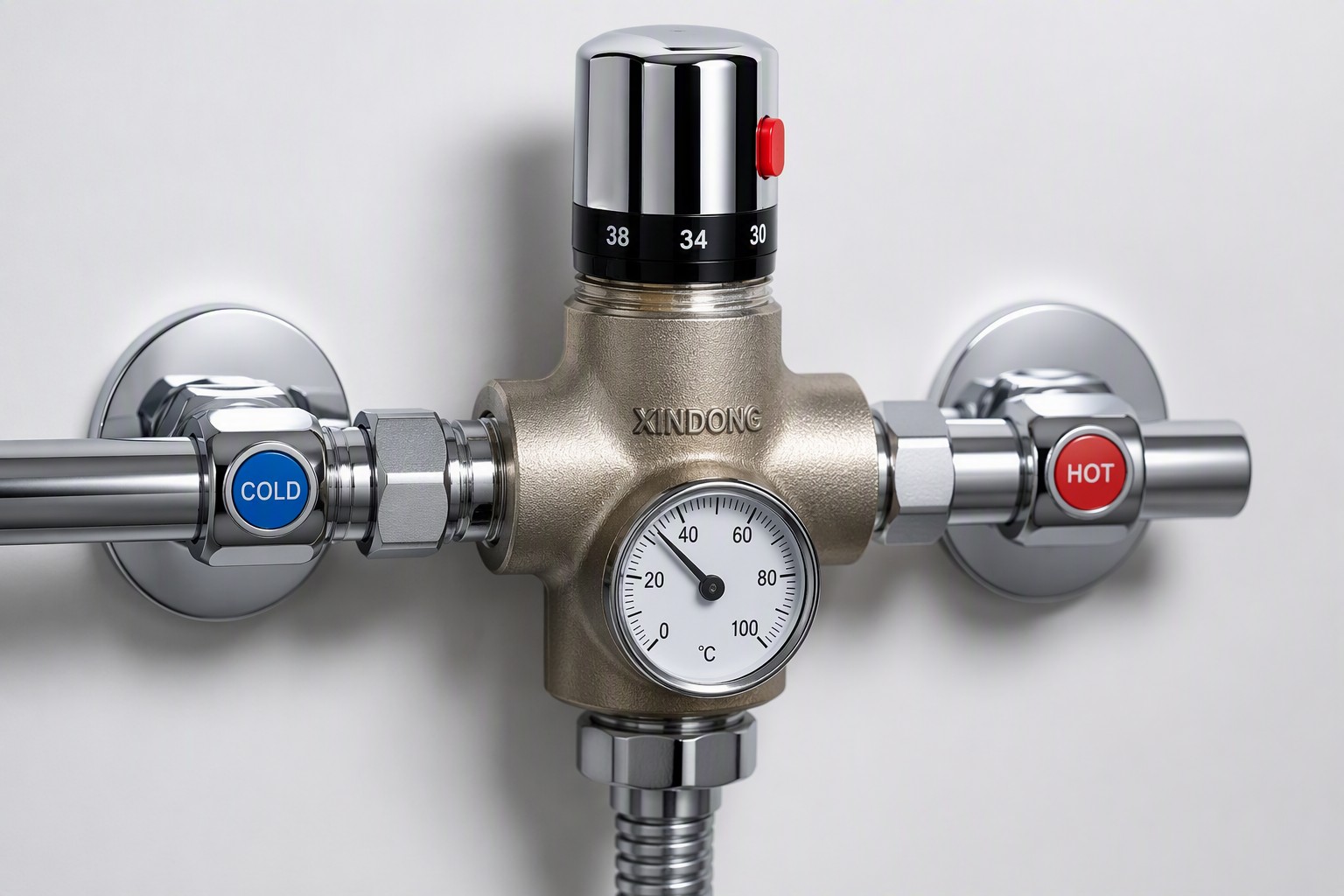
A TMV blends hot and cold water to deliver a stable, safe outlet temperature — typically 41 °C for washbasins and bidets (TMV3, healthcare) or 38–46 °C for general-use fixtures (TMV2). But even a WRAS-approved, factory-calibrated valve will drift if the supply conditions it faces on site differ from test-bench assumptions.
The three common failure modes that commissioning catches:
| Failure Mode | Root Cause | Consequence |
| Temperature overshoot | Cold water supply failure simulation | Scalding risk not prevented |
| Thermal creep | Inlet pressure imbalance not corrected | Gradual drift above setpoint |
| Dead-leg stagnation | Flushing sequence omitted | Legionella risk from biofilm |
Before touching the TMV, verify these supply-side conditions:
• Static pressures: Measure both hot and cold inlet pressures with a calibrated gauge. The differential should not exceed the manufacturer's stated limit (typically 3:1 for domestic-grade TMVs; precision models from manufacturers like Xindong handle wider differentials through balanced spool designs).
• Supply temperatures: Hot water storage at ≥60 °C, cold water below 20 °C. Log both before starting.
• Strainers and check valves: Physically inspect integrated or in-line strainers for debris. A single solder ball or piece of PTFE tape in a strainer can mask as a faulty cartridge.
• Flushing: Run both hot and cold supplies at full flow for at least 30 seconds to clear commissioning debris. This is also the moment to check that dead legs in the distribution pipework have been eliminated.
Field note: In retrofit projects, we often find that a "failed" TMV is actually a partially blocked strainer. Always check the simple things before calling the valve.
Open the outlet fully. Adjust the temperature control to the target setpoint. Allow the valve to stabilise for 2–3 minutes under flow. Do not take readings during the first minute — the thermal mass of the brass body and internal components needs time to reach equilibrium.
Using a calibrated digital thermometer (±0.2 °C accuracy), record outlet temperature at three flow rates:
1. Full flow (all outlets open)
2. Reduced flow (~3 L/min, simulating a trickle)
3. Minimum flow (just above shut-off)
BS 7949 requires the deviation between full and minimum flow to stay within ±2 °C of the setpoint. If the swing exceeds this, check for inlet pressure imbalance — the most common correctable fault.
This is the critical safety test. With the TMV at its stabilised setpoint:
1. Isolate the cold water supply abruptly
2. Measure the outlet temperature within 2 seconds
3. The TMV must shut down hot flow within this window, limiting the outlet temperature spike
For TMV3 (healthcare) applications, the outlet temperature must not exceed 43 °C during isolation. Record the peak temperature observed and the shut-down time.
Restore the cold supply and verify the TMV returns to its setpoint within the manufacturer's recovery time — typically under 5 seconds for a well-designed valve with a responsive thermostatic element.
Record in the commissioning log: date, engineer name, valve serial number, inlet temperatures and pressures, setpoint, full-flow/minimum-flow readings, cold isolation peak temperature, and recovery time. This is not bureaucracy — it is legal evidence for your Water Safety Plan. Store this log in the building's O&M manual.
| Symptom | Likely Cause | Resolution |
| Temperature drifts up over time | Cold inlet check valve leaking, allowing hot backflow | Replace check valve cartridge |
| Outlet temperature always below setpoint | Hot water supply too cool or strainer restricted | Verify storage ≥60 °C; clean strainer |
| Outlet temperature oscillates | Hunting — oversized valve for duty | Verify flow rate against valve range |
| Cold isolation fails | Thermostatic element sluggish or scaled | Replace cartridge; consider water treatment |
Not all TMVs are equal at the commissioning stage. Valves with adjustable temperature stops, accessible strainers, and test-point ports reduce commissioning time significantly. When specifying for projects, look for:
• TMV2 or TMV3 certification from a UKAS-accredited laboratory
• WRAS or equivalent water regulations approval for the target market
• Balanced spool design for stable performance across pressure differentials
• Serviceable internals — cartridges that can be replaced without removing the valve body from the wall
Zhejiang Xindong Sanitary Ware has been manufacturing TMV2 and TMV3 certified valves since 1999, with 65+ patents in valve design and structure. Our WRAS and ACS certified thermostatic mixing valves are used in commercial, healthcare, and hospitality projects across Europe and the Middle East, designed for straightforward commissioning with test-point access and field-serviceable cartridges.
A correctly commissioned TMV will protect building occupants for years. The 20 minutes you spend on proper commissioning today will prevent the incident report that lands on your desk tomorrow.
For technical support on TMV selection or commissioning procedures, contact Xindong's engineering team at [www.cn-xindong.com](https://www.cn-xindong.com).
 Hot News
2026-10-17
2026-10-16
2026-10-15
2026-10-14
2026-10-13
2026-10-12

The company, founded in 1999 and located in Yuhuan,specializes in taps, thermostatic shower valves and shower kits. With over 30,000 sqm of space and 380+ employees, we hold numerous certifications and 65+ patents.
 EN
EN