Every floor a tower adds to a municipal water connection raises static pressure by roughly 0.43 psi per foot of elevation. At 20 stories, a fixture on the ground floor can see 60 psi or more of building-added pressure on top of street pressure — frequently exceeding the 80 psi (550 kPa) maximum that most plumbing codes set for individual fixtures. The result is a maintenance department's worst year: burst flex lines, dripping cartridges, failed solenoid valves, and flow rates that make aerators useless and touchless faucets misbehave.
A pressure reducing valve (PRV) is the standard, code-accepted tool for bringing branch pressures back into the 40–60 psi operating band that fixtures, water heaters, and sensor faucets are actually designed for. This article covers when to install them, how to size them correctly, and what to specify for mixed-use towers — the densest, most variable pressure environment in commercial plumbing.
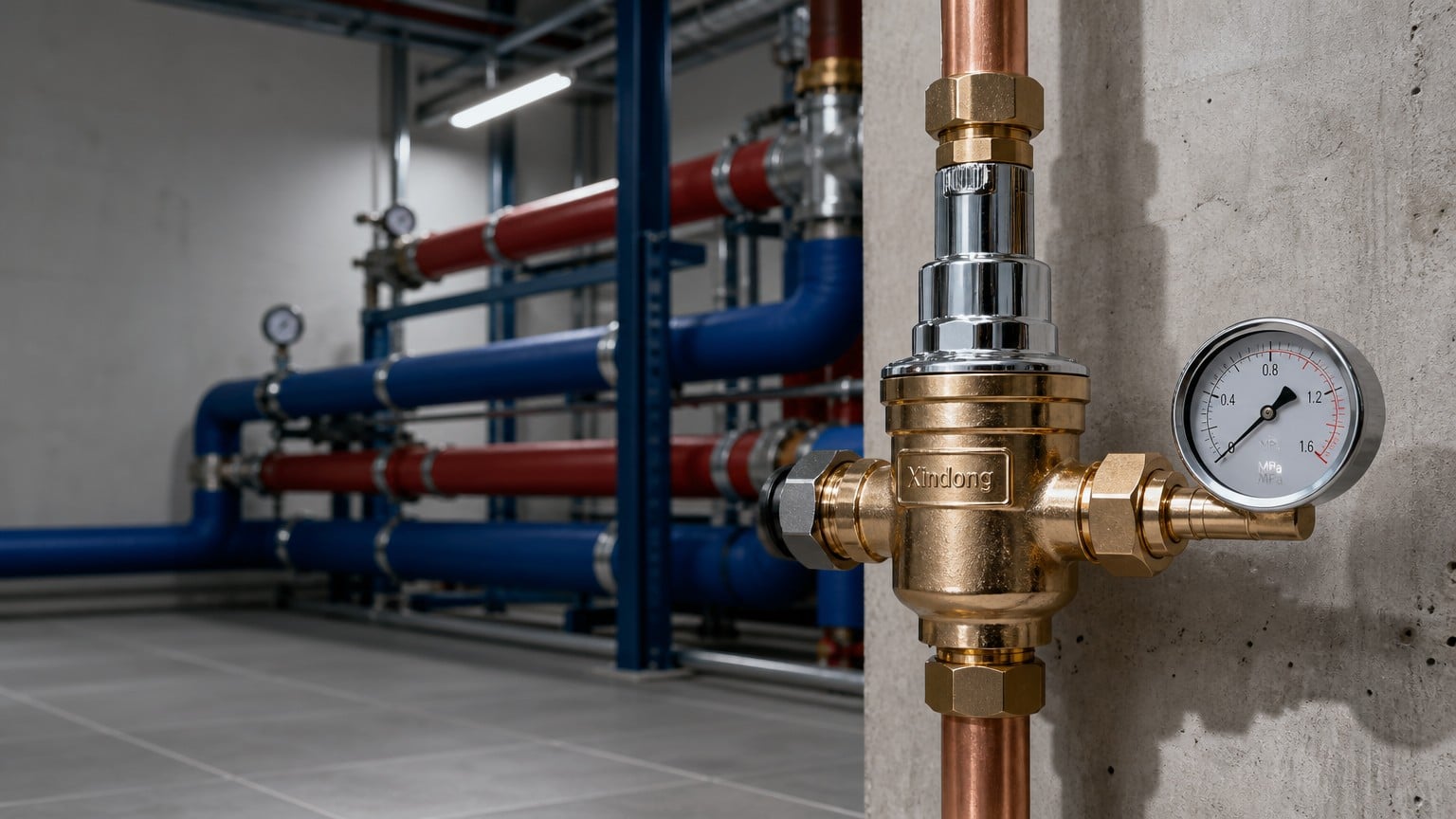
A typical direct-acting PRV uses a spring-loaded diaphragm. Downstream (outlet) pressure acts against the diaphragm; when it exceeds the spring setpoint, the diaphragm closes the main valve seat, restricting flow until outlet pressure returns to setpoint. Balanced-seat designs cancel out inlet-pressure effects, giving more stable outlet pressure across a wide supply range — the feature to look for when street pressure varies dramatically with time of day.
Key operating characteristics to note on a datasheet:
• Maximum inlet pressure — the pressure the valve body and seat must withstand when the supply is at its worst.
• Adjustable outlet range — typically 25–75 psi; you want a range that brackets your design target, not one that sits at the edge.
• Cv (flow coefficient) — the gallons per minute of water that pass through the valve with a 1 psi pressure drop. This is the number that drives sizing.
Sizing: Flow Rate First, Pressure Second
The single most common sizing mistake is selecting a PRV by pipe size. A 1-inch valve is not a "1-inch-sized" valve in any meaningful sense — it is a valve with a certain Cv. If you undersize, the valve starves the building at peak demand; if you oversize, the valve hunts and chatters at low flow because the seat is nearly closed, which wears the seat and produces noise complaints in the very apartments you are trying to protect.
The sizing procedure for each pressure zone:
1. Determine the design flow rate for the zone. Use the building's fixture-unit method (Hunter's curve) or the engineer's peak-demand calculation — not the pump curve and not the service size. For mixed-use towers, calculate the hotel, office, and residential wings separately; they peak at different hours and should rarely share a zone.
2. Establish inlet and outlet pressures. Inlet = maximum anticipated street/riser pressure (design for the worst case). Outlet = your target, typically 50–60 psi for general fixtures, sometimes 40 psi for sensor faucets and water heaters.
3. Compute required Cv: `Cv = Q / √ΔP`, where `ΔP` is the available pressure drop (inlet minus outlet, minus losses through strainer, meter, and piping). Select a valve whose catalog Cv at the desired outlet pressure equals or exceeds the required Cv — then verify that the valve's flow at that setpoint is also stable (manufacturers publish minimum stable flow curves; avoid operating below them).
4. Check the secondary effects: thermal expansion (an expansion tank is almost always required on the downstream side of a PRV when a water heater is in the zone), water hammer, and pressure creep from a failed seat. Specify a valve with a built-in or add-on by-pass or expansion provision where code requires it.
For potable-water service in a tower, specify:
• Brass or lead-free bronze bodies — dezincification-resistant (DZR) brass for aggressive water, chrome or nickel plating where the valve is visible.
• Replaceable seat and diaphragm — the valve will be serviced in place; a rebuildable design avoids cutting out the riser.
• Integral strainer or upstream strainer — debris is the leading cause of premature seat wear in new towers.
• Lockable adjusting cap — prevents residents' plumbers from "improving" the setting.
• Certifications — WRAS approval for potable contact, and compliance with ASSE 1000 / CSA B356 where the project requires them.
For multi-zone towers, many engineers place one master PRV at the building service entrance plus floor-bank PRVs every 8–12 floors, rather than attempting one giant valve. Master valves handle total demand; zone valves give each pressure band its own setpoint, which is essential when ground-floor retail washrooms and 40th-floor residential fixtures share a riser but not a pressure requirement.
• Sizing from pipe diameter. Always size from Cv and flow. A valve "one size up" from the pipe is a red flag unless the engineer can show the flow calculation.
• Ignoring minimum stable flow. Hotels at night and offices on weekends drop to near-zero demand; the PRV must hold setpoint at trickle flow without chattering.
• Skipping the expansion analysis. PRVs isolate the downstream system from street pressure; without thermal expansion protection, tank-style water heaters can push pressure past the PRV setpoint within minutes of a heating cycle.
• Not accounting for the strainer's pressure drop. A clogged strainer can rob 5–10 psi from the available ΔP and quietly starve the upper floors.
Zhejiang Xindong Sanitary Ware Co., Ltd. (established 1999, Yuhuan, Zhejiang) manufactures brass valves, faucets, and thermostatic shower systems for export to more than 700 client installations worldwide, backed by 65+ structural patents, WRAS-certified product lines, and in-house laboratory testing. Our engineers regularly support OEM and specification projects with custom brass valve bodies, finishes, and packaging — from prototype to monthly production of 200,000+ sets. For project engineers, that means valve programs that arrive tested, documented, and ready for the pressure chart.
A correctly sized PRV is quiet, holds setpoint within ±2–3 psi across the demand curve, and never starves the top floor. After commissioning, check: pressure at the farthest fixture during peak demand, valve stability at trickle flow (listen for chatter), and downstream pressure rise during water-heater cycling. If all three pass, your zone design is sound.
About the author: The Xindong engineering team designs and manufactures brass valves and thermostatic shower systems for commercial and residential projects worldwide. Contact us at [[email protected]](mailto:[email protected]) or +86-0576-87499008 for valve specifications, samples, and OEM support. Visit [cn-xindong.com](https://www.cn-xindong.com) for the full product range.
 Hot News
2026-10-17
2026-10-16
2026-10-15
2026-10-14
2026-10-13
2026-10-12

The company, founded in 1999 and located in Yuhuan,specializes in taps, thermostatic shower valves and shower kits. With over 30,000 sqm of space and 380+ employees, we hold numerous certifications and 65+ patents.
 EN
EN