Legionella pneumophila thrives in exactly the water conditions building services unintentionally create: warm (20–45°C), stagnant, and nutrient-rich. The pathogen is not exotic — it colonizes storage tanks, calorifiers, and the dead legs of hot water distribution in hotels, hospitals, schools, and apartments worldwide. Managing the risk is a design problem, a maintenance problem, and increasingly a compliance problem under ASHRAE 188, the UK Health & Safety Executive's ACOP L8, and equivalent national codes.
Thermostatic mixing valves (TMVs) sit at the center of this problem, because they are the device that lets you store water hot enough to kill Legionella while delivering water cool enough to prevent scalding. This article explains how to design flushing and thermal disinfection regimes around TMVs without undoing either safety goal.
Legionella risk management rests on a temperature sandwich:
• Storage and distribution hot: store hot water at 60°C or above (some schemes require 65°C at the calorifier outlet). At 60°C, Legionella dies within minutes; below 50°C, it survives and multiplies.
• Delivery cool: deliver blended water at ≤43–50°C to outlets depending on the application — 38–43°C for showers and hand-wash basins, and lower where young children or vulnerable users are present.
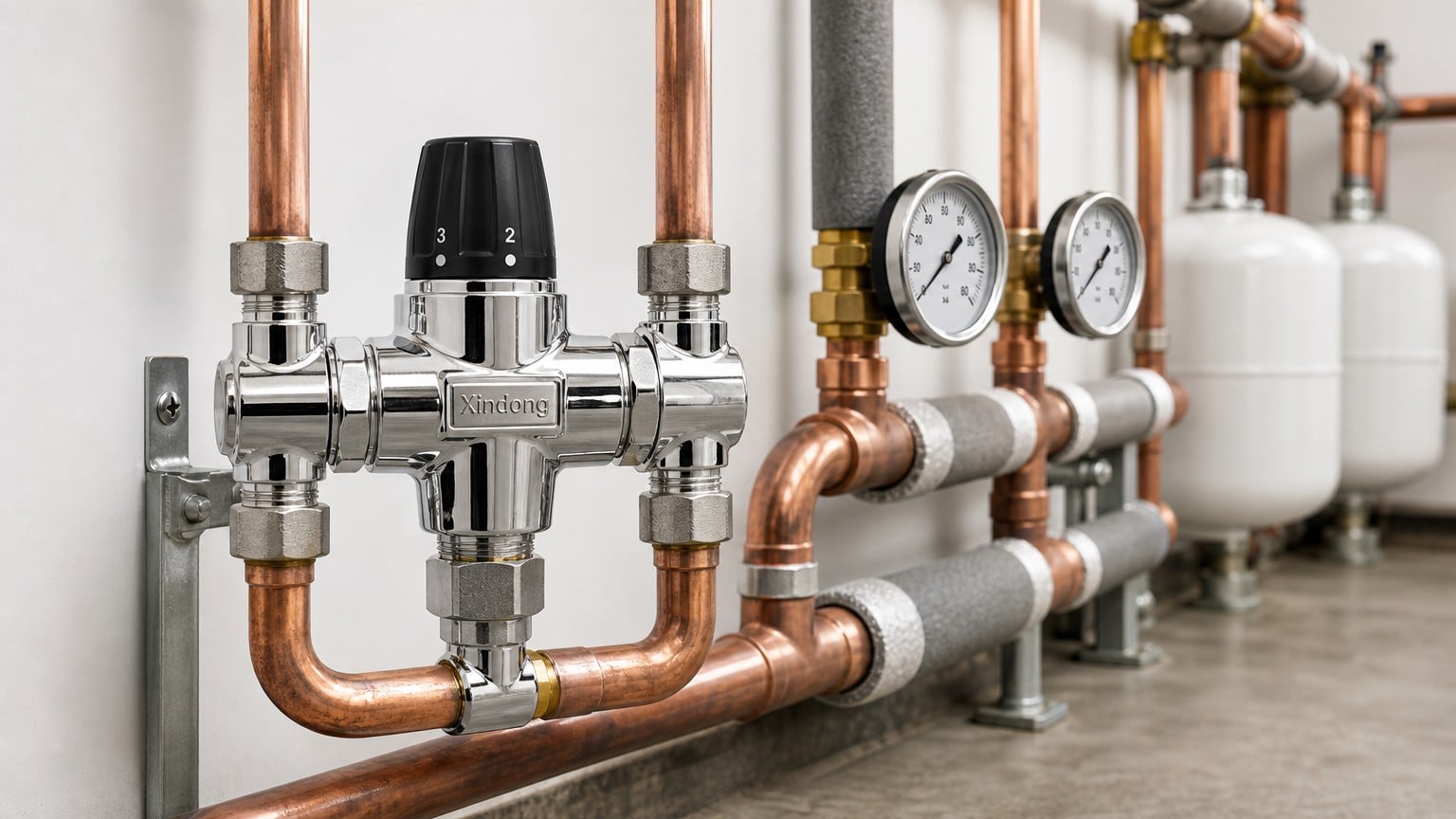
The only safe way to run both temperatures is to blend hot and cold at or very near the point of use with a thermostatic mixing valve. A TMV with a wax-element thermostat senses blended outlet temperature and modulates the hot/cold proportion; on cold-water failure it shuts off hot flow (fail-safe), and it typically includes integral check valves and strainers. This is why UK healthcare schemes require WRAS-approved TMVs verified to TMV2 or TMV3 — and why the same discipline is spreading to commercial buildings under ASHRAE 188's risk-management plans.
Every meter of pipe downstream of a TMV that carries blended water at 35–45°C is a colonization zone. Design rules:
• Locate TMVs as close to outlets as possible (point-of-use blending) or at zone manifolds serving small groups.
• Eliminate dead legs — capped branches longer than a few pipe diameters are breeding tanks. Where a future outlet is planned, install a ball valve and drain point instead of a capped stub.
• Keep blended-water pipe runs short and fully insulated; the goal is to hold blended temperature stable, not to let it drift into the growth band.
Stagnation is the second half of the risk equation. A flushing regime is mandatory where systems are intermittently used — school holidays, hotel low season, office weekends, and unoccupied apartments:
• Daily/weekly flush: open every outlet for a defined period (commonly 1–5 minutes per outlet, or until the blended temperature stabilizes) on a weekly minimum schedule. Automated flush controllers that cycle solenoid valves are the practical answer for large buildings; manual rosters fail within months.
• Flush both hot and cold: flushing only the hot side leaves cold dead legs at 20–25°C — Legionella's favorite room temperature.
• Document every flush: ASHRAE 188 and L8 both demand records. Choose TMVs and manifold stations with accessible temperature test points so a technician can verify blended temperature without disassembly.
Thermal disinfection (heat-and-flush) raises the entire system — including the blended side — to 65–70°C for at least one minute at every outlet (L8 recommends flushing sequentially, outlet by outlet). Two design consequences:
• A TMV cannot simply be "turned up." Most TMVs are rated for a maximum blended temperature well below 65°C, and many are not certified for repeated hot-side exposure. Thermal disinfection is performed by isolating the TMV with service valves and a bypass, flushing the hot water line at 65°C+, then restoring the TMV to normal service. Specify TMVs with integral or adjacent service isolation so this is a ten-minute job, not a surgery.
• Check the TMV's disinfection capability: some WRAS TMV2/TMV3 designs are tested to withstand thermal disinfection cycles; confirm the manufacturer's rating before promising "disinfection in place" in your O&M manual.
A regime without verification is a guess:
• Temperature monitoring: log calorifier outlet, return, and representative blended-outlet temperatures. Continuous data loggers on critical zones beat quarterly spot checks.
• Microbiological testing: periodic culture testing of stored water and outlets validates the regime; investigate any positive result by re-checking temperatures, flushing frequency, and TMV setpoints first — most failures are schedule failures, not hardware failures.
• Annual TMV servicing: inspect and test check valves, strainers, and the thermostatic element; replace elements outside their ±2°C performance band. A worn element that lets blended temperature creep to 46°C is an invisible Legionella risk.
For commercial and institutional hot water systems, specify:
• WRAS-approved TMVs verified to TMV2 (general) or TMV3 (healthcare and high-risk settings), with fail-safe hot shut-off, integral check valves, and strainers.
• Brass bodies with dezincification-resistant materials where water chemistry demands, chrome or nickel finish for exposed plant.
• Integral service isolation to enable thermal disinfection and maintenance without draining the riser.
• Accessible test points for compliance logging.
Zhejiang Xindong Sanitary Ware Co., Ltd. manufactures brass valves and thermostatic mixing products — including WRAS-certified TMV2/TMV3 lines — from our Yuhuan, Zhejiang facility, which has supplied 700+ client sites since 1999. Our in-house lab tests thermostatic response, pressure balancing, and durability, and our engineers support OEM and specification projects with custom valve bodies and documentation packages.
Safe hot water is a system, not a component: store hot, blend at the point of use with a certified TMV, flush on a documented schedule, and disinfect through a planned bypass route. Design the TMV installation around the flushing and disinfection regime from day one — then the regime survives contact with real building operation, and so does your compliance file.
About the author: The Xindong engineering team designs and manufactures brass valves, thermostatic shower systems, and TMVs for commercial and institutional projects worldwide. Contact [[email protected]](mailto:[email protected]) or +86-0576-87499008 for TMV specifications, WRAS documentation, and OEM support. Visit [cn-xindong.com](https://www.cn-xindong.com) for the full range.
 Hot News
2026-10-17
2026-10-16
2026-10-15
2026-10-14
2026-10-13
2026-10-12

The company, founded in 1999 and located in Yuhuan,specializes in taps, thermostatic shower valves and shower kits. With over 30,000 sqm of space and 380+ employees, we hold numerous certifications and 65+ patents.
 EN
EN