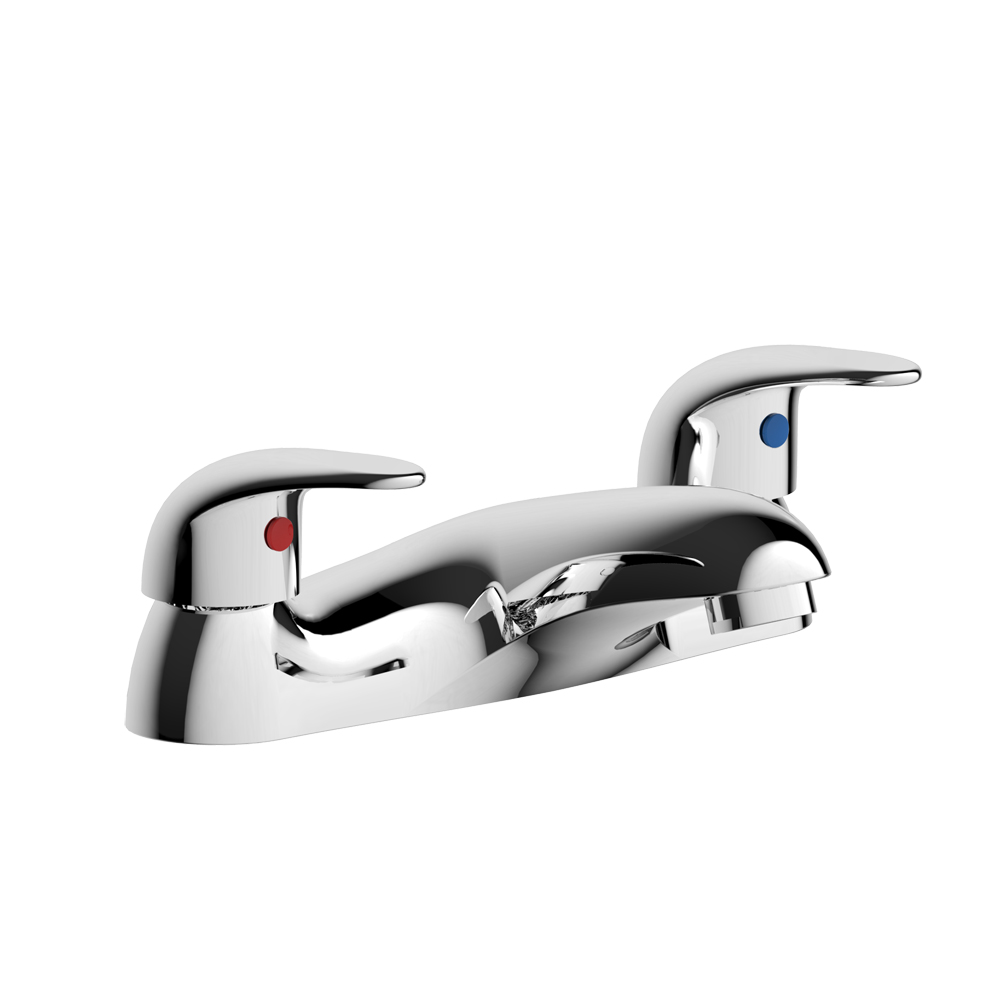
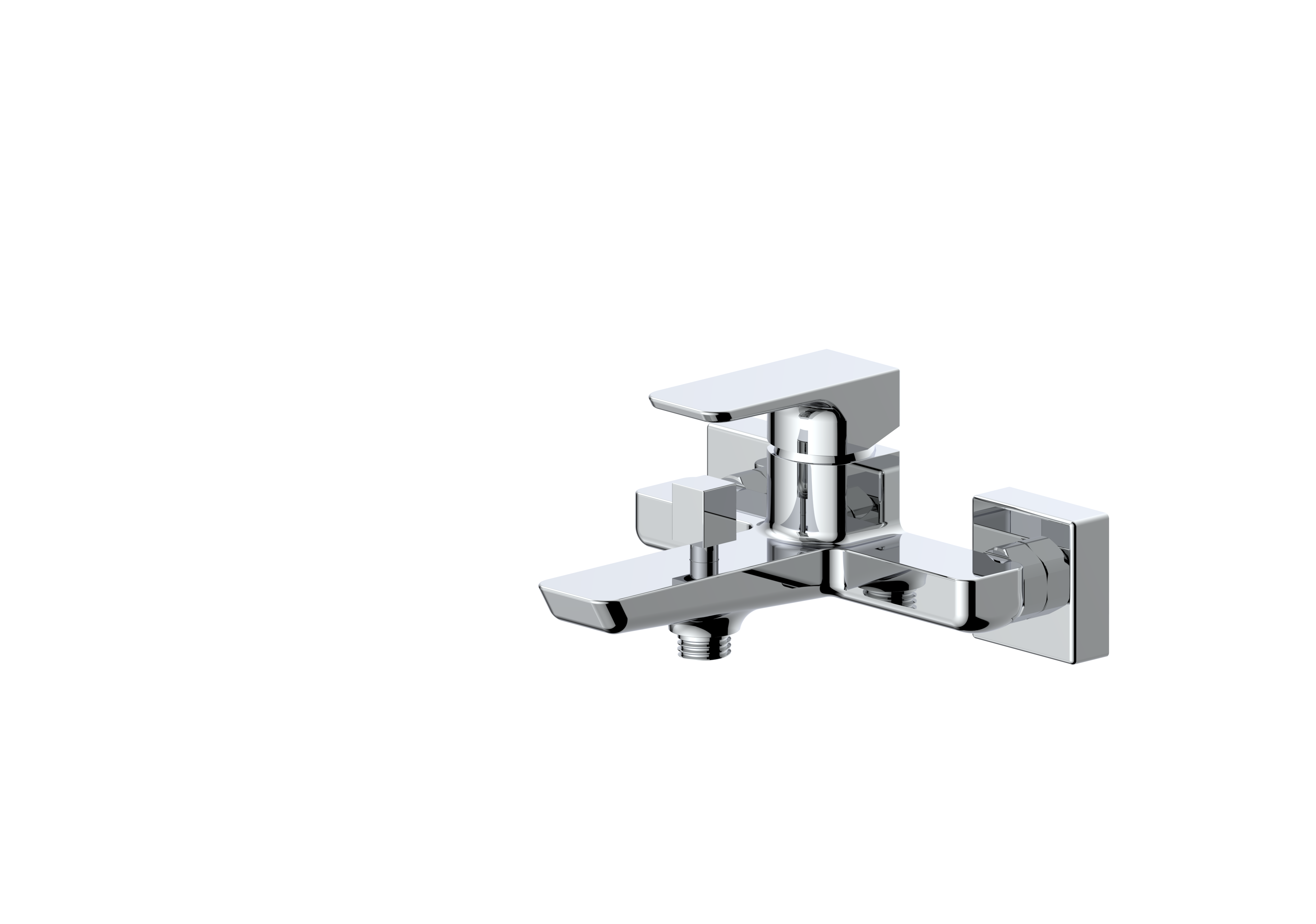
Chrome does not fail on its own. By the time a customer photographs a blistered basin tap, the argument is usually between a factory that says the coating passed salt spray and a buyer who says the tap is two years old. Both can be right. Chrome problems are almost always decided earlier — in casting, polishing, or the first thirty seconds of pre-treatment — and the failure mode tells you which.
On a brass basin mixer the decorative coating is a system, not a single layer. Die-cast or forged brass is polished, then cleaned through alkaline soak and electroclean stages, acid-activated, nickel-struck, built up in nickel, and finally chromed.
The division of labour matters. Chromium is only a few tenths of a micron thick; it provides the hard, bright, wear-resistant surface and almost none of the corrosion protection. Nickel does the protective work. A duplex nickel system — semi-bright under bright — creates a layered structure that deflects corrosion sideways. Microporous or micro-cracked chrome then spreads any corrosion current over thousands of tiny sites.
Skip any of that and the tap looks perfect in the showroom and fails in service. This is why thickness numbers alone are a weak specification: 15 µm of poorly adhered nickel is worse than 10 µm of correctly adhered nickel.
| Appearance | Where it starts | Root cause | Coating defect? |
|---|---|---|---|
| Dome-shaped bump, often with a pinhole, sometimes weeping green or white residue | Isolated points, frequently near cast edges or sprue areas | Corrosion cell at a through-porosity; corrosion products swell under the coating | Usually substrate porosity, not the plating bath |
| Sheet lifting, coating intact and liftable with a fingernail, sharp boundary | Flat or low-current-density areas, inside recesses | Adhesion failure at nickel–brass or chrome–nickel interface; contamination or passivation before plating | Yes — pre-treatment |
| Bright metal showing at rims, aerator edge, lever edge | Handling and cleaning contact points | Mechanical abrasion through the coating | No — wear, not a defect |
The distinction between a plating blister and a corrosion blister is the one buyers most often miss. A plating blister is present at goods-in and is caused by gas occlusion or organic contamination. A corrosion blister appears months later, starts from a pore, and brings corrosion products with it. Inspect at goods-in and you separate the two immediately.
Brass die castings are porous by nature. Gas entrapment, shrinkage porosity and cold shuts all create subsurface voids that behave badly in a plating line: trapped air expands in the hot bath and blows a void in the deposit, and polishing compound — fatty acids, waxes, lime — lodges in open pores and is extremely hard to remove completely.
The consequences are predictable. Polishing residue that survives cleaning causes adhesion loss, which shows up as peeling months later. Incomplete acid activation leaves a passive oxide film on the brass, so nickel deposits onto oxide rather than metal.
Two process controls do most of the work: porosity control on visible casting areas, and validated cleaning with ultrasonic stages and controlled rinse water. Both are invisible in a finished tap, which is exactly why they get cut.
Neutral salt spray testing to ISO 9227, with results rated under ISO 10289, is the standard way to compare coating systems. Typical commercial acceptance levels for decorative tapware run from 24 hours to 200 hours NSS depending on grade and market, with higher grades adding acetic acid spray.
Three caveats. Salt spray is a comparative ranking tool, not a service-life prediction — 96 hours does not mean four years. It is sensitive to sample preparation: an un-edged sample flatters the result. And it says nothing about adhesion, which is what most peeling claims are about. Pair it with an ISO 2409 cross-cut and an XRF thickness reading.
Visual inspection at 300 mm under at least 500 lux, plus a raking-light pass to catch orange peel and haze
Coating thickness by XRF on flat, edge and recess areas — record all three, not an average
ISO 2409 cross-cut adhesion on a sample part per lot
ISO 9227 salt spray on a sample per lot, rated under ISO 10289
Porosity check on castings before plating, especially at sprue cut-off
Handling discipline audit — gloves at final assembly, no bare-hand contact with the coated surface
Batch traceability: date code stamped or labelled on the body, linked to plating records
When a claim arrives, work in this order and the argument usually resolves itself:
A fair settlement follows the evidence: pre-treatment failures in the first months are the maker's; porosity-driven blistering is a casting issue and still the maker's; chemical attack and abrasion are user-side, though a good supplier offers a goodwill replacement rather than argue over a £40 tap.
Specify the system, not the shine: substrate quality, validated pre-treatment, duplex nickel, microporous chrome, and a test pack that includes adhesion as well as salt spray. Keep batch records too, because in a dispute the factory holding a plating record and a retained sample wins the conversation in five minutes. Buyers sourcing brass basin mixers and kitchen mixer taps from Zhejiang Xindong Sanitary Ware Co., Ltd. can request the full coating and test documentation package with each shipment.
---
Zhejiang Xindong Sanitary Ware Co., Ltd., Yuhuan, Zhejiang, China, manufactures brass basin mixers, wall-mounted basin mixers and kitchen mixer taps for OEM and ODM customers, with in-house laboratory testing and batch-level coating records. Technical enquiries: [email protected] | +86-0576-87499008.
 Hot News
2026-11-20
2026-11-19
2026-11-18
2026-11-17
2026-11-16
2026-11-15

The company, founded in 1999 and located in Yuhuan,specializes in taps, thermostatic shower valves and shower kits. With over 30,000 sqm of space and 380+ employees, we hold numerous certifications and 65+ patents.
 EN