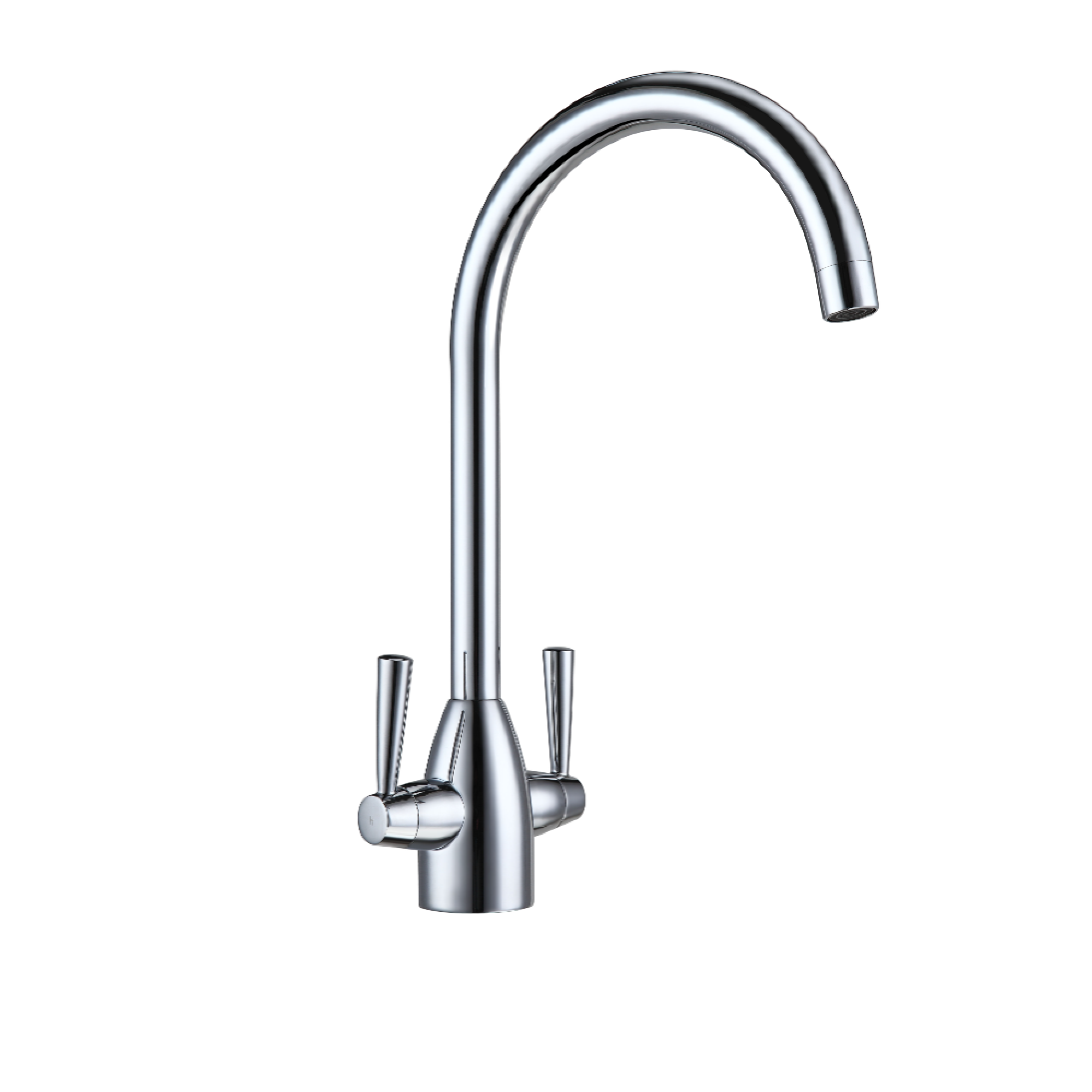
In a soft-water market, a ceramic disc cartridge is effectively a lifetime part. Put the same tap into a region running 250–350 mg/L total hardness and that cartridge becomes a consumable, failing at eighteen to thirty months with a complaint that reads: "the handle has gone stiff and the spout drips." The disc itself almost never breaks. What fails is the sealing interface, and the mechanism is predictable.
A quarter-turn cartridge is two lapped alumina plates pressed together by a spring, with a thin film of water between them doing the lubricating. That film is the whole trick. It is roughly a few microns thick, and it only works if both faces stay flat and clean.
Hard water destabilises it in two ways. First, calcium bicarbonate converts to calcium carbonate whenever the water sits still and gives up carbon dioxide — inside the cartridge body overnight, in the spout, in the inlet tails. The crystals nucleate preferentially on micro-scratches and on the edge of the sealing band, where the water film is thinnest. Second, those crystals are harder than the alumina binder phase around them, so every lever movement drags abrasive grit across the face. You get a stiff lever first, then a faint weep, then a drip no amount of tightening will fix.
The damage is mechanical, not chemical. Scale lifts the two plates apart by a few microns at one point, the hydraulic seal breaks, and abrasion finishes the job. That is why a cartridge that has failed in a hard-water house usually looks perfectly intact when you take it out.
Scale deposition is strongly temperature-dependent. Carbonate hardness comes out of solution far faster above roughly 60 °C, and the rate climbs steeply from there. This matters because the water inside a cartridge is not always the water coming out of the spout.
Consider a basin mixer blending to 42 °C at the outlet. The hot inlet side of the cartridge body may still be holding water at 65–70 °C during long stagnation, overnight or through a working day in a guest bathroom. That is exactly where the first hard ring of scale forms, on the hot-side seating area. When someone finally opens the tap, the cold side has to slide across a contaminated face.
This is the most useful diagnostic question in a warranty investigation: is the failure symmetric, or concentrated on the hot side? Hot-side-only scaling points at stagnation temperature, not at cartridge quality.
Orientation. A cartridge has a locating lug and a defined hot-inlet side. Fit it rotated 180° and the tap still works — hot on the wrong side, which the installer notices — but the internal bypass and rinse geometry now faces the wrong way. Debris that should be swept out on every operation parks against a dead face instead. In hard water that shortens life noticeably, so the cartridge should carry a mechanical key that makes wrong assembly impossible.
Rinse ports. The small ports at the base plate are not decorative. Every lever movement sends a pulse of water across the seat, and those ports carry grit away. Ports that are undersized, or positioned off the sealing band, let sediment accumulate in the one place you cannot flush. Generous, well-placed ports with a slightly wider sealing band are more forgiving of poor water quality than a nominally higher-specification part with tight ports.
| Symptom reported | Most likely mechanism | Design or specification response |
|---|---|---|
| Stiff lever, no leak | Scale on the sliding face, film breakdown | Wider sealing band, lower disc roughness, inlet strainers |
| Drip from spout when closed | Scale lifted the plates off seat | Flatness tolerance on the disc pair, debris-tolerant seat geometry |
| Gritty feel through the arc | Particulate trapped between plates | Pre-filter mesh in inlet tails, larger rinse ports |
| Cross-flow hot to cold | Seal damage from abrasion, O-ring wear | Duplex O-rings, correct lubricant, verified orientation key |
A few decisions inside the tap change the outcome more than any single cartridge brand:
Inlet strainers as standard, not optional. A 0.3 mm stainless mesh in each tail connection stops the grit that starts the whole sequence. It costs almost nothing and is routinely deleted to save a few cents.
40 mm cartridge in place of 35 mm where the body allows. A larger disc means lower water velocity across the seat, so less scale nucleates per litre passed, and lever force drops because the same flow passes a longer perimeter.
Alumina grade and finish. Cartridges at 99.5% Al₂O₃ with a lapped finish below Ra 0.1 µm hold the water film longer than economy grades. Ask for the number.
Screened aerator with a removable insert. In hard water the aerator blocks first. If the insert cannot be unscrewed and descaled with citric acid by the end user, the customer concludes the tap is failing.
Send these and require written answers:
Hard-water markets are not a reason to accept shorter tap life; they are a reason to specify differently. A mixer sold into a 300 mg/L region with inlet strainers, a 40 mm cartridge, a proper orientation key and a serviceable aerator will outlast a superficially similar tap by years, and the warranty cost difference dwarfs the few cents saved on the bill of materials. If you are sourcing brass basin mixers for a hard-water territory, our team can quote cartridge and strainer options against your target price.
---
Zhejiang Xindong Sanitary Ware Co., Ltd. is a manufacturer of brass basin mixers, wall-mounted basin mixers and kitchen mixer taps based in Yuhuan, Zhejiang, China, producing OEM and ODM programmes for European and UK buyers since 1999. Technical enquiries: [email protected] | +86-0576-87499008.
 Hot News
2026-11-20
2026-11-19
2026-11-18
2026-11-17
2026-11-16
2026-11-15

The company, founded in 1999 and located in Yuhuan,specializes in taps, thermostatic shower valves and shower kits. With over 30,000 sqm of space and 380+ employees, we hold numerous certifications and 65+ patents.
 EN