Every municipal water utility in North America, the UK, and the EU operates under one quiet, absolute fear: that a single unreported cross-connection will contaminate the public water supply. When it happens—and it has, from pesticide back-siphonage incidents in agricultural connections to glycol ingress from HVAC systems in commercial buildings—the consequences include public health crises, multi-million-dollar liability claims, and utility managers called before elected officials to explain what went wrong.
A properly designed cross-connection control program built on correctly specified backflow prevention assemblies is the only reliable defence. Here is how to get the hardware right.
Not all backflow risks are equal. Most jurisdictions classify premises by the degree of hazard they present to the public water supply:
• Low Hazard (Fluid Category 3, AWWA Low Hazard): Aesthetic degradation only—discolored water, odd taste, minor temperature change. Examples: office buildings, retail units with basic pantry plumbing.
• Medium Hazard (Fluid Category 4, AWWA Moderate Hazard): Potential for illness or discomfort but no life-threatening risk. Examples: restaurant kitchens, hotels, school science laboratories, dental surgeries.
• High Hazard (Fluid Category 5, AWWA High Hazard): Risk of serious illness or death. Examples: hospitals, mortuaries, chemical processing plants, commercial laundries, agricultural premises, fire sprinkler systems with antifreeze additives.
The hazard classification directly determines which backflow prevention assembly type is legally required. Guessing wrong is not just noncompliant—it is negligent.
The simplest device: a spring-loaded poppet that allows flow in one direction. Suitable only for Fluid Category 3 applications where the consequence of failure is aesthetic rather than sanitary. Not testable in-situ, so verification requires removal. Very low pressure drop.
Two independently acting check valves in series, each capable of holding against backpressure independently. Testable via dedicated test cocks between the two checks and downstream. DCVAs are the minimum requirement for Fluid Category 4 hazards (restaurants, commercial buildings, hotels) in most regulatory frameworks. Pressure drop is roughly double that of a single check valve—confirm the manufacturer's published flow curve at your expected peak flow rate.
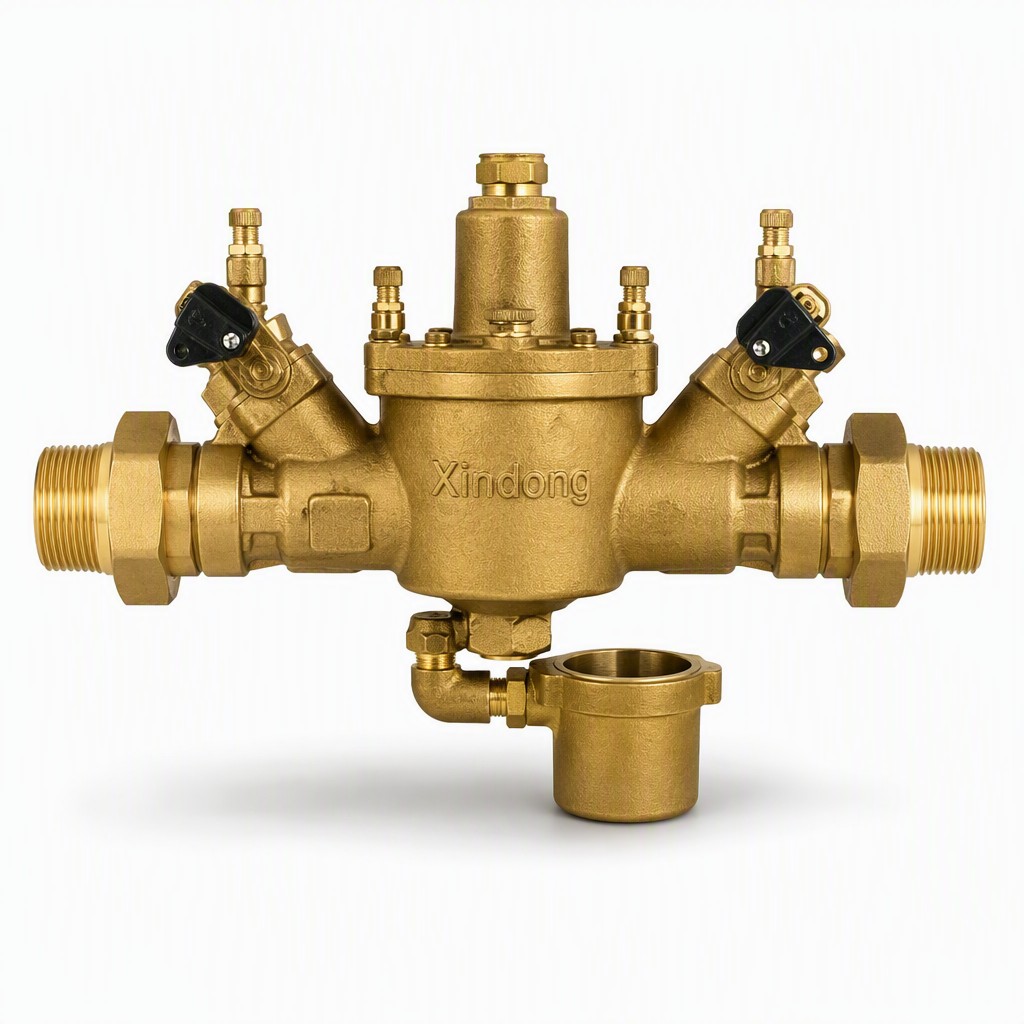
The workhorse of high-hazard backflow protection. An RPZ valve contains two check valves separated by a "zone" maintained at a lower pressure than the supply side by a differential relief valve. If either check valve fails, the relief valve opens and discharges water to atmosphere—visibly, and unambiguously—rather than allowing a cross-connection. This is the required assembly for Fluid Category 5 hazards. RPZ valves must be installed with a visible air gap at the relief discharge point, and many jurisdictions require the discharge to be plumbed to a drain with a visible tundish.
RPZ valves impose the highest pressure drop of the three main types—typically 8–12 psi (0.55–0.83 bar) at rated flow. In low-pressure municipal systems or high-rise buildings with marginal incoming pressure, this may require a booster pump downstream. Always check the manufacturer's published pressure loss curve before specifying.
An RPZ valve with an integrated bypass metering line, used primarily on fire sprinkler connections where the utility needs to detect unauthorized water use (e.g., someone tapping the sprinkler main for irrigation) while maintaining full RPZ-level backflow protection.
| Premises Type | Typical Fluid Category | Required Assembly | Notes |
| Office building (no kitchen) | 3 | Single or double check | Confirm no shared commercial kitchen |
| Restaurant / commercial kitchen | 4 | DCVA minimum | Grease interceptor upstream does not change fluid category |
| Hotel with spa and pool | 4-5 | RPZ | Pool chemical dosing raises hazard to Cat 5 |
| Dental practice | 4 | DCVA minimum | Biological hazard from suction lines |
| Hospital / healthcare | 5 | RPZ | No exceptions—RPZ mandatory at service connection |
| Fire sprinkler (wet, no additives) | 3 | Double check | Confirm no antifreeze in system |
| Fire sprinkler (glycol/foam) | 5 | RPZ or RPDA | Antifreeze = high hazard automatically |
| Car wash | 5 | RPZ | Detergent and grit backflow risk |
| Chemical plant / laboratory | 5 | RPZ | RPZ with air gap at discharge |
Backflow preventers are among the most frequently mis-installed devices in commercial plumbing. Three errors dominate field failures:
1. Inadequate clearance for testing: An RPZ or DCVA without 300mm (12 inches) of clearance on every test cock port is untestable—and therefore noncompliant. The test kit must physically connect, and the tester needs line of sight to a pressure gauge. Wall-hung installations in cramped mechanical cupboards are the worst offenders.
2. Flooding the relief valve: An RPZ installed in a pit, vault, or below-grade location where the relief port can become submerged during a drain backup is a failed installation. The relief valve must discharge freely to atmosphere. If the discharge port is underwater, backpressure can disable the relief mechanism.
3. Thermal expansion locking: In closed-loop systems with a backflow preventer at the service entrance, thermal expansion from water heating has nowhere to go. The resulting pressure spike can lock the check valves closed or damage the assembly. Always install a thermal expansion tank or pressure relief valve downstream of an RPZ on a closed system.
Backflow prevention assemblies are mechanical devices with seals, springs, and seats that degrade over time. Annual testing by a certified backflow tester is a legal requirement in virtually every jurisdiction with a cross-connection control ordinance. The test procedure follows a standardized sequence (check valve #1 integrity, check valve #2 integrity, relief valve opening point, relief valve tightness) and must be documented on an approved test report form submitted to the water utility.
Facility managers should maintain a digital register of every backflow preventer on the premises, including make, model, serial number, installation date, test due date, and the last test report. Cloud-based compliance platforms now offer automatic test reminders and digital report submission, which is worth the modest subscription cost for any facility with more than five preventers to manage.
Specify assemblies with:
• Solid brass or bronze body (not plastic-bodied residential-grade units for commercial applications)
• Replaceable seat and seat disc (enables in-line repair without replacing the entire valve body)
• Integrated full-port isolation valves with test cocks (reduces installation complexity)
• Third-party approval to a recognized standard: ASSE 1013/1015 (North America), WRAS (UK), EN 1717 (EU), or equivalent
• Low-lead or lead-free compliance (NSF/ANSI 372 or NSF/ANSI 61, Annex G) for potable water contact
Zhejiang Xindong Sanitary Ware Co., Ltd. manufactures precision brass check valve cartridges, double check valve assemblies, and custom backflow prevention solutions with WRAS, ACS, NSF/Lead-free, and CE certifications. Our in-house CNC machining and casting capability supports OEM/ODM valve assemblies tailored to municipal and commercial cross-connection control program requirements across 40+ export markets.
To request technical datasheets, flow curves, or discuss a custom backflow prevention valve assembly for your municipal or commercial project, contact our engineering team at [www.cn-xindong.com](https://www.cn-xindong.com).
 Hot News
2026-10-17
2026-10-16
2026-10-15
2026-10-14
2026-10-13
2026-10-12

The company, founded in 1999 and located in Yuhuan,specializes in taps, thermostatic shower valves and shower kits. With over 30,000 sqm of space and 380+ employees, we hold numerous certifications and 65+ patents.
 EN
EN