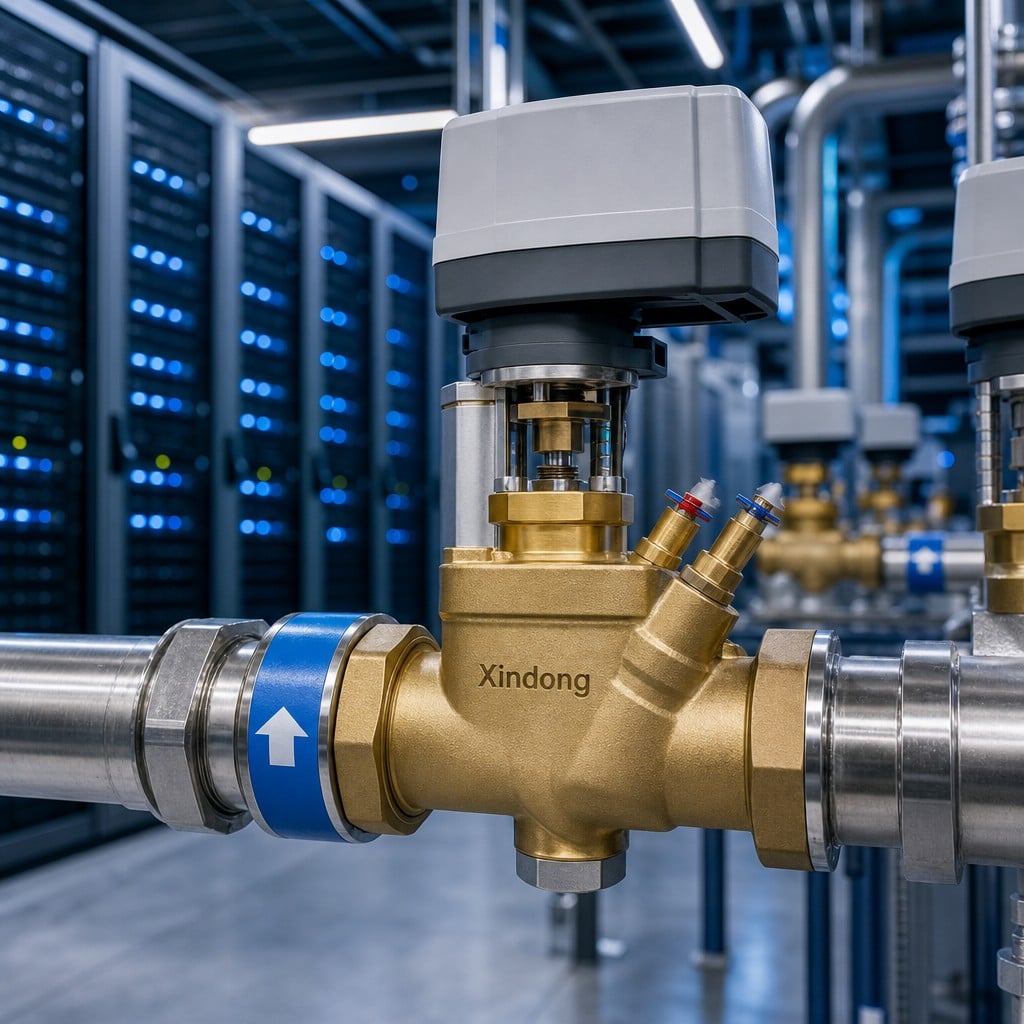
A Tier IV data center cooling loop has exactly one acceptable failure mode: none. When 50,000 servers in a colocation facility depend on a continuous supply of chilled water at precisely 18°C ±1°C, the difference between a valve that modulates to 0.1% of its stroke and one that hunts a 3°C deadband is the difference between a routine day and an emergency call to the facility director at 3 AM.
Valves are the least discussed and most consequential components in data center cooling infrastructure. Pumps and chillers get the attention and the budget. Valves get specified in the last 5% of the design phase, often by copying a specification from a previous project. This is a mistake.
A typical data center cooling loop contains valves at five critical positions:
1. Chiller isolation valves: Full-bore butterfly or ball valves that must close reliably after years of remaining open. Failure means you cannot isolate a chiller for maintenance while the data hall remains live.
2. Primary loop balancing valves: Set once during commissioning, then rarely touched. Accuracy matters more than cycle life.
3. Secondary loop control valves: The valves that modulate continuously to maintain supply air temperature at the computer room air handler (CRAH) or computer room air conditioner (CRAC) level. These valves cycle millions of times over their service life.
4. Direct-to-chip (liquid cooling) flow regulation valves: The highest-precision requirement. A server cold plate requires a specific flow rate; ±5% deviation can create hot spots that throttle processor performance or trigger thermal shutdown.
5. Makeup water and blowdown valves: Used on the condenser water side in cooling tower systems. Less precision-critical but must handle chemically treated water without corrosion or scaling failure.
Each position has distinct specification requirements. A balancing valve from position #2 has no business in position #4.
For modulating control valves in data center secondary loops, three performance parameters determine whether the cooling system holds its setpoints:
Rangeability is the ratio of maximum controllable flow to minimum controllable flow. A valve with 50:1 rangeability and a maximum flow of 100 GPM can accurately control flow down to 2 GPM. Below that, flow becomes unstable or the valve effectively acts as on/off. Data center cooling loops with variable primary flow and low-load conditions (e.g., nighttime, winter economizer mode) demand valves with rangeability of at least 50:1, and preferably 100:1 for direct-to-chip applications.
Hysteresis is the difference in valve position for a given control signal depending on whether the valve is opening or closing. In a feedback loop, hysteresis creates oscillation—the BMS commands "more cooling," the valve overshoots, the BMS commands "less cooling," and the cycle repeats. This is not just inefficient; it can cause condensation on cold surfaces inside the data hall. Look for valves with published hysteresis of less than 1% of full stroke.
Equal-percentage trim produces a logarithmic relationship between stem position and flow. At 50% stem lift, flow is roughly 10–20% of maximum. This characteristic compensates for the nonlinear heat transfer behavior of coils, providing near-linear control of heat output across the valve's operating range. Linear trim, while intuitive, creates unstable control at low flows and should be avoided for cooling coil modulation in data centers unless the coil manufacturer specifically recommends it.
In a data center with variable-speed primary pumps, differential pressure across each control valve changes continuously as pumps ramp up and down. A conventional control valve exposed to varying pressure delivers varying flow even at constant stem position—a phenomenon called "valve authority loss."
Pressure-independent control valves solve this by integrating a differential pressure regulator with the control valve in a single body. The internal regulator maintains constant pressure across the control valve's trim regardless of system pressure fluctuations, so flow is a predictable function of control signal alone. For direct-to-chip cooling and any application where flow stability directly protects server hardware, PICVs are rapidly becoming the default specification. Expect a price premium of 30–50% over conventional control valves, and confirm the manufacturer's minimum differential pressure requirement—typically 2–5 psi (14–35 kPa)—to ensure the internal regulator can operate.
Data center cooling loops present a deceptively aggressive environment for valve materials:
• Treated water chemistry: Corrosion inhibitors, biocides, and pH stabilizers in closed loops can attack certain elastomeric seals and accelerate dezincification in non-DZR brass.
• Glycol solutions: Data centers in cold climates often mix 20–40% propylene or ethylene glycol into chilled water loops for freeze protection. Glycol reduces the lubricity of water and accelerates wear on valve stem seals and seat materials. Specify EPDM or FKM (Viton) seals for glycol service; nitrile (Buna-N) may swell and degrade.
• Oxygen ingress: Closed loops are never perfectly closed. Makeup water introduces dissolved oxygen that drives corrosion in ferrous components. Brass body valves with DZR alloy designation eliminate this concern on the valve side.
For data center isolation valves in the 2–6 inch (DN50–DN150) range, specify DZR brass ball valves with PTFE seats and FKM stem seals. For larger diameters, EPDM-seated butterfly valves with stainless steel discs and 316 stainless steel stems are the cost-effective alternative. Avoid cast iron valve bodies in closed chilled water loops unless lined or coated; stray current corrosion from nearby electrical infrastructure can accelerate iron degradation.
A modulating control valve in a CRAH unit that adjusts position every 30 seconds accumulates over 1 million cycles per year. Valves specified for "general HVAC service" with no published cycle life rating are gambling with uptime. Look for valves with a published endurance rating—typically 100,000 to 500,000 full-stroke cycles for industrial-grade control valves—and verify the rating applies to the specific temperature and pressure conditions of your loop, not just ambient water at 20°C.
Valve packing design is equally critical for high-cycle service. Live-loaded packing with Belleville spring washers maintains seal compression as the packing wears, extending the maintenance-free service interval. A valve with live-loaded packing and a polished stem surface finish of Ra ≤0.2 µm will typically outlast an equivalent valve with conventional packing by 3–5x in high-cycle modulation service.
Data centers are designed with N+1 or 2N redundancy for every major component—chillers, pumps, CRACs, power feeds. Valves deserve the same treatment. On every chiller and CRAH branch, specify double isolation: two valves in series with a bleed port between them. This allows positive isolation of any single component for maintenance while the loop remains pressurized and operational. The incremental cost of a second isolation valve is negligible compared to the cost of a full-loop shutdown.
Data center MEP specifications increasingly demand:
• Full traceability from melt to finished valve
• Material test certificates to EN 10204 Type 3.1 or 3.2
• Factory pressure testing at 1.5× rated working pressure with documented test reports
• WRAS, NSF/Lead-free, or equivalent potable water contact certification (even for non-potable cooling loops, as commissioning and flushing may use potable water)
• Low-lead brass compliance for soldered or threaded connections
Zhejiang Xindong Sanitary Ware Co., Ltd. manufactures precision brass ball valves, check valves, and custom valve assemblies with full WRAS, ACS, CE, and NSF/Lead-free certification. Our 30,000-square-meter facility includes in-house CNC machining, pressure testing stations, and a dedicated R&D team supporting OEM/ODM valve development for mission-critical cooling applications. With 25+ years of manufacturing experience and 65+ patents, we deliver the documentation trail and quality consistency that data center projects demand.
For material test certificates, endurance test data, or to discuss a custom valve specification for your data center project, contact our engineering team at [www.cn-xindong.com](https://www.cn-xindong.com).
 Hot News
2026-10-17
2026-10-16
2026-10-15
2026-10-14
2026-10-13
2026-10-12

The company, founded in 1999 and located in Yuhuan,specializes in taps, thermostatic shower valves and shower kits. With over 30,000 sqm of space and 380+ employees, we hold numerous certifications and 65+ patents.
 EN
EN