When a commercial landlord receives a single £12,000 quarterly water bill covering a mixed-use building with a ground-floor restaurant, two floors of offices, and a basement gym, the instinct is often to divide by square footage and call it a day. The restaurant tenant—whose commercial kitchen accounts for 60% of the building's water consumption—quietly benefits from a subsidy paid for by the accountants upstairs. This arrangement is not just unfair; it is increasingly untenable as water costs rise and tenants demand billing transparency.
Water submetering solves this problem, but only when the physical hardware—valves, meters, and backflow preventers—is specified correctly from the outset.
Three forces are converging to make submetering essential for commercial landlords. First, water utility tariffs across Europe and North America have risen by 30–50% over the past decade, turning water from a negligible line item into a material operating expense. Second, ESG reporting frameworks increasingly require landlords to disclose and reduce water consumption at the tenant level—an impossible ask without submetered data. Third, tenants in premium commercial buildings now expect utility billing transparency as a matter of course, much as they expect individually metered electricity.
The business case is straightforward: submetering typically reduces total building water consumption by 15–30% simply by making usage visible and billable. Tenants who pay for what they use fix leaks faster. The investment in submetering infrastructure typically pays back within 18–36 months through reduced consumption and recovered costs.
Most discussions about submetering start with the meter. The experienced facility manager starts with the valve.
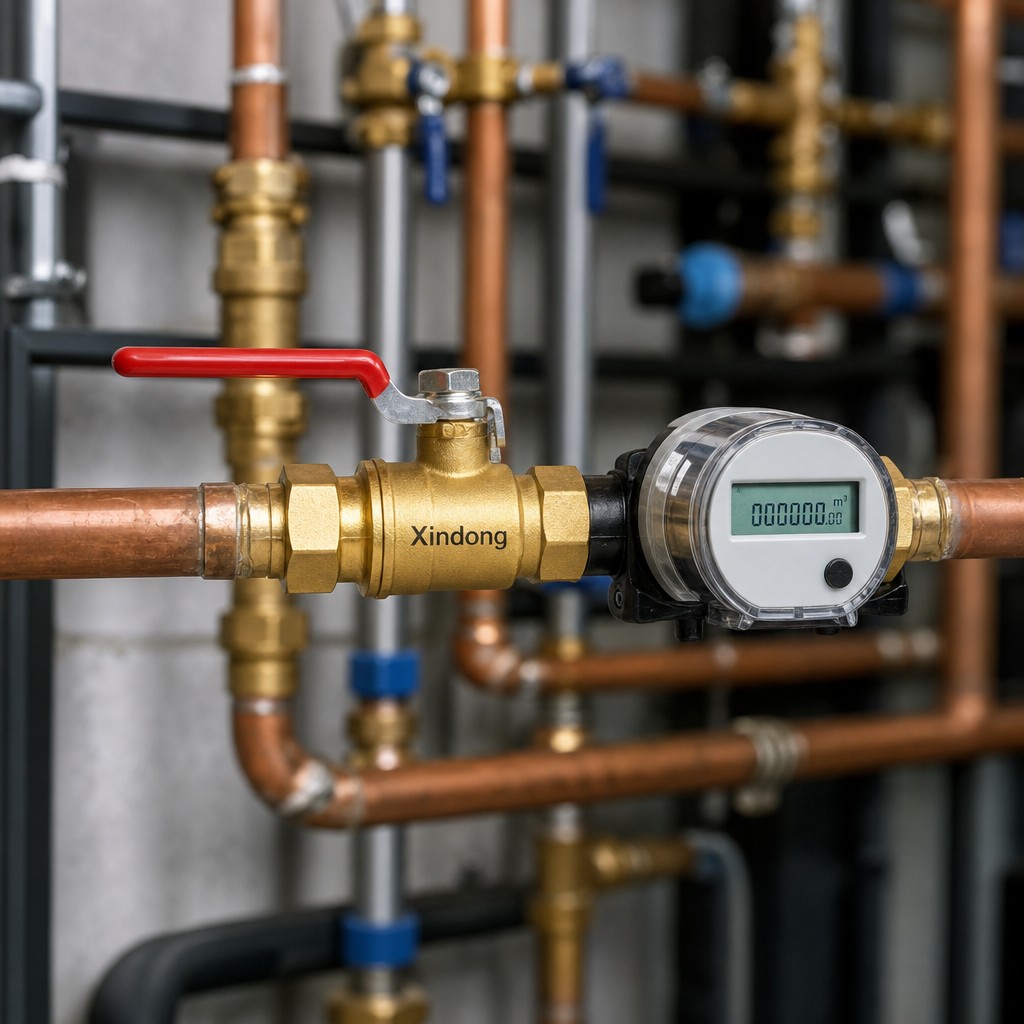
Every submeter installation requires at least two precision isolation valves per tenant branch: one upstream of the meter (for meter replacement or calibration without shutting off the building riser) and one downstream (for tenant-side isolation during fit-out changes or leak events). Cheap ball valves that seize after two years of inactivity undermine the entire investment. The valve that cannot close when a tenant's dishwasher floods the floor at 2 AM is the valve that just cost you an insurance claim.
Specify full-bore, quarter-turn brass ball valves with PTFE seats and blowout-proof stems. For submetering applications, the valve must maintain a bubble-tight shutoff even after prolonged periods in the fully open position—a characteristic that distinguishes industrial-grade valves from residential plumbing components. DZR (dezincification-resistant) brass is essential in areas with aggressive water chemistry, particularly in regions with soft or acidic water that accelerates dezincification in standard brass alloys.
For multi-tenant risers, consider lever-handle isolation valves that allow facility staff to visually confirm open/closed status at a glance. In mechanical rooms where multiple tenant branches converge, color-coded handles or clearly labeled tag systems reduce the risk of isolating the wrong tenant during maintenance—an expensive mistake that destroys tenant trust.
Once the physical isolation infrastructure is in place, the meter selection determines the quality of billing data. Ultrasonic and electromagnetic flow meters offer the highest accuracy (±1–2%) and have no moving parts to foul or wear, making them ideal for submetering applications with variable flow rates. For budget-conscious retrofits, multi-jet or single-jet mechanical meters with pulse outputs can feed data into a building management system (BMS) at lower upfront cost, though annual recalibration should be factored into the lifecycle budget.
The pulse output from each submeter should feed into either a dedicated submetering data concentrator or directly into the BMS via Modbus, M-Bus, or LoRaWAN, depending on building scale and existing infrastructure. Cloud-based submetering platforms have matured significantly and now offer tenant-facing dashboards, automated invoice generation, and leak detection algorithms worth the subscription cost for buildings with ten or more tenants.
Every submetered tenant connection is effectively a service connection from the building's perspective, and most water utilities require backflow prevention at each submeter takeoff. The required protection level depends on the tenant's fluid category risk:
• Fluid Category 3 (office, retail): A verified single check valve cartridge may suffice.
• Fluid Category 4 (restaurant kitchen, laboratory, dental practice): A testable double check valve assembly (DCVA) or reduced pressure zone (RPZ) valve is typically mandated.
• Fluid Category 5 (commercial laundry, chemical storage, medical): An RPZ valve with a visible discharge tundish and regular testing regime is non-negotiable.
The critical specification detail: ensure your backflow prevention assemblies have integrated isolation valves and test cocks. Annual backflow testing is a legal requirement in most jurisdictions, and a backflow preventer without accessible test points means the plumber will need to break into the pipework—adding hours of labor and tenant disruption to what should be a 15-minute test procedure.
Submetering creates the data. How you bill it back to tenants is a commercial decision, but three models dominate:
1. Direct meter read: Each tenant is billed based on actual consumption at an agreed rate per cubic meter. Most transparent, most fair, highest administrative burden.
2. Hybrid allocation: A fixed percentage of the common-area water (cooling tower make-up, irrigation, cleaning) is allocated across all tenants, while submetered consumption is billed directly. Common in buildings with significant shared water usage.
3. Ratio utility billing system (RUBS): Total water cost is allocated based on a formula combining submetered consumption, tenant square footage, and occupancy factors. Used when 100% submetering coverage is impractical.
For buildings transitioning from a master-metered model, consider a 12-month parallel billing period where tenants see both their old allocation and their new submetered bill without being charged the latter. This transparency builds buy-in and surfaces anomalies before they become disputes.
A submetering system is only as credible as its commissioning report. After installation, flow-test each meter at three points across its operating range (low, medium, high) and record accuracy against a calibrated reference meter. Document every isolation valve's torque requirement and cycle count. Share the commissioning report with tenants—it is your evidence that the system is fair.
Schedule annual isolation valve cycling to prevent seizing, biannual meter accuracy verification against portable reference meters, and annual backflow preventer testing by a certified tester. Budget for this maintenance as a line item in the service charge; tenants who see their water bills shrink by 20% after submetering rarely object to the cost of keeping the system accurate.
When sourcing valves and backflow preventers for a submetering project, look for:
• Solid brass bodies (DZR where water chemistry demands it) to BS EN 12165
• WRAS, ACS, or NSF/Lead-free product-level approvals covering the full valve assembly, not just the material
• Full-bore design with minimal pressure drop (confirm the Kv/Cv flow coefficient from the manufacturer's datasheet)
• Blowout-proof stem design with visible position indication
• Integrated test cocks and isolation valves on backflow assemblies
• OEM capability for custom manifold assemblies combining isolation, metering, and backflow in a single pre-tested module
Zhejiang Xindong Sanitary Ware Co., Ltd., with 25+ years of precision valve manufacturing and WRAS, ACS, CE, and NSF certifications, supplies OEM/ODM brass isolation valves, check valve cartridges, and custom valve assemblies for submetering applications across commercial, hospitality, and multi-residential projects.
For technical datasheets, flow coefficient curves, or to discuss a custom valve manifold for your submetering project, visit [www.cn-xindong.com](https://www.cn-xindong.com) or contact our commercial engineering team.
 Hot News
2026-10-17
2026-10-16
2026-10-15
2026-10-14
2026-10-13
2026-10-12

The company, founded in 1999 and located in Yuhuan,specializes in taps, thermostatic shower valves and shower kits. With over 30,000 sqm of space and 380+ employees, we hold numerous certifications and 65+ patents.
 EN
EN