Water reuse has moved from green-building aspiration to regulatory requirement. BREEAM, LEED, and local building codes now incentivise — or mandate — greywater recycling and rainwater harvesting in commercial projects. For the MEP engineer, this means designing pipework networks that carry non-potable water safely alongside potable supplies.
The stakes are high. A single cross-connection between a reclaimed water line and the potable supply can contaminate an entire building's drinking water — or worse, backflow into the public mains. Valve specification is the primary line of defence.
BS EN 1717 classifies water into five fluid categories based on the hazard they present to human health. The category determines the backflow protection required:
| Fluid Category | Examples | Required Backflow Protection |
| 1 | Wholesome water from public mains | None (source) |
| 2 | Water that has changed temperature or taste | Single check valve |
| 3 | Water with low-hazard substances | Double check valve |
| 4 | Water with toxic or carcinogenic substances | RPZ valve or break tank with air gap |
| 5 | Water with pathogenic organisms (sewage, greywater) | Break tank with AA or AB air gap |
Greywater — from showers, basins, and laundry — typically falls into Fluid Category 5. Even treated greywater that has passed through filtration and disinfection carries residual risk and should be treated as Category 4 or 5 depending on the treatment standard and local water authority requirements.
For non-potable reuse systems, backflow protection is layered:
Every reclaimed water storage tank must have a verified air gap between the potable make-up supply and the tank's maximum water level. The AA air gap (unrestricted discharge above the spillover level, ≥20 mm or 2× inlet diameter, whichever is greater) provides the highest level of protection. An AB air gap (with weir overflow) is the minimum acceptable for Category 5 fluids.
No valve, however well-engineered, replaces a physical air gap. RPZ valves are secondary protection, not primary.
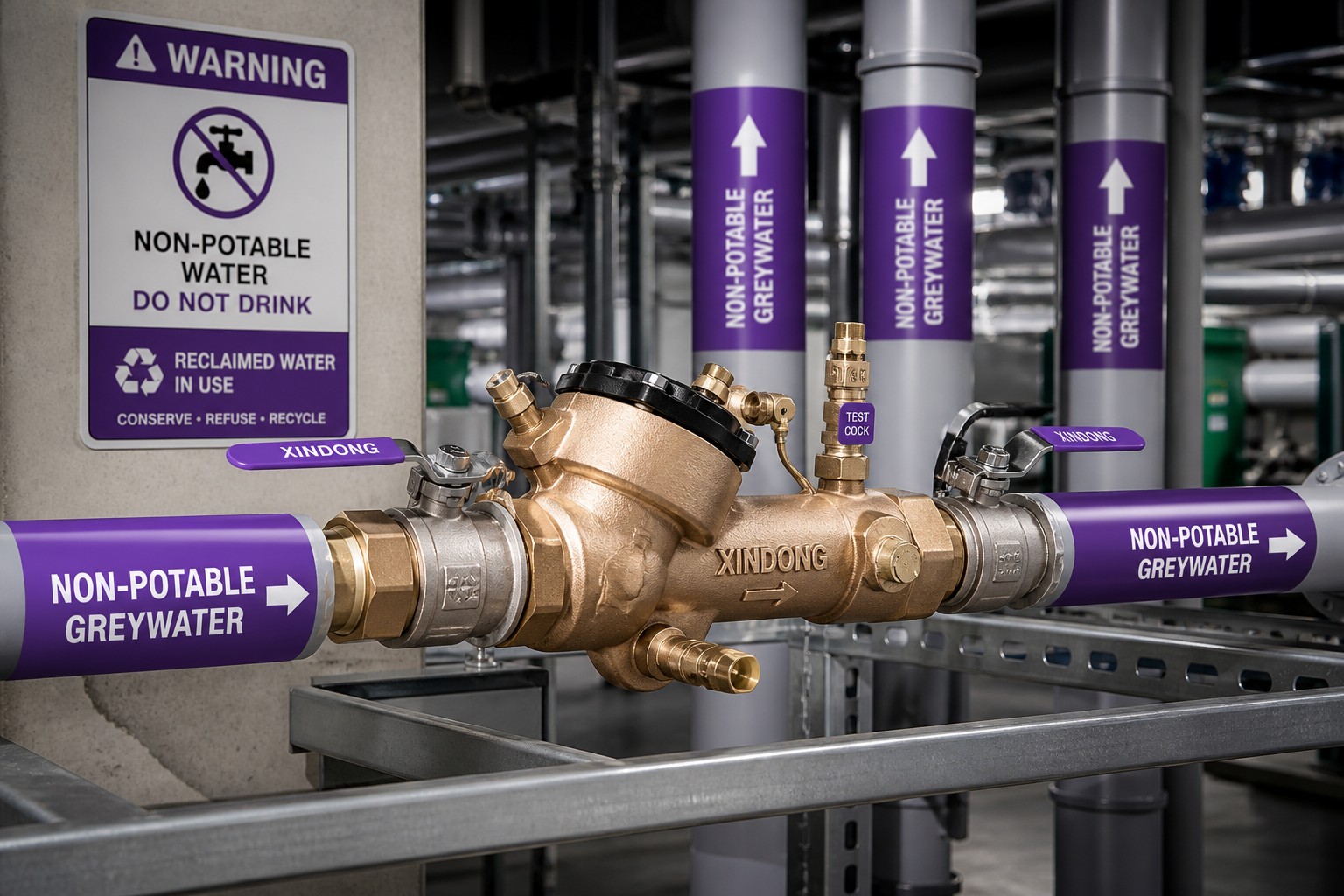
Where a direct pipe connection to a non-potable system is unavoidable — for example, a pressurised make-up line feeding a treatment system — an RPZ valve is the required backflow preventer. RPZ valves maintain a reduced pressure zone between two check valves, with a relief valve that discharges to atmosphere if the zone pressure rises. This creates a physical separation even without an air gap.
Specifying RPZ valves for greywater service requires attention to:
• Material compatibility: Brass body with dezincification-resistant (DZR) alloy specified for reclaimed water contact
• Strainer protection: An upstream Y-strainer prevents debris from the reclaimed water side from fouling the RPZ internals
• Test cock accessibility: RPZ valves require annual testing by a certified tester — install them where test cocks are accessible
• Drainage: The RPZ relief port discharges under fault conditions. Provide a tundish and visible trap to a drain
Each greywater distribution zone should be isolatable without affecting other zones. Full-bore ball valves or gate valves with purple-coloured handles (the universal colour for non-potable water) provide positive shut-off for maintenance.
Greywater is chemically different from potable water. It contains soaps, detergents, oils, suspended solids, and — depending on treatment — residual chlorine or chloramines from disinfection. These affect valve materials:
| Material | Suitability for Greywater | Notes |
| DZR brass (CW602N / CZ132) | Excellent | Resists dezincification in aggressive water; preferred for valve bodies and trim |
| Standard brass (CW617N) | Conditional | Acceptable for treated greywater with pH 6.5–8.5; at risk in acidic conditions |
| Stainless steel 316 | Excellent | Preferred for high-chloride treated effluent; higher cost |
| EPDM seals | Good | Standard O-ring material; compatible with most greywater chemistry |
| PTFE / Viton seals | Excellent | Use where chloramines are present in disinfection |
Xindong manufactures valve bodies in DZR brass as standard for commercial applications, with EPDM and PTFE seal options specified according to the water chemistry data provided by the project's water treatment consultant.
BS 1710 and ISO 14726 specify pipe colour coding:
• Potable water: Green (BS 4800 12 D 45) or blue
• Non-potable / reclaimed water: Purple (universally adopted in the US, Australia, and increasingly the UK)
• Greywater: Purple with black text band reading "GREYWATER — NOT FOR DRINKING"
Valve tags must follow the same colour convention. A maintenance technician opening a valve at 2:00 AM must be able to identify instantly that they are working on a non-potable line. Purple valve handles, purple pipe bands, and warning signage at every isolation point are not decorative — they are safety-critical.
Before a reclaimed water system is put into service, the MEP commissioning team must verify that no cross-connections exist between the potable and non-potable networks. The standard procedure:
1. Pressurise the non-potable system with coloured water (food-grade dye) at 1.5× operating pressure
2. Open every potable outlet in the building and run for 30 seconds
3. Collect water samples at the furthest outlets
4. Any coloured water detected = cross-connection present = system must not be commissioned until resolved
This test should be repeated after any major maintenance work on either system. Document the test date, pressure, and results in the building's Water Safety Plan.
For greywater and reclaimed water valve packages, the specification should call for:
• DZR brass valve bodies (CW602N or equivalent)
• RPZ backflow preventers with integral strainers and test cocks
• Purple-identified isolation valves at every zone boundary
• WRAS or equivalent approval for the target market
• Certificate of material conformity for all wetted components
Xindong has been manufacturing WRAS, CE, ACS, and NSF/Lead-free certified brass valves since 1999. Our DZR brass valves are specified in commercial water reuse projects across Europe and the Middle East, with full material traceability and technical submittal support for MEP consultants. From backflow preventers to zone isolation valves, we provide valve packages engineered for the specific chemical and hydraulic conditions of non-potable water networks.
Greywater systems are the future of sustainable building design. The valves that control them must be specified with the same rigour as the treatment plant they serve.
For valve data sheets and material certificates for water reuse projects, contact Xindong at [www.cn-xindong.com](https://www.cn-xindong.com).
 Hot News
2026-10-17
2026-10-16
2026-10-15
2026-10-14
2026-10-13
2026-10-12

The company, founded in 1999 and located in Yuhuan,specializes in taps, thermostatic shower valves and shower kits. With over 30,000 sqm of space and 380+ employees, we hold numerous certifications and 65+ patents.
 EN
EN