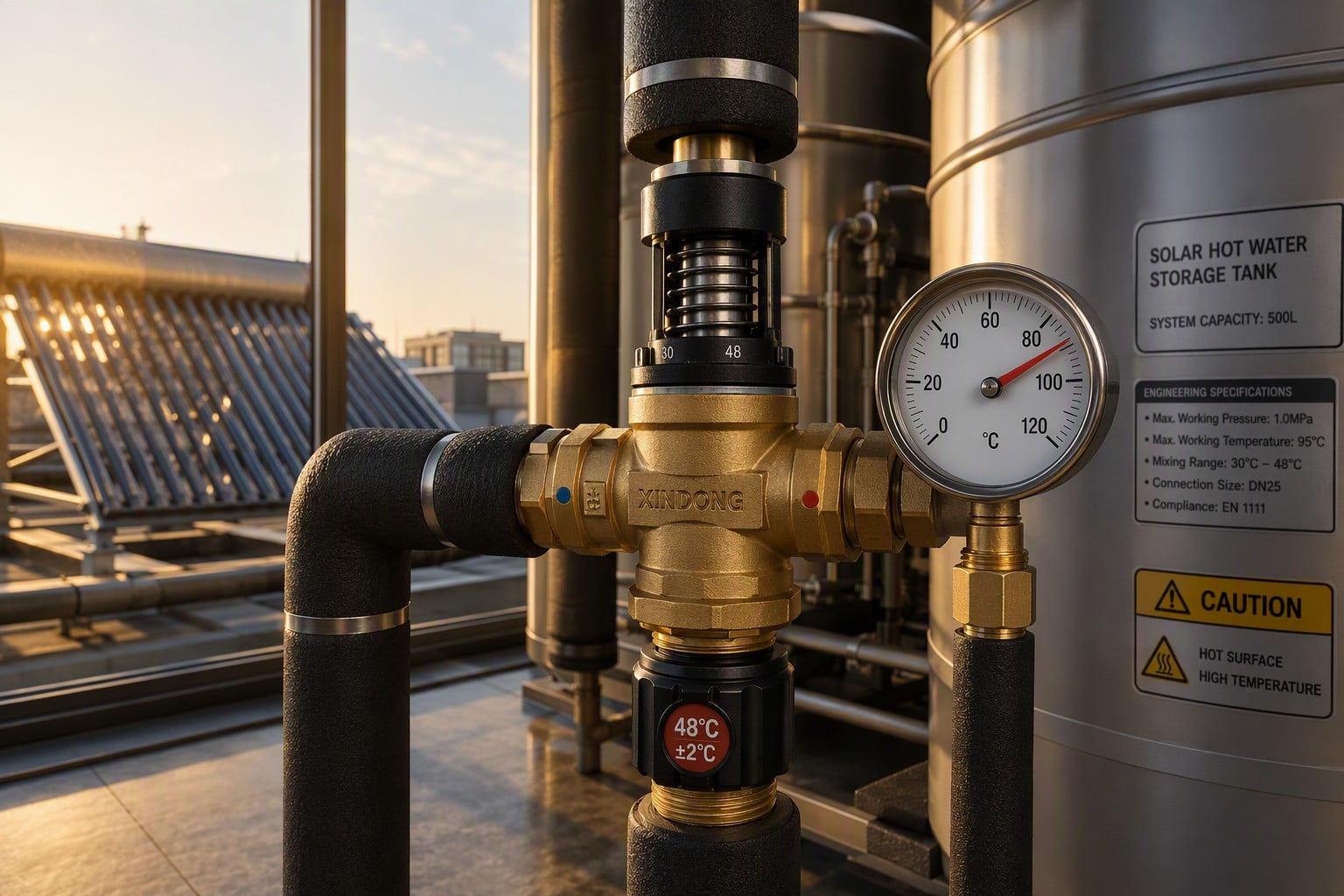
Solar thermal collectors routinely produce water temperatures that would destroy a standard domestic valve. On a clear summer day, a well-designed solar thermal array can drive storage tank temperatures past 85 °C — and under stagnation conditions, the collector itself can reach 200 °C.
For the MEP engineer and installer, this means every valve downstream of the solar storage tank must be specified for temperatures and thermal shocks that conventional plumbing components were never designed to handle.
Let's establish the actual operating conditions before discussing valve specifications:
| Operating Condition | Typical Temperature Range | Valve Exposure |
| Normal solar charging (summer) | 60–85 °C | Continuous, hours per day |
| High-charge stagnation | 85–99 °C in tank; 150–200 °C at collector | Intermittent, minutes to hours |
| Winter anti-freeze mode | –20 to 40 °C in collector loop | Low-temperature cycling |
| Backup heater boost (winter) | Steam formation possible if controls fail | Thermal shock |
The most dangerous scenario for valves: the system has been sitting in summer stagnation at 95 °C, and suddenly cold mains water enters the circuit when a tap opens. The thermal shock — a 75 °C temperature swing in under a second — can crack ceramic discs, warp plastic internals, and permanently deform standard EPDM seals.
A solar water heating system requires valves in three distinct locations, each with different thermal demands:
These are the most thermally stressed valves in the system. The collector loop transports heat-transfer fluid (typically glycol-water mixture) between the roof-mounted collectors and the storage tank heat exchanger. The valves in this loop — isolation valves, check valves, and air vents — must withstand:
• Temperature range: –30 °C to 200 °C (for stagnation survival)
• Fluid: Propylene glycol/water mixture, which is more aggressive than water on seals
• Pressure: Pump discharge pressure plus static head from the collector elevation
For collector loop isolation, specify full-bore ball valves with PTFE seats and graphite stem packing. Standard brass ball valves with PTFE seats are rated to ~180 °C, which covers normal operation but not extreme stagnation. For installations in high-insolation climates (Middle East, Southern Europe, Australia), consider stainless steel 316 valves for the collector loop.
Every solar storage tank requires a temperature and pressure relief (T&P) valve rated for the tank's maximum operating conditions. EN 12897 requires:
• Temperature relief setpoint: 95–99 °C (below boiling point at atmospheric pressure)
• Discharge capacity: Matched to the maximum energy input from the solar array
• Discharge pipe: Metallic, with continuous fall to a safe visible discharge point
A T&P valve that dribbles at 85 °C is wrongly specified. The relief point must be above the highest normal operating temperature (typically 85 °C during summer stagnation) but below boiling. A setpoint of 95 °C with a ±3 °C tolerance band is standard for solar thermal.
This is where the engineering gets interesting. A TMV on the hot water distribution side of a solar thermal system has two jobs:
1. Blend high-temperature stored water (65–95 °C) down to a safe delivery temperature (38–46 °C)
2. Protect itself against sustained inlet temperatures that would degrade a standard TMV cartridge
A standard TMV2 valve is tested for continuous hot water inlet temperatures up to 85 °C. In a solar-charged storage tank, the TMV hot inlet may see 90–95 °C for hours at a time during summer. Specifying a valve not rated for this condition leads to:
• Thermal element fatigue: The wax-filled thermostatic capsule loses responsiveness after prolonged exposure above its design maximum
• Seal degradation: EPDM O-rings and diaphragms harden and crack
• Spring relaxation: The return spring that closes the hot port loses tension, causing temperature drift
The specification checklist for a solar-duty TMV:
| Requirement | Minimum Specification | Preferred Specification |
| Maximum continuous hot inlet temperature | 85 °C | 95–99 °C |
| Thermal element type | Wax capsule | High-temperature wax capsule with metal over-travel stop |
| Seal material | EPDM | PTFE or high-temperature EPDM (peroxide-cured) |
| Anti-scald fail-safe | Shuts within 2 seconds of cold failure | Shuts within 1 second; outlet <43 °C |
| Serviceability | Replaceable cartridge | Replaceable cartridge without valve body removal |
Xindong manufactures TMV2- and TMV3-certified thermostatic mixing valves with high-temperature rated cartridges for solar thermal applications. Our engineering team can provide temperature derating curves and material certificates for solar duty specifications, supporting MEP consultants with technical submittal packages for renewable energy projects.
For systems where storage tank temperatures routinely exceed the TMV's continuous rating, the most robust solution is a pre-cooling heat exchanger between the storage tank and the TMV. A small plate heat exchanger on the cold water supply pre-cools the hot water before it reaches the TMV inlet:
• Cold mains water at ~15 °C passes through one side of the plate exchanger
• Hot water from the solar tank at 90 °C passes through the other side
• The TMV hot inlet receives water at a pre-cooled temperature of ~70 °C
• The cold water that did the pre-cooling is now pre-heated to ~35 °C, reducing the TMV's blending duty
This arrangement extends TMV service life significantly, reduces anti-scald risk by narrowing the blending range the TMV must handle, and recovers waste heat into the cold supply — a small energy bonus.
Commissioning a solar thermal system requires the same TMV testing procedure as a conventional system (see our companion article on BS 7949 commissioning), with these additions:
1. Test at maximum storage temperature: Run the backup heater (if fitted) to bring the storage tank to its maximum design temperature, then perform the full TMV commissioning sequence. A TMV that passes at 65 °C may fail at 85 °C.
2. Verify T&P discharge: Manually lift the T&P valve test lever and verify free discharge. Do this with the system cold — never attempt to lift a T&P valve on a hot, pressurised tank.
3. Stagnation simulation: During summer commissioning, isolate the collector loop pump and monitor collector and tank temperatures for 30 minutes. Verify that the system's over-temperature protection controls activate before any valve exceeds its rated temperature.
4. Document solar-specific readings: In addition to standard TMV commissioning data, record the solar collector stagnation temperature, storage tank maximum temperature, glycol concentration, and the T&P valve rating and setpoint.
Solar thermal is a 25-year investment. The collectors on the roof may last that long with minimal maintenance, but the valves in the plant room will be replaced at least once — unless they are specified correctly from day one. The marginal cost of upgrading from a standard TMV to a high-temperature solar-rated TMV is negligible compared with the cost of cartridge replacement, call-out labour, and tenant disruption over the system's life.
Zhejiang Xindong Sanitary Ware Co., Ltd. has been manufacturing valves for the global plumbing industry since 1999. With 65+ patents, WRAS/CE/ACS/NSF certifications, and a monthly production capacity exceeding 200,000 sets, we supply thermostatic mixing valves, temperature relief valves, and isolation valves engineered for the thermal demands of renewable energy systems. Our technical team supports MEP specifiers with material certificates, temperature rating documentation, and project-specific valve schedules.
Solar thermal integration is not a niche — it is the direction of travel for commercial plumbing. Specifying valves that are thermally up to the job is the quiet engineering decision that protects the system for decades.
For valve specifications and high-temperature application support, contact Xindong at [www.cn-xindong.com](https://www.cn-xindong.com).
 Hot News
2026-10-17
2026-10-16
2026-10-15
2026-10-14
2026-10-13
2026-10-12

The company, founded in 1999 and located in Yuhuan,specializes in taps, thermostatic shower valves and shower kits. With over 30,000 sqm of space and 380+ employees, we hold numerous certifications and 65+ patents.
 EN
EN