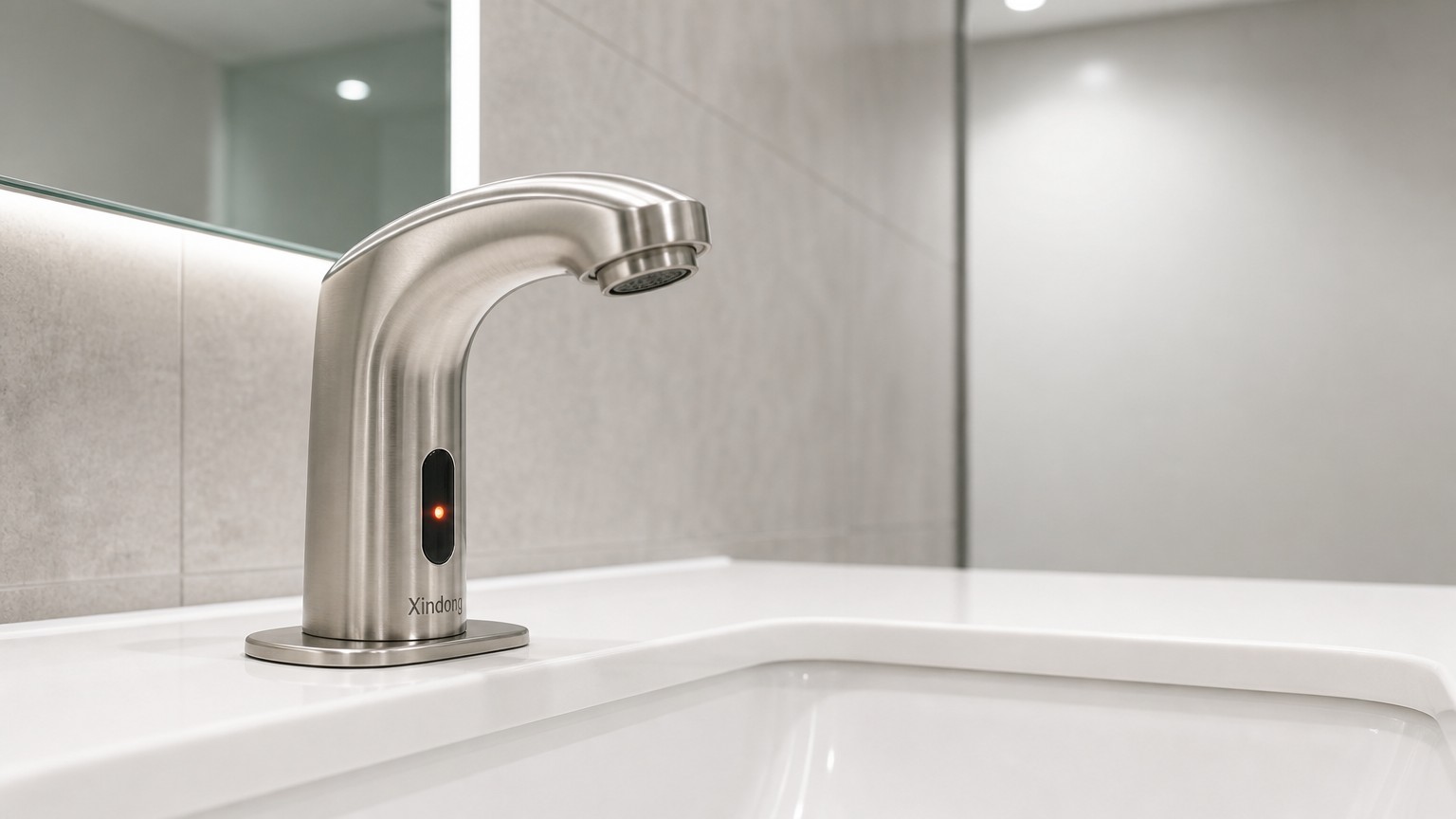
Touchless faucets are now standard in airport washrooms, hospital hand-wash stations, food-service kitchens, and high-traffic office facilities — not because they are novel, but because they are measurably more hygienic and cut water consumption by 30–70% versus manual fixtures. But "sensor faucet" is not one technology. Under the spout, two fundamentally different sensing principles compete: active infrared (IR) proximity sensing and capacitive sensing. They behave differently with dark objects, glossy surfaces, ambient sunlight, and water spray — and the wrong choice for an application shows up as phantom flushes, dead batteries, and calls to the maintenance desk.
This article gives MEP engineers, facility managers, and specifiers a decision-grade comparison of the two technologies.
An IR faucet contains an infrared emitter (LED) and a photodiode receiver, usually behind a window near the base of the spout. The emitter pulses IR light; when a hand enters the detection zone, the reflected pulse reaches the receiver and the controller opens the solenoid valve. When the hand withdraws and the reflection disappears, the valve closes, often after a short delay.
• Works at a distance — detection zones of 5–20 cm are typical, which suits sink geometries where the user's body must not trigger the faucet.
• No contact with the faucet surface at all; the hand never needs to touch anything.
• Low cost and mature supply chain; field-proven for decades.
• Reflectivity-dependent: dark clothing, dark skin tones, or matte-black objects absorb IR and reduce detection range; shiny or light-colored objects can reflect at unintended angles.
• Ambient-light interference: strong sunlight or high-CRI spotlights can saturate the receiver, causing missed or phantom activations unless the controller uses modulated (pulsed) IR with synchronous detection. Modulated IR is now standard, but cheap unmodulated designs still fail in bright washrooms.
• Water-spray false triggers: a water stream can refract and scatter IR, briefly registering as a hand.
• Continuous pulsing draws power even at idle, which matters for battery-operated units.
A capacitive faucet treats the spout or a sensor zone as one plate of a capacitor. The human body is a large, conductive, grounded object; when a hand approaches, it changes the electric field around the sensing electrode, and the controller detects that capacitance change. Crucially, the detection does not depend on the hand reflecting light — it depends on the hand's dielectric and conductive properties changing the field.
• Material-independent: dark gloves, wet hands, or a towel all change the field reliably. This makes capacitive sensing the stronger choice for kitchens, laboratories, and industrial hand-wash stations where users wear gloves or handle dark materials.
• Immune to ambient light — no optical window to fog, coat with soap scum, or saturate with sunlight.
• The sensor can be embedded in a solid brass spout with no visible window, which is easier to keep clean and far more vandal-resistant.
• Shorter, less predictable range — typically 2–8 cm, and the sensitivity depends on the surrounding installation (countertop material, pipework grounding, and water film on the spout all shift the baseline).
• More sensitive to installation variables — a capacitive faucet mounted on a conductive countertop or with long non-grounded supply hoses may need sensitivity tuning on site.
• Slightly higher unit cost in many configurations.
| Criterion | Infrared (IR) | Capacitive |
| Detection principle | Reflected IR light | Change in electric field |
| Detection range | 5–20 cm typical | 2–8 cm typical |
| Dark / matte objects | Reduced range | No effect |
| Ambient sunlight | Interference (needs modulated IR) | Immune |
| Water spray / soap film on window | Can false-trigger / block | No optical window |
| Gloved hands | Weak reflection, may miss | Detects reliably |
| Sensor visibility | Visible window required | Can be fully concealed in spout |
| Idle power draw | Pulses continuously | Low, event-driven |
| Vandal resistance | Window can be damaged/coated | Better |
| Typical cost | Lower | Slightly higher |
Choose IR when: the priority is a long, predictable activation zone over a standard white vitreous china basin; the washroom has controlled lighting; and users are ungloved (offices, retail, airports, schools). IR's longer range also gives more forgiveness for users who hover without entering the "sweet spot."
Choose capacitive when: the environment defeats optics — kitchen prep areas with gloves and dark cutting boards, labs, industrial wash stations, or any washroom with floor-to-ceiling glazing that pours sunlight onto the basin. Choose it also when vandal resistance and cleanability outrank range, such as public transport terminals and stadium concourses.
Don't forget the rest of the faucet. The sensor is one component in a system that also includes the solenoid, power source (battery, plug-in, or hardwired), mixing valve, and flow limiter. In commercial service, specify brass bodies (chrome or brushed-nickel finished), ceramic cartridges, and serviceable solenoid assemblies. A sensor that fails means a faucet that must be shut off — so specify units whose solenoid and controller can be replaced without decommissioning the fixture.
Zhejiang Xindong Sanitary Ware Co., Ltd. has manufactured brass faucets and valves since 1999, with 380+ employees, 65+ structural patents, in-house laboratory testing, and monthly output exceeding 200,000 sets. Our engineering team develops sensor faucet bodies, basins mixers, and thermostatic shower systems for OEM partners, supporting both IR and capacitive configurations with custom brass spout designs, finishes, and control electronics integration. For specifiers, that means the mechanical core — body, cartridge, finish, and durability — is built to the same standard as the sensor itself.
Whichever technology you choose, commission it with a three-point test: activation with a clean dry hand, activation with wet/soapy hands, and a 30-second idle check with the washroom lights on and off. If the unit passes all three without adjustment, the sensor choice fits the environment. If it fails, adjust sensitivity first, then re-check grounding and mounting before you blame the faucet.
About the author: The Xindong engineering team designs and manufactures brass valves, faucets, and thermostatic shower systems for commercial projects worldwide. Contact [[email protected]](mailto:[email protected]) or +86-0576-87499008 for samples, specifications, and OEM development. Visit [cn-xindong.com](https://www.cn-xindong.com) for the full range.
 Hot News
2026-10-17
2026-10-16
2026-10-15
2026-10-14
2026-10-13
2026-10-12

The company, founded in 1999 and located in Yuhuan,specializes in taps, thermostatic shower valves and shower kits. With over 30,000 sqm of space and 380+ employees, we hold numerous certifications and 65+ patents.
 EN
EN