Walk into a mechanical room in Singapore, Miami, or Dubai in August, and you will see the telltale signs within seconds: beads of condensation dripping from cold-water pipes, rust stains on uninsulated brass valve bodies, and puddles on the floor that breed mold, corrode adjacent steel supports, and eventually find their way into the ceiling of the floor below. What starts as a minor nuisance—"just pipe sweat," someone says—ends as a structural repair that costs more than the entire mechanical room plumbing installation.
Condensation on cold-water plumbing is physics, not a design flaw. But managing it correctly is a specification discipline that too many MEP engineers delegate to the insulation contractor. Here is the case for owning it upstream.
Pipe sweating occurs when the surface temperature of a pipe or valve drops below the ambient air's dew point. Cold water entering a building at 5–10°C flows through an unconditioned service riser at 30°C and 80% relative humidity. At those conditions, the dew point is approximately 26°C. The cold-water pipe surface—at perhaps 8°C with no insulation—is 18°C below the dew point. Condensation is immediate, continuous, and predictable.
The formula is simple: if T_surface < T_dewpoint, condensation occurs. The solution demands a systems approach, not a single product.
Closed-cell elastomeric foam insulation (e.g., nitrile rubber to ASTM C534 or EN 14304) is the standard material for cold-water pipe insulation in humid environments. Its closed-cell structure prevents water vapor from reaching the cold pipe surface—provided the insulation is thick enough to keep its outer surface above the local dew point.
The required insulation thickness is a function of three variables: pipe temperature, ambient temperature, and ambient relative humidity. ASHRAE Standard 90.1 and EN 12828 provide minimum thickness tables, but these assume "typical" conditions that often do not apply in tropical mechanical rooms. Calculate the required thickness for your specific worst-case ambient conditions, not the code minimum. In a mechanical room in Bangkok with 35°C ambient and 85% RH, a 2-inch (50mm) cold-water main carrying 7°C water may require 38mm of elastomeric insulation rather than the 25mm commonly specified from standard tables.
Critically, every butt joint, longitudinal seam, and termination must be sealed with the manufacturer's approved adhesive and vapor-barrier tape. A single unsealed joint in 100 linear meters of otherwise perfect insulation will create a localized condensation point that saturates adjacent insulation and propagates outward over months. This is why visual inspection of every seam before concealing insulation is the single most cost-effective quality control measure on any humid-climate plumbing project.
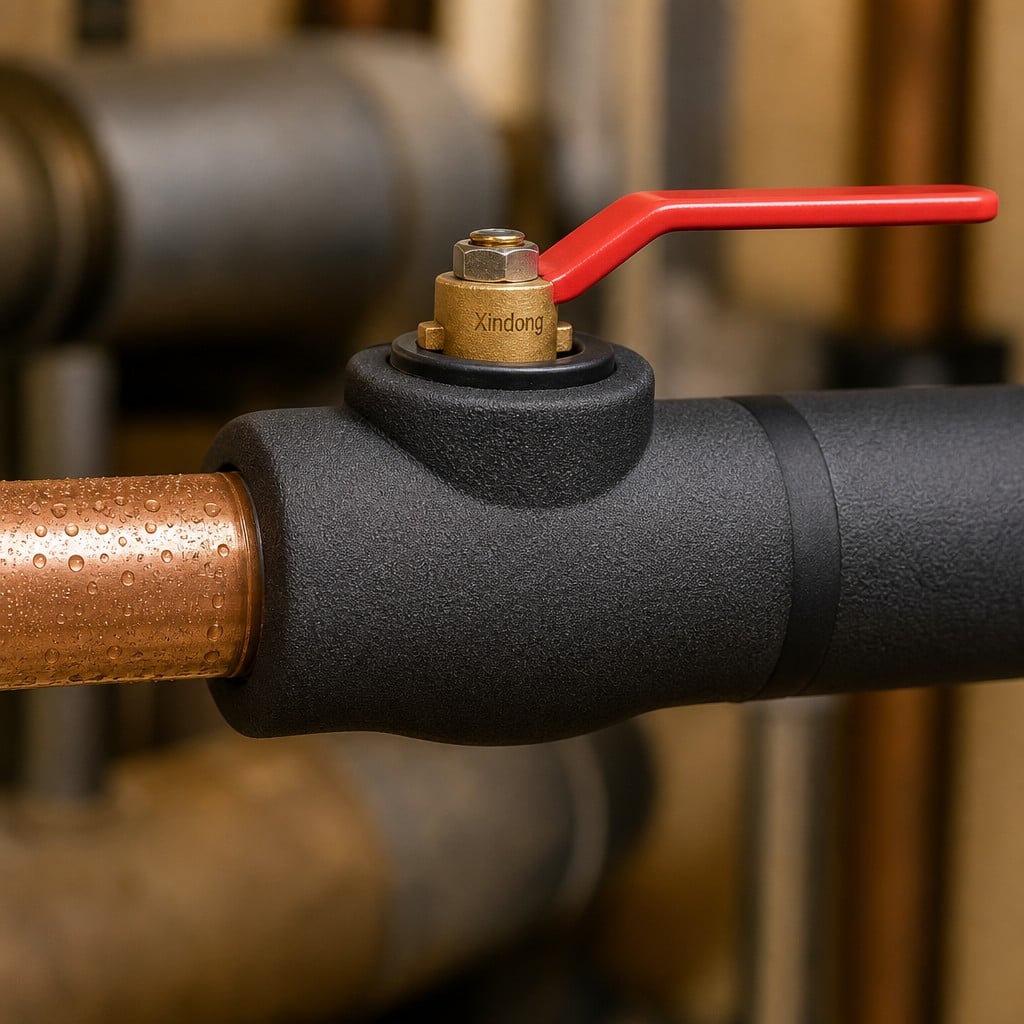
Here is the uncomfortable truth: most mechanical rooms with otherwise well-insulated pipework still sweat—at the valves. A brass ball valve body has roughly 5–8 times the thermal conductivity of closed-cell foam insulation. When a cold-water valve is installed in-line and insulated only up to the valve body, the exposed brass acts as a thermal bridge, pulling heat from the ambient air and dropping the valve surface temperature below the dew point. Condensation forms on the valve body, drips onto the stem packing nut, and eventually migrates into the packing material, accelerating corrosion and increasing stem torque.
Three approaches solve this, in ascending order of effectiveness:
1. Removable valve insulation jackets. Pre-fabricated or custom-fabricated elastomeric jackets that wrap around the valve body and seal with Velcro or snap fasteners. Serviceable—the jacket can be removed for valve operation—but dependent on proper reinstallation after each maintenance event. In facilities with high maintenance turnover, assume at least 20% of jackets will be missing or improperly sealed within two years.
2. Full encapsulation with extended stem access. A custom-molded, permanently adhered insulation shell covering the entire valve body and neck, with a tight-fitting boot over the stem area that allows handle operation. More reliable than removable jackets because there is nothing to lose, but must be specified during procurement and is harder to retrofit.
3. Thermally broken valve stem extensions. The most engineered approach: a valve with a factory-fitted thermal break between the brass body and an extended stainless steel stem. The thermal break (typically a glass-reinforced nylon or PPS polymer collar) interrupts the conductive path, keeping the handle and packing area above the dew point while the insulated valve body remains cold. Combined with full insulation encapsulation, this represents the gold standard for condensation-critical valve installations in data centers, healthcare facilities, and luxury hospitality.
Insulated cold-water pipes suspended from uninsulated steel clevis hangers create a direct thermal path from ambient air to the cold pipe surface. The hanger itself cools below the dew point, sweats, and the condensation follows the threaded rod down into the ceiling space below. This is a classic thermal bridging failure that insulation contractors routinely miss.
The solution is a high-density insulation insert—typically a preformed polyisocyanurate or high-density polyurethane block—placed between the pipe and the hanger, with a vapor barrier wrapping that overlaps the pipe insulation on both sides. For vertical risers, spring-loaded or hydraulic pipe supports must also be isolated from the pipe with thermal breaks.
Open-cell insulation (fiberglass, mineral wool) is fundamentally unsuitable for cold-water service in humid environments, regardless of thickness. Water vapor will diffuse through the open-cell structure and condense on the cold pipe surface inside the insulation. Over months, the insulation becomes saturated with water, loses its thermal resistance, and accelerates corrosion of the pipe beneath. If you inherit a building with fiberglass-insulated cold-water lines in a humid climate, plan to replace it with closed-cell insulation during the next available shutdown window. The cost of doing nothing is a concealed leak that announces itself through a collapsed ceiling.
Specification Checklist for Cold-Water Pipe Insulation in Humid Climates
| Element | Requirement |
| Insulation material | Closed-cell elastomeric foam (nitrile rubber) |
| Thickness | Calculated from worst-case ambient T + RH, not code minimum |
| Vapor barrier | Integral closed-cell structure (no separate foil wrap needed for elastomeric) |
| Joint sealing | Manufacturer's solvent-based adhesive + vapor-barrier tape, 100% continuous |
| Valve insulation | Factory-molded insulating shells or custom-fabricated jackets with stem boot |
| Pipe supports | High-density insulation block + vapor barrier wrap at every hanger and support |
| Penetrations | Insulation continuous through wall/floor penetrations; fire-stopping to maintain vapor seal |
| Commissioning | Visual inspection of every joint before concealing; IR thermography of completed system under worst-case ambient conditions |
Brass valves installed on cold-water lines in humid environments face a double threat: external condensation and internal chloramine or chlorine residuals in municipal water. DZR (dezincification-resistant) brass to BS EN 12165 or CW602N is strongly recommended, as standard brass alloys are susceptible to dezincification—a form of corrosion where zinc leaches from the alloy, leaving a porous, mechanically weak copper structure—when exposed to aggressive water chemistry. The risk increases with temperature and is most pronounced in valves with low internal flow velocity where water stagnates against the brass surface.
Specify DZR brass valve bodies, EPDM or PTFE seals, and stainless steel stems for all cold-water isolation and control valves in condensation-prone environments. The incremental material cost is modest; the cost of replacing a corroded 4-inch isolation valve in an operational mechanical room is not.
Condensation damage is cumulative, invisible, and expensive. By the time a ceiling tile stains or a steel support rusts through, the condensation has been active for months or years. The total cost of repairing condensation damage in a large commercial building in a tropical climate can exceed the cost of proper insulation and valve specification by an order of magnitude—and that is before considering mold remediation, tenant disruption, and reputational damage.
Specify correctly. Inspect thoroughly. Commission with IR thermography under worst-case conditions. And never, ever accept "it's just pipe sweat" as an answer.
Zhejiang Xindong Sanitary Ware Co., Ltd. manufactures DZR brass ball valves, check valves, and custom brass valve assemblies suitable for cold-water service in condensation-prone environments. Our WRAS, ACS, and NSF/Lead-free certified products are manufactured in a 30,000-square-meter facility with in-house CNC machining and pressure testing. For valve datasheets, thermal conductivity data, or to discuss OEM custom insulation-ready valve configurations, contact us at [www.cn-xindong.com](https://www.cn-xindong.com).
 Hot News
2026-10-17
2026-10-16
2026-10-15
2026-10-14
2026-10-13
2026-10-12

The company, founded in 1999 and located in Yuhuan,specializes in taps, thermostatic shower valves and shower kits. With over 30,000 sqm of space and 380+ employees, we hold numerous certifications and 65+ patents.
 EN
EN