Understanding the quality control process inside a faucet factory is not just background knowledge—it directly informs the risk assessment a B2B buyer should perform before committing a significant purchase order. Factories that compress or skip QC stages to reduce cost and lead time are the primary source of warranty claims, premature failures, and market returns that erode importer margins. Knowing what a rigorous QC process looks like allows procurement teams to ask the right questions during supplier audits.
Every batch of brass alloy entering a quality faucet factory should be tested using an X-ray fluorescence (XRF) spectrometer to confirm the alloy composition. For lead-free applications, this confirms that copper, zinc, and bismuth ratios meet the specified alloy standard (e.g., CW511L dezincification-resistant brass or similar). Ceramic disc cartridges from component suppliers are sampled and tested for hydraulic seal integrity before entering production. A factory that cannot demonstrate IQC on incoming brass is unlikely to maintain consistent material quality across production batches.
During CNC machining and assembly, operators perform dimensional checks at defined intervals—typically every 20 to 50 pieces—using calibrated micrometers, plug gauges, and thread gauges. Critical dimensions include the cartridge seat diameter and depth (which determine whether the ceramic disc seals properly), the body thread specifications (BSP, NPT, or G-thread depending on market), and the wall thickness at the highest-stress sections of the body casting. Any casting that fails dimensional checks is quarantined before it reaches assembly, preventing defective bodies from consuming cartridge and trim components.
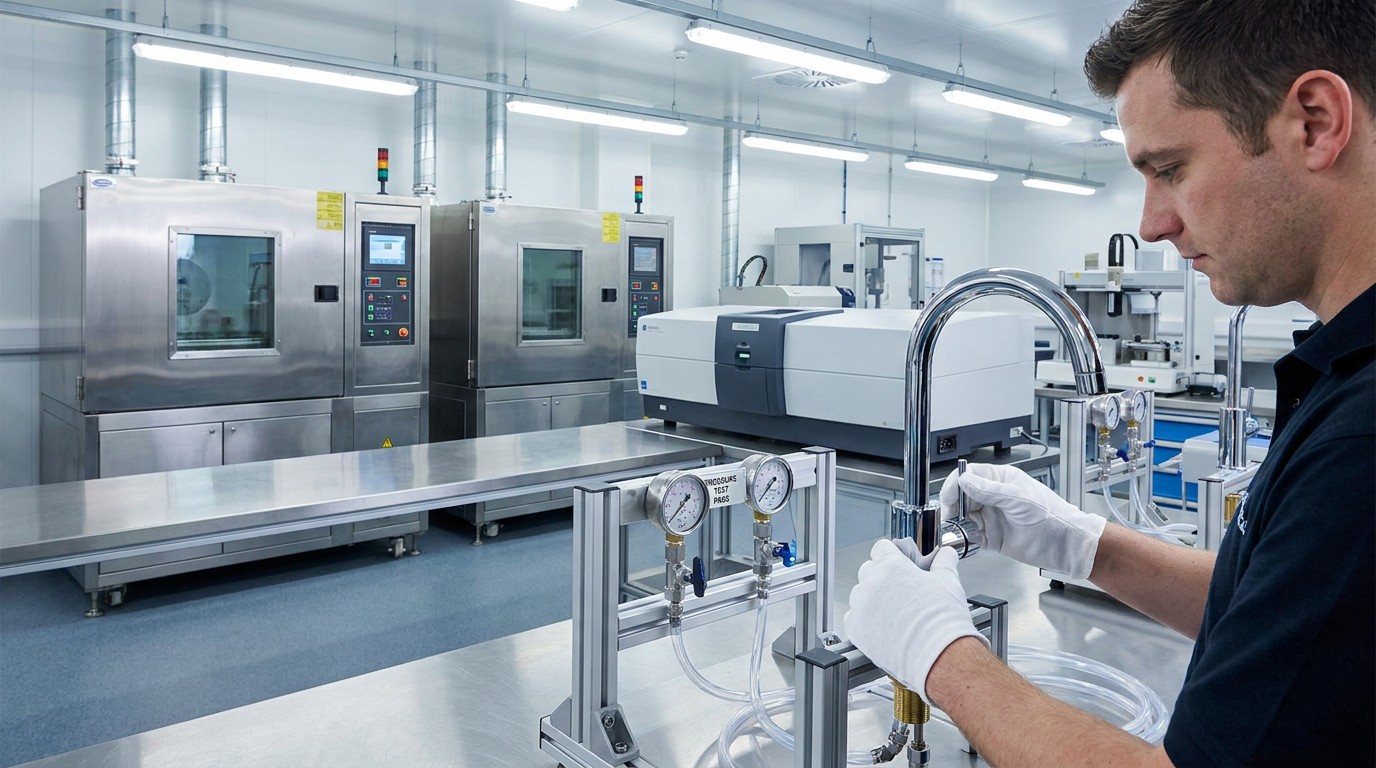
Every completed faucet body—before trim and handle assembly—is subjected to a hydraulic pressure test on an automated test rig. The test cycle pressurises the internal water channels to 1.5 to 2 times the rated working pressure (typically 10 to 16 bar) and holds for a defined dwell time. Any body that shows pressure drop, bubbling through water submersion, or visible deformation is rejected. This 100% test catches micro-porosity in castings, thread joint leaks, and body cracking that would become catastrophic in-service failures.
Finished taps are visually inspected under standardised 500-lux lighting for surface defects: pinholes, pitting, streaking, colour variation, and mechanical damage. A sample from each production batch is placed in an automated salt spray chamber for the required NSS test duration. For export-grade products, this is typically 24 to 48 hours minimum. The results are logged against the batch number and retained as part of the product's traceability record.
Ceramic disc cartridges are tested on automated cycle rigs that rotate the cartridge through its full operating arc the equivalent of 500,000 times. For thermostatic cartridges, temperature stability tests expose the assembled valve to rapid supply temperature changes and record the response time and settling temperature. Handle torque testing confirms that operation remains smooth within specified force limits after cycling.
Xindong's factory is equipped with three-coordinate measuring machines, X-ray spectrometers, automated pressure test rigs, salt spray chambers, and life-cycle testing equipment. Quality records are maintained per production batch and are available to B2B buyers as part of standard shipment documentation. For large orders, third-party pre-shipment inspection (PSI) by agencies such as SGS or Bureau Veritas can be arranged and is actively encouraged as an additional layer of independent verification.
Established 1999 · 30,000+ sqm factory · 65+ patents · Monthly capacity 200,000+ sets · ISO 9001 certified. Contact: [email protected] | www.cn-xindong.com
 Hot News
2026-10-17
2026-10-16
2026-10-15
2026-10-14
2026-10-13
2026-10-12

The company, founded in 1999 and located in Yuhuan,specializes in taps, thermostatic shower valves and shower kits. With over 30,000 sqm of space and 380+ employees, we hold numerous certifications and 65+ patents.
 EN
EN